The difference between an ideal voltage source and a practical voltage source lies in how each maintains voltage under load and how the internal resistance affects the output. An ideal voltage source provides a constant voltage regardless of the current drawn, whereas a practical voltage source experiences a voltage drop due to its internal resistance when supplying current.
This article explores the difference between ideal and practical voltage sources, covering their definitions, working principles, characteristics, practical examples, and a detailed comparison table for easy understanding.
What is a Voltage Source?
A voltage source is an electrical device that provides a potential difference to drive current through a load. Voltage sources are essential in almost every circuit, and their performance directly affects the operation of devices and systems. Depending on their characteristics, voltage sources can be ideal or practical.
What is an Ideal Voltage Source?
An ideal voltage source is a theoretical device that maintains a constant voltage across its terminals regardless of the current drawn. Its output voltage does not change, even when the circuit current varies.
- Key Feature: Zero internal resistance
- Voltage Behavior: Constant under all load conditions
- Example: Used in circuit theory and simulations
The voltage across an ideal source remains constant because there is no internal resistance. The load voltage equals the source voltage, and no power is lost within the source.
The internal resistance of an ideal voltage source is zero. This ensures:
- Load voltage = Source voltage
- No voltage drop inside the source
- Efficient energy delivery from source to load
Diagram: Shows an ideal voltage source with zero internal resistance, maintaining voltage from no-load to full-load.
What is a Practical Voltage Source?
A practical voltage source, unlike an ideal source, has a small but finite internal resistance. When delivering current, the terminal voltage drops slightly.
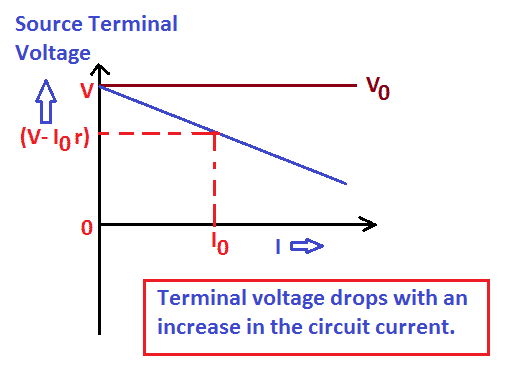
- Voltage Behavior: Decreases under load
- Internal Resistance: Non-zero
- Example: Batteries, generators, DC power supplies
The load voltage can be calculated using Kirchhoff’s Voltage Law (KVL. The voltage across the load equals the source voltage minus the voltage drop across the internal resistance. The higher the circuit current, the greater the voltage drop, reducing the load voltage.
Difference Between Ideal and Practical Voltage Sources
| Parameter | Ideal Voltage Source | Practical Voltage Source |
| Internal Resistance | Zero | Non-zero (finite) |
| Voltage at Load | Constant and equal to source voltage | Slightly less than source voltage |
| Current-Voltage Relation | Independent of current | Dependent on internal resistance |
| Power Loss | Zero | Exists due to internal resistance |
| Practical Example | Theoretical concept | Battery, generator, or DC supply |
| Efficiency | 100% | Less than 100% due to internal resistance |
| Load Variation Impact | No effect | Voltage drops with increasing load |
| Real-World Availability | Does not exist | Widely available |
| Response to High Current | No effect | Voltage drops under high current |
| Output Stability | Perfectly stable | Slight fluctuations under load |
| Application Usage | Used for simulation and theoretical analysis | Powers real devices and circuits |
| Maintenance | None | Low to moderate, depending on device |
Quick Summary – Ideal vs Practical Voltage Source
- Ideal Voltage Source: Maintains constant voltage, zero internal resistance, theoretical device.
- Practical Voltage Source: Experiences voltage drop, has finite internal resistance, real-world device.
- Load Voltage: Always equal to source voltage in ideal sources; slightly less in practical sources.
- Applications: Ideal sources are used for simulation; practical sources power real devices like batteries, generators, and DC supplies.
Key Takeaways
- Ideal sources simplify circuit analysis in theory.
- Practical sources represent real-world devices with internal resistance.
- Understanding the difference is crucial for designing circuits, predicting performance, and improving efficiency.
- Always account for voltage drop in practical sources when calculating load voltage.
Conclusion
In summary, the main distinction between ideal and practical voltage sources is the presence of internal resistance. An ideal voltage source maintains a constant voltage regardless of the current drawn, making it useful for theoretical analysis. In contrast, a practical voltage source has internal resistance, causing the terminal voltage to drop under load.
Knowing this difference is essential for engineers, students, and technicians to analyze circuits accurately and ensure efficient power delivery in real-world applications.
FAQs
An ideal voltage source maintains a constant voltage under all load conditions and has zero internal resistance.
A practical voltage source has finite internal resistance, causing voltage drops when supplying current to a load.
The voltage drop occurs due to the internal resistance of the source, which increases with circuit current.
No. Ideal voltage sources are theoretical constructs used for circuit analysis. Real devices always have some internal resistance.
Q1. What is an ideal voltage source?
An ideal voltage source maintains a constant voltage under all load conditions and has zero internal resistance.
Q2. What is a practical voltage source?
A practical voltage source has finite internal resistance, causing voltage drops when supplying current to a load.
Q3. Why does load voltage drop in practical sources?
The voltage drop occurs due to the internal resistance of the source, which increases with circuit current.
Q4. Can ideal voltage sources exist in reality?
No. Ideal voltage sources are theoretical constructs used for circuit analysis. Real devices always have some internal resistance.
Related Articles: