HV(High Voltage) plays a critical role in modern electrical systems, powering everything from industrial machinery to national power grids. Without high voltage transmission, it would be nearly impossible to efficiently deliver electricity over long distances. This article explores what High Voltage (HV) is, how it works, its applications, and essential safety considerations.
What is High Voltage (HV)?
High Voltage (HV) refers to electrical potential large enough to cause injury or damage. While the exact threshold varies by context, voltage above 1,000 volts (1 kV) for alternating current (AC) and 1,500 volts for direct current (DC) is typically considered high voltage. In the context of power engineering, these levels are often classified by the International Electrotechnical Commission (IEC) to ensure global standardization.
High voltage is primarily used to:
- Transmit electricity over long distances
- Reduce energy loss in power systems
- Operate heavy industrial equipment
- Facilitate the operation of specialized medical and scientific devices.
International Standards for High Voltage
To maintain safety and interoperability across global power grids, several international organizations define the specific parameters of High Voltage. Referencing these standards is essential for regulatory compliance and engineering design.
1. IEC 60038 (IEC Standard Voltages)
The International Electrotechnical Commission (IEC) is the primary body for electrical standards. IEC 60038 defines the standard voltages used in electricity supply systems. It categorizes “High Voltage” as any system where the nominal voltage is above 1,000V AC or 1,500V DC.
2. IEEE Standard 141 (Red Book)
The Institute of Electrical and Electronics Engineers (IEEE) provides the “Red Book,” which is widely used in North America for industrial and commercial power systems. It classifies voltages as follows:
- Low Voltage: 0V – 1,000V
- Medium Voltage: 1,001V – 72,500V (72.5 kV)
- High Voltage: 72,501V – 242,000V (242 kV)
- Extra-High Voltage (EHV): Above 242 kV
3. ANSI C84.1
The American National Standards Institute (ANSI) establishes nominal voltage ratings and operating tolerances for 60Hz electric power systems in the United States. This standard ensures that electrical equipment from different manufacturers can operate safely on the same grid.
4. NFPA 70E (Standard for Electrical Safety in the Workplace)
While not a technical “limit” standard, NFPA 70E is critical for the “Safety” section of this article. It defines the “Flash Protection Boundary” and requirements for PPE when working near energized high-voltage conductors.
Difference Between HV (High Voltage) and LV (Low Voltage)
While both HV and LV are essential parts of the electrical ecosystem, they serve very different purposes. Low Voltage is designed for safe, end-user consumption, whereas High Voltage is the “transmission highway” used for transporting massive amounts of power.
Comparison Table: HV vs. LV
| Feature | High Voltage (HV) | Low Voltage (LV) |
| Voltage Range | Typically > 1,000V AC / 1,500V DC | Typically < 1,000V AC / 1,500V DC |
| Primary Use | Long-distance transmission & heavy industry | Residential, commercial, and light industrial |
| Safety Risk | Extreme (Arc flash and proximity risks) | Moderate (Shock and fire hazards) |
| Equipment | Lattice towers, step-up transformers, GIS | Distribution transformers, wall sockets, MCBs |
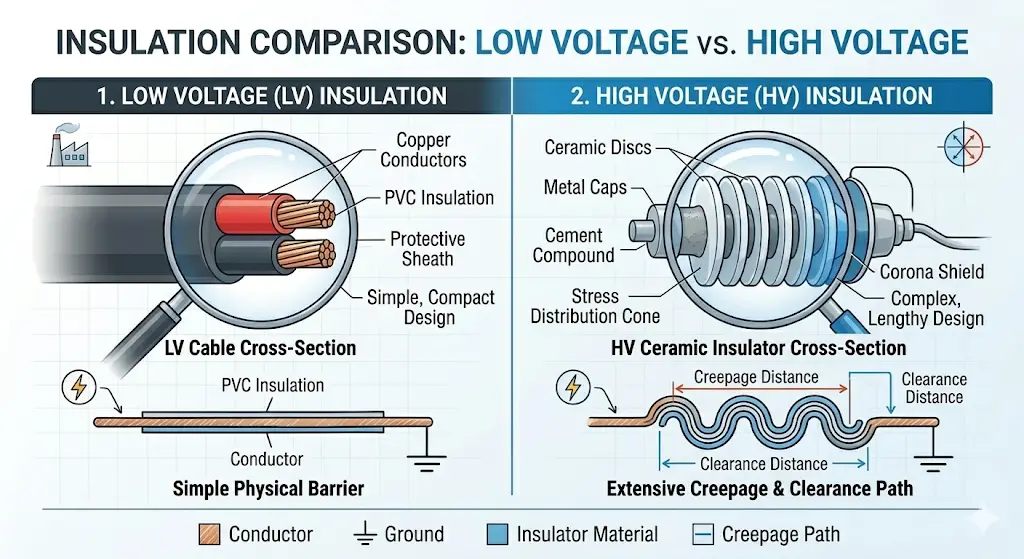
| Insulation | Porcelain, Glass, or SF6 Gas | Standard PVC or Rubber coatings |
Key Functional Differences
- Insulation Requirements: HV systems require massive amounts of insulation (porcelain, glass, or SF6 gas) to prevent electricity from ionizing the air. LV systems use simple plastic or rubber coatings.
- User Interaction: Ordinary consumers never interact directly with HV. It is stepped down to LV levels (like 230V or 110V) before it enters a building to ensure human safety.
The Hierarchy of Voltage (MV, HV, EHV, UHV)
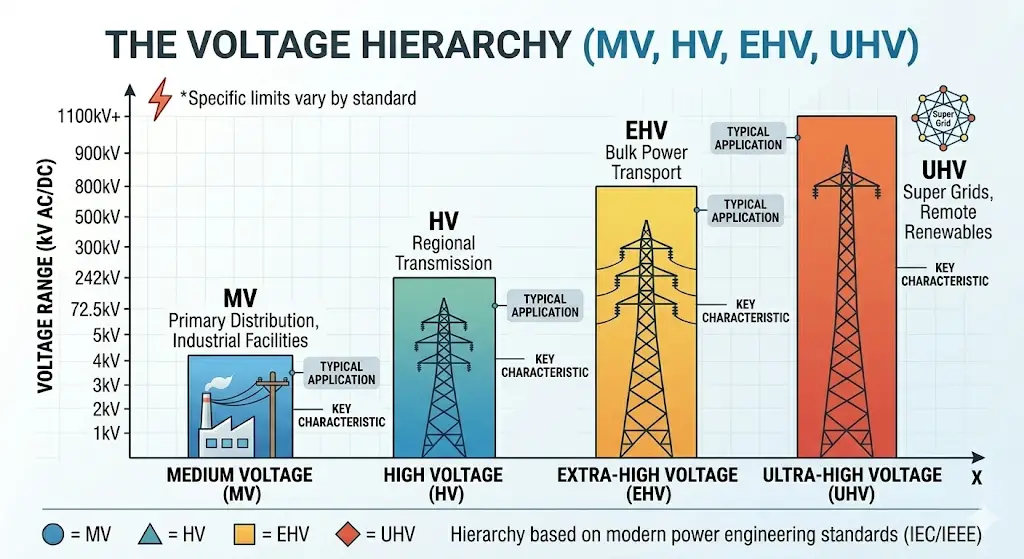
While “High Voltage” is a broad term, professional engineers further categorize it to better describe grid architecture:
- Medium Voltage (MV): 1kV to 72.5kV. Used in primary distribution to industrial facilities.
- High Voltage (HV): 72.5kV to 242kV. Used for regional transmission.
- Extra-High Voltage (EHV): 242kV to 800kV. Used for long-distance bulk power transport.
- Ultra-High Voltage (UHV): Above 800kV. Utilized in “Super Grids” to connect distant renewable energy sources to urban centers.
Why High Voltage is Used
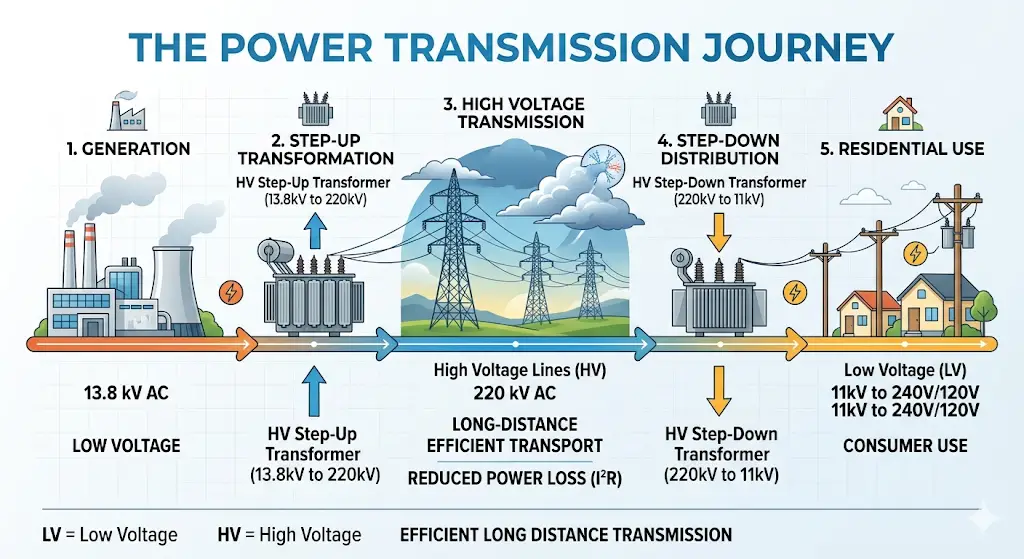
One of the main reasons high voltage is used in power systems is efficiency. When electricity travels long distances at low voltage, significant energy is lost as heat due to resistance in wires.
The science behind this is defined by Joule’s Law of Heating:
Ploss = I2 R
Where:
- Ploss is the power lost as heat (Watts).
- I is the current (Amperes).
- R is the resistance of the conductor (Ohms).
By increasing the voltage (V), the current (I) required to deliver the same amount of power is significantly reduced. Since power loss is proportional to the square of the current, doubling the voltage can reduce energy loss by four times.
Technical Nuance:
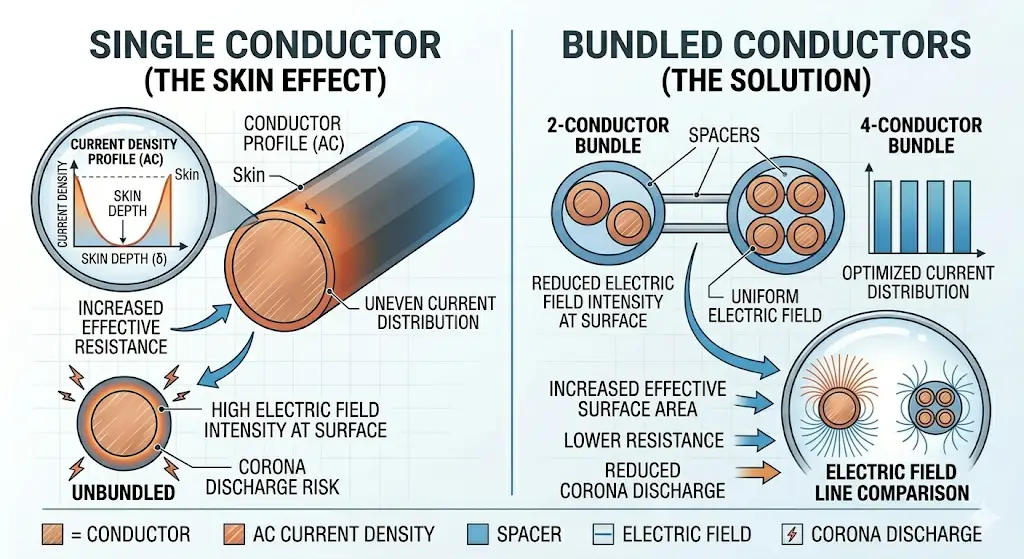
The Skin Effect In High Voltage AC (HVAC) systems, alternating current tends to flow primarily on the outer surface (the “skin”) of a conductor. This increases effective resistance. To combat this, HV engineers use “Bundled Conductors” (multiple wires held apart by spacers) to increase surface area and reduce Corona Discharge—the “hissing” sound often heard near transmission lines.
Applications of High Voltage (HV)
1. Power Transmission
High voltage is widely used in electrical grids to transmit electricity from power plants to substations. Transmission lines often operate at tens or hundreds of kilovolts (kV). Bulk power transmission typically utilizes Extra High Voltage (EHV) levels between 345 kV and 765 kV.
2. Industrial Equipment
Many industries rely on high voltage for:
- Heavy machinery
- Electric furnaces (Arc furnaces for steel production)
- Welding systems (Industrial-scale spot welding)
3. Medical Equipment
High voltage is used in devices like:
- X-ray machines (Requires high potential to accelerate electrons)
- MRI systems (in supporting components)
- CAT Scanners and Radiation Therapy equipment.
4. Scientific Research
Laboratories use high voltage in experiments involving:
- Particle acceleration (Large Hadron Collider style experiments)
- Plasma generation
- High-energy physics and vacuum tube technology.
5. Transportation
Electric trains and metro systems often operate on high voltage systems for efficient power delivery. Standard overhead line voltages often range from 15 kV to 25 kV AC.
Types of High Voltage Systems
1. High Voltage AC (HVAC)
Used in most traditional power grids due to the ease of voltage transformation via electromagnetic induction in transformers.
2. High Voltage DC (HVDC)
Increasingly popular for long-distance and underwater transmission because it has lower losses and better efficiency over very long distances. HVDC is also the preferred method for connecting two unsynchronized AC grids.
Key Components in HV Systems
High voltage systems consist of several critical components:
- Step-up and Step-down Transformers (to step up or step down voltage)
- Circuit breakers (to protect systems from faults and clear electrical arcs)
- Insulators (to prevent leakage of current using materials like porcelain or composite glass)
- Transmission lines (to carry electricity over vast geographic areas)
- Surge Arresters (to protect equipment from lightning strikes and switching surges).
Safety Considerations
High voltage can be extremely dangerous and requires strict safety measures. The primary danger is that high voltage can “jump” through the air (arcing), meaning physical contact isn’t always necessary for an injury to occur.
Common Risks:
- Electric shock (causing internal organ damage)
- Arc flash (explosive releases of energy)
- Equipment damage
- Fire hazards
Safety Measures:
- Proper insulation and grounding
- Use of personal protective equipment (PPE) (Arc-rated clothing, insulated gloves)
- Regular system maintenance
- Warning signage and restricted access
- Lockout/Tagout (LOTO) procedures during repairs.
Only trained professionals should handle high voltage systems.
Environmental and EMF Safety
High Voltage lines generate electromagnetic fields (EMF). While the World Health Organization (WHO) has found no consistent evidence of long-term health risks from low-level exposure, engineers maintain a “Right of Way” (ROW)—a specific clear distance between power lines and residential buildings to ensure public safety.
Advantages of High Voltage
- Efficient long-distance power transmission
- Reduced energy loss
- Enables large-scale electricity distribution
- Supports industrial and infrastructure development
- Smaller conductor sizes are required compared to low-voltage high-current alternatives.
Disadvantages of High Voltage
- High installation cost
- Requires specialized equipment and expensive insulation
- Increased safety risks
- Complex maintenance
- Electromagnetic interference (EMI) issues.
Maintenance and Troubleshooting Guide
| Symptom | Potential Cause | Action Required |
| Audible Hissing/Buzzing | Corona Discharge or Dirty Insulators | Cleaning or Hardware Replacement |
| Discoloration of Insulators | Overheating or Electrical Tracking | Thermal Imaging & IR Inspection |
| Sudden Trip of HV Breaker | Phase-to-Ground Fault | Insulation Resistance (Megger) Test |
Pro-Tips:
- “When maintaining HV transformers, performing a Dissolved Gas Analysis (DGA) is critical for detecting early-stage internal faults.
- “Accurate Knee Point Voltage calculations are essential to ensure Current Transformers (CT) do not saturate during high-voltage faults.
Future of High Voltage Technology
With growing energy demand and renewable energy integration, high voltage systems are evolving rapidly. Technologies like HVDC transmission and smart grids are improving efficiency and reliability. We are seeing a shift toward “Super Grids” that connect continents using Ultra-High Voltage (UHV) lines exceeding 1,100 kV.
High voltage will continue to be a backbone of global power infrastructure, especially as countries invest in sustainable and large-scale energy systems.
Conclusion
High Voltage (HV) is essential for modern life, enabling efficient power transmission and supporting industries worldwide. While it offers numerous advantages, it also requires careful handling and strict safety measures. As technology advances, high voltage systems will become even more efficient and integral to future energy solutions.
Read Next: