Have you ever wondered how your radio tunes into a specific station, or how your computer processor measures its lightning-fast speeds? The answer lies in how we measure cycles per second, which relies entirely on understanding the standard frequency unit.
This foundational measurement is essential for grasping how everything from sound waves to Wi-Fi signals operate. In this guide, we will break down what frequency is, look at its official unit, explore the formulas to calculate it, and look at real-world examples.
What is Frequency?
Before diving into its unit, let’s define frequency itself.
Frequency is the number of times a repeating event occurs per unit of time.
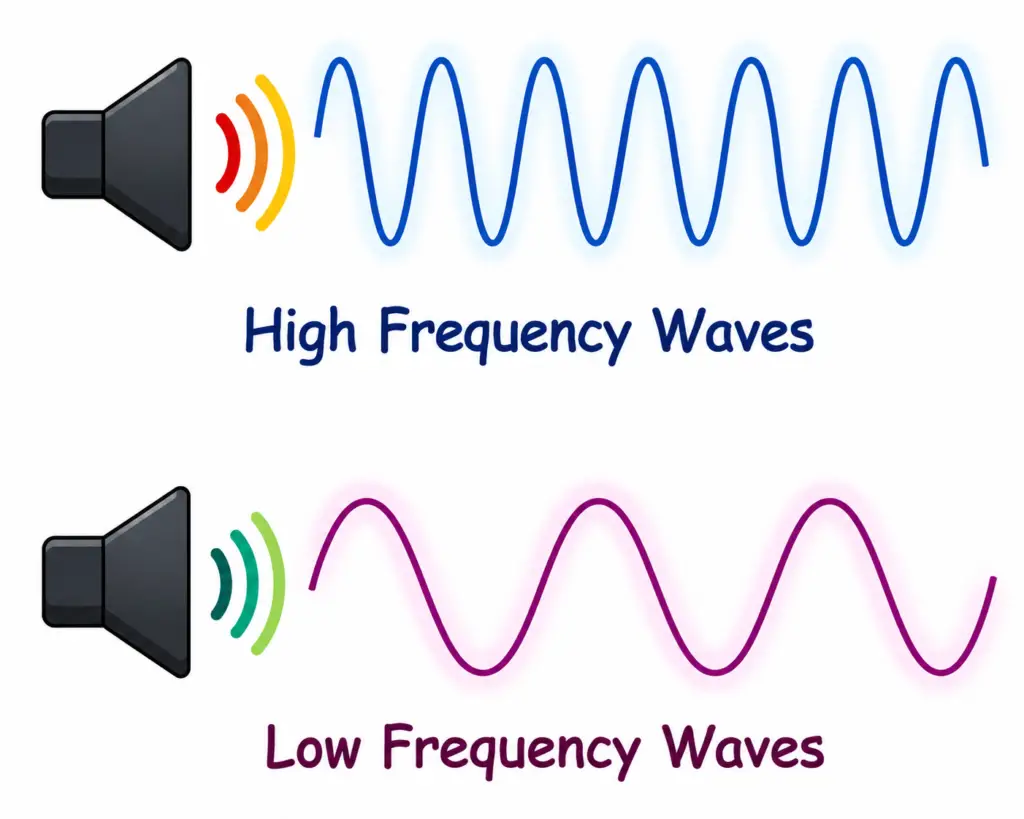
Think of it as a counter for cycles. If you clap your hands rhythmically, the number of claps you perform in a single second represents the frequency of your clapping. In physics, it usually refers to the rate of vibrations or oscillations in waves, such as sound waves, light waves, and radio signals.
What is the Unit of Frequency? – Symbol & Meaning
The standard frequency unit in the International System of Units (SI) is the Hertz.
- Unit Name: Hertz
- Symbol: Hz
Meaning of Hertz
One Hertz simply means one cycle per second. If a wave repeats its full pattern once every second, its frequency is 1 Hz.
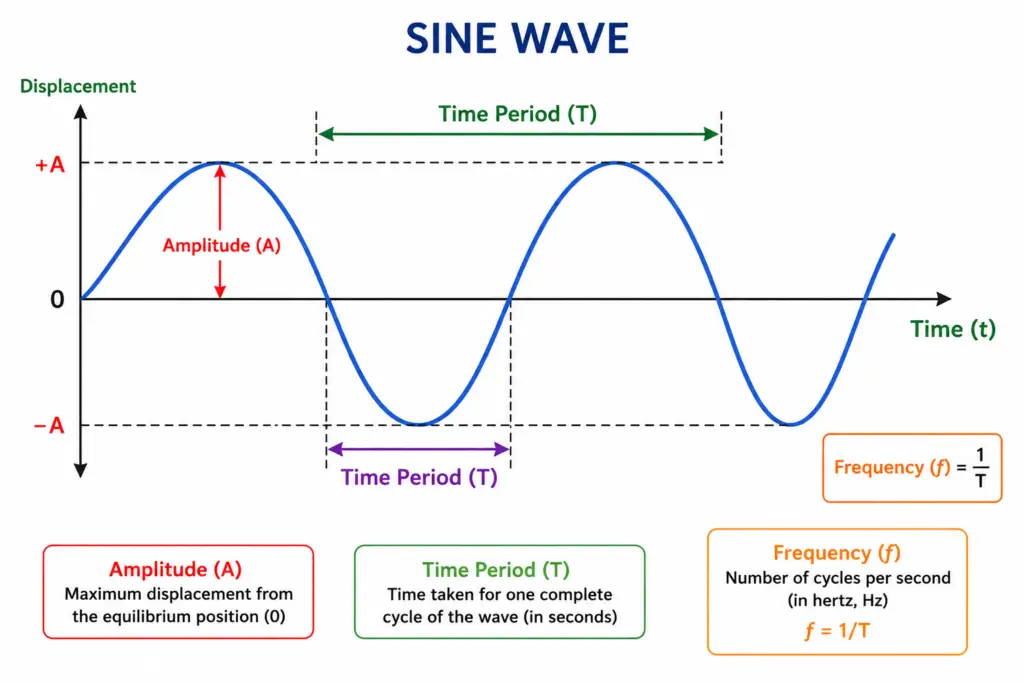
Because “Hz” is technically a measure of “per second,” its base SI unit is expressed mathematically as:
List of Frequency Units and Common Uses
In everyday technology and advanced science, frequencies can range from very slow to incredibly fast. Instead of writing out massive strings of zeros, we use metric prefixes to scale the frequency unit.
Below is the complete list of frequency units, their definitions, and where they are used:
- Hertz (Hz): The base unit representing one cycle per second. Used for describing the frequencies of audible sounds and basic electrical signals.
- Kilohertz (kHz): Equivalent to 1,000 hertz. Often used in radio frequency equipment, audio signals, and lower frequency electromagnetic waves.
- Megahertz (MHz): Equal to 1,000,000 hertz or 1,000 kHz. Commonly used to describe the frequencies used in FM and TV broadcasting, as well as telecommunications like mobile phone frequencies.
- Gigahertz (GHz): Equal to 1,000,000,000 hertz or 1,000 MHz. Typically used to describe the clock speeds of computer processors and microwave frequencies, including those used for cellular telephone signals.
- Terahertz (THz): Equal to 1 trillion hertz (1,000,000,000,000 Hz). Terahertz radiation is utilized in scientific research, particularly in imaging and spectroscopy for materials science, security scanning, and biomedical applications.
- Petahertz (PHz): Equal to 1 quadrillion hertz (1,000,000,000,000,000 Hz). These frequencies are primarily of interest in ultrafast science where researchers study extremely fast processes, such as the dynamics of chemical reactions and quantum physics phenomena.
- Exahertz (EHz): Equal to 1 quintillion hertz (1,000,000,000,000,000,000 Hz). Not commonly used in practical applications, but describes theoretical studies and high-energy physics, including some forms of gamma radiation.
- Zettahertz (ZHz): Represents frequencies in the order of 1021 hertz. This unit relates to frequencies observed in complex astrophysical phenomena and advanced theoretical models.
- Yottahertz (YHz): The largest frequency unit, representing 1024 cycles per second. This unit is mainly theoretical and used in cutting-edge scientific research that explores the highest possible frequencies, far beyond the electromagnetic spectrum commonly used in technology today.
Frequency Unit Conversion Chart
To help you easily convert between different scales of measurement, here is a quick-reference conversion chart showing each frequency unit’s equivalent value in base Hertz (Hz).
| Frequency Unit | Symbol | Equivalent Value in Hertz (Hz) | Scientific Notation |
| Hertz | Hz | 1 Hz | 1 Hz |
| Kilohertz | kHz | 1,000 Hz | 103 Hz |
| Megahertz | MHz | 1,000,000 Hz | 106 Hz |
| Gigahertz | GHz | 1,000,000,000 Hz | 109 Hz |
| Terahertz | THz | 1,000,000,000,000 Hz | 1012 Hz |
| Petahertz | PHz | 1,000,000,000,000,000 Hz | 1015 Hz |
| Exahertz | EHz | 1,000,000,000,000,000,000 Hz | 1018 Hz |
| Zettahertz | ZHz | 1,000,000,000,000,000,000,000 Hz | 1021 Hz |
| Yottahertz | YHz | 1,000,000,000,000,000,000,000,000 Hz | 1024 Hz |
The Frequency Unit Formula
Frequency is intimately tied to two other concepts: Time Period (T) and Wave Speed (v). Depending on the information you have, you can calculate frequency using two primary formulas.
1. The Time Period Formula
The time period is the duration of time it takes to complete one full cycle. Frequency is the exact inverse of the time period.
Where:
- f = Frequency (measured in Hertz, Hz)
- T = Time period (measured in seconds, s)
2. The Wave Speed and Wavelength Formula
If you are dealing with traveling waves (like light or sound), frequency depends on how fast the wave moves and how long the wave is.
Where:
- f = Frequency (Hz)
- v = Wave velocity or speed (measured in meters per second, m/s)
- λ = Wavelength (measured in meters, m)
Real-World Examples of Frequency
To make the frequency unit less abstract, let’s look at how it manifests in the real world:
- The Human Heart: A resting heart beats roughly 60 to 100 times per minute. If a heart beats 60 times in 60 seconds, its frequency is exactly 1 Hz.
- Musical Notes: When a musician tunes a guitar, the standard reference note “A” vibrates at a frequency of 440 Hz (meaning the string moves back and forth 440 times every single second).
- Household Electricity: The AC electricity powering your home wall outlets operates at a frequency of 50 Hz or 60 Hz (depending on your country).
- Smartphones & Wi-Fi: Modern wireless routers broadcast internet data at frequencies of 2.4 GHz or 5 GHz. That means billions of wave cycles pass by your device every second!
Summary:
Need a quick recap? Keep these core facts in mind:
- The primary frequency unit is the Hertz (Hz).
- 1 Hz equals one cycle per second.
- To find frequency from time, use the inverse formula:
- Tech devices leverage larger multiples like MHz and GHz to measure computing power and wireless data speeds.
Conclusion
Understanding the frequency unit is a fundamental step in grasping how wave dynamics, electrical systems, and modern communications function. From the basic audio waves measured in Hertz (Hz) to the lightning-fast processing speeds of computing components calibrated in Gigahertz (GHz), tracking cycles per second gives us a precise language for standardizing repeating events. By utilizing the core formulas (f = 1/T and f = v/λ), engineering professionals and science enthusiasts alike can accurately calculate, analyze, and convert parameters across any scale within the electromagnetic spectrum.
Read Next: