Battery performance is measured using several technical ratings, and one of the most important among them is Battery Reserve Capacity (RC). This parameter helps determine how long a battery can continue supplying power when the charging system stops working or when the battery is required to run electrical loads for an extended period. Understanding battery reserve capacity is essential for selecting the right battery and ensuring reliable performance in vehicles, backup systems, and other electrical applications.
As an electrical engineer, I often see battery RC overlooked in favor of CCA, but RC is the truer measure of a battery’s “deep-cycle” endurance.
What Is Battery Reserve Capacity (RC)?
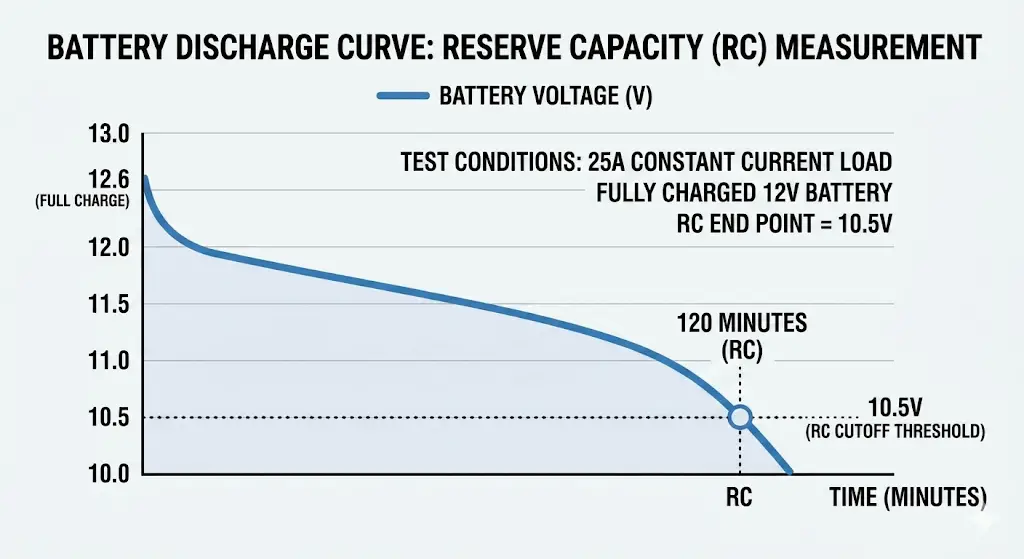
Battery Reserve Capacity, often abbreviated as RC, represents the amount of time a fully charged 12-volt battery can deliver a constant current of 25 amps before its voltage falls to 10.5 volts. The value is expressed in minutes. This 10.5V threshold is critical because it represents the “fully discharged” state for a lead-acid battery under load; dropping below this can cause permanent sulfation.
For example, if a battery has an RC rating of 150 minutes, it means the battery can provide a 25-amp load for 150 minutes before the voltage drops to the minimum usable level. This rating provides a practical way to estimate how long a battery can support essential electrical systems without being recharged.
Reserve capacity focuses on time duration, which makes it especially useful for evaluating how long a battery can power devices when the primary charging source is unavailable.
Why Reserve Capacity Matters
Reserve capacity is a key indicator of a battery’s ability to sustain electrical loads over time. It becomes particularly important in situations where the charging system fails or when devices rely solely on stored battery power. In modern vehicles with high parasitic loads (GPS, security systems, and ECUs), a high RC prevents “dead battery” syndrome during short trips.
A battery with a higher RC value can keep equipment running for a longer period. This can be crucial for vehicles, boats, recreational vehicles, and backup power systems where continuous power is necessary. For instance, if the alternator in a vehicle stops working, the reserve capacity determines how long essential components—such as headlights, electronic control units, and ventilation systems—can continue functioning.
Knowing the reserve capacity also helps users estimate how long they can safely operate electrical devices without draining the battery completely.
How Reserve Capacity Is Measured
The RC rating is determined through a standardized test procedure defined by international standards such as SAE J537. During testing:
- A fully charged 12-volt battery is connected to a constant 25-amp load.
- The battery begins discharging while its voltage is continuously monitored.
- The test ends when the battery voltage reaches 10.5 volts, which is considered the minimum functional voltage for most applications.
- The time taken to reach this point is recorded in minutes and becomes the battery’s RC rating.
This standardized method allows manufacturers and users to compare different batteries under similar conditions.
Reserve Capacity vs Other Battery Ratings
Battery specifications often include multiple ratings, each measuring a different aspect of performance. Understanding the distinction between RC, Ah, and CCA is vital for correct battery sizing in industrial and automotive applications.
Reserve Capacity (RC)
- Measured in minutes
- Indicates how long a battery can supply a constant load before voltage drops to a minimum level
- Focuses on endurance and backup power
Ampere-Hours (Ah)
- Measures the total energy storage capacity of a battery
- Indicates how much current a battery can deliver over a specified period
Cold Cranking Amps (CCA)
- Represents the battery’s ability to deliver a large burst of current for starting an engine in cold conditions
While CCA measures starting power and Ah measures energy storage, RC focuses on how long the battery can sustain a continuous load, making it a practical indicator for real-world usage scenarios.
Quick Comparison: RC vs. Ah vs. CCA Ratings
| Rating | Standard Test Condition (SAE J537) | Primary Engineering Purpose |
| RC (Reserve Capacity) | 25 Amps @ 80°F (27°C) | Measures emergency “get home” or backup power duration. |
| Ah (Amp-Hours) | Low constant current over 20 hours | Measures total energy storage (Total Capacity). |
| CCA (Cold Cranking Amps) | High burst current @ 0°F (-18°C) | Measures engine starting power in extreme cold weather. |
Is Battery Reserve Capacity the Same as Amp Hours?
No, reserve capacity (RC) and amp hours (Ah) are not the same. They measure different aspects of a battery’s performance.
Reserve capacity indicates how long a fully charged battery can continue supplying power before it drops below a usable voltage level. It is essentially a time-based measurement, usually expressed in minutes.
In contrast, amp hours measure the amount of electrical current a battery can supply over time. In simple terms, it shows how many amps a battery can deliver for one hour.
Even though these two ratings describe different things, they are related. You can estimate amp hours from reserve capacity using a simple formula:
Amp Hours (Ah) ≈ Reserve Capacity (minutes) × 0.4167
However, for a more accurate engineering calculation, one must consider Peukert’s Law, which states that as the rate of discharge increases, the battery’s available capacity decreases. This is why a battery might have a high Ah rating but a lower-than-expected RC if its internal resistance is high.
The relationship is governed by the Peukert Equation

Where:
- t = the actual discharge time (in hours).
- H = the rated discharge time (usually 20 hours for standard batteries).
- C = the rated capacity at that discharge rate (the Ah rating).
- I = the actual discharge current (25A when calculating for Reserve Capacity).
- k = the Peukert constant (typically 1.1 to 1.3 for lead-acid batteries).
For example, if a battery has a reserve capacity of 120 minutes:
120 × 0.4167 ≈ 50 Ah
This means the battery is roughly equivalent to 50 amp hours.
Keep in mind that this conversion only provides an approximation. The calculation does not consider voltage, so it does not represent the exact total energy stored in the battery.
Factors That Affect Battery Reserve Capacity
Several technical and environmental factors influence a battery’s reserve capacity.
1. Battery Age and Condition
As batteries age, chemical degradation inside the cells reduces their ability to store and deliver energy. This naturally lowers the RC value over time.
Design Tip: To maintain RC, ensure your charging system reaches the absorption voltage (typically 14.4V to 14.7V) regularly to reverse mild sulfation before it becomes permanent.
2. Battery Size and Capacity
Larger batteries generally contain more active material, allowing them to store more energy and provide longer reserve capacity.
3. Battery Type and Technology
Different battery technologies provide different performance levels. Advanced battery types often deliver more efficient power output and better voltage stability, which improves reserve capacity.
4. Temperature
Battery chemistry is highly sensitive to temperature. Extremely cold conditions slow chemical reactions, reducing effective capacity, while high temperatures accelerate wear and degradation.
5. Electrical Load
Heavy or excessive electrical loads cause the battery to discharge faster, effectively shortening the usable reserve capacity.
6. Charging System and Maintenance
A poorly functioning charging system or inadequate maintenance can prevent the battery from reaching a full charge, reducing its ability to provide extended backup power.
What is a Good Reserve Capacity for a Battery?
Determining a “good” RC rating depends heavily on the vehicle’s electrical demand and intended use. For a standard passenger car with minimal aftermarket accessories, an RC of 90 to 120 minutes is typically sufficient to provide a safety margin if the charging system fails.
However, for modern luxury vehicles equipped with sophisticated electronic control units (ECUs) or off-road vehicles utilizing winches and auxiliary lighting, an RC of 150 minutes or higher is recommended to ensure system stability. For marine applications, the requirement is even more rigorous, typically ranging from 150–240+ minutes to account for continuous deep-cycle usage.
Recommended Reserve Capacity (RC) by Application
When selecting a battery, always cross-reference the manufacturer’s specifications. While a higher RC improves reliability, it generally indicates a larger physical Battery Group Size, so ensure your battery tray can accommodate the increased dimensions.
Impact of Low Reserve Capacity
When a battery has a low RC rating, several problems may arise:
- Electrical systems may shut down sooner during a charging failure
- Electronic components may not receive sufficient power
- Battery stress increases due to frequent deep discharges
- Overall battery lifespan may shorten
For vehicles with numerous electronic accessories, a low reserve capacity can lead to frequent battery drainage and unreliable performance.
Maintaining Battery Reserve Capacity
Proper care can help maintain a battery’s reserve capacity and overall performance.
- Avoid allowing the battery to fully discharge frequently
- Ensure the charging system is functioning correctly
- Limit unnecessary electrical loads
- Protect the battery from extreme temperatures
- Perform regular inspections and load tests
These maintenance practices help preserve the battery’s ability to provide reliable backup power.
Conclusion
Battery Reserve Capacity (RC) is an important specification that reflects how long a battery can deliver sustained power when charging is unavailable. By prioritizing RC alongside CCA, engineers and technicians can ensure that power systems are robust enough to handle emergency failures.
Understanding reserve capacity helps users select suitable batteries for their applications, maintain system reliability, and prevent unexpected power loss. Whether used in vehicles, marine systems, or backup power applications, a battery with an appropriate reserve capacity ensures dependable performance when it is needed most.

Read Next: