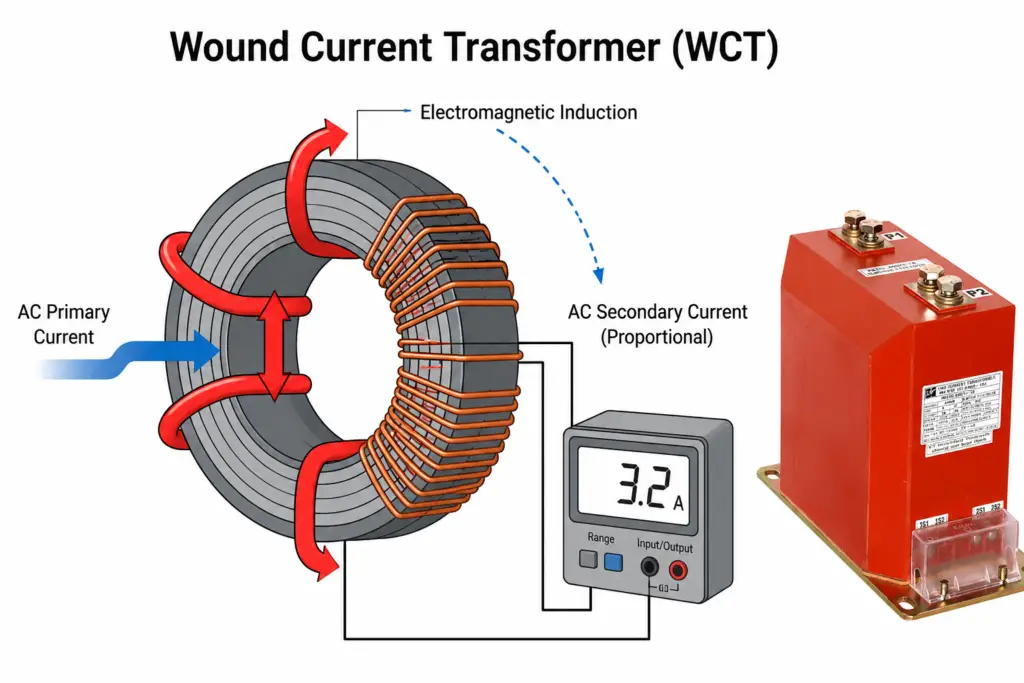
A Wound Current Transformer (WCT) is a type of instrument transformer in which the primary winding is directly connected in series with the electrical circuit, just like the secondary winding is coupled through a magnetic core. It is designed for accurate measurement and protection of relatively low to medium current levels.
Unlike other categories in types of current transformers, a wound current transformer has a physically wound primary winding, which improves measurement accuracy and control of the turns ratio.
Construction of Wound Current Transformer
A wound CT is built using a carefully engineered magnetic and winding structure to ensure accuracy and stability.
1. Magnetic Core
- Made of laminated silicon steel or advanced materials like nano-crystalline alloys
- Laminations reduce eddy current losses
- Provides a closed, low-reluctance path for magnetic flux
2. Primary Winding
- Consists of one or more turns of thick insulated conductor
- Connected in series with the load circuit
- Carries the actual current to be measured
3. Secondary Winding
- Made of fine copper wire with many turns
- Produces a reduced proportional current
- Connected to meters or protective relays
4. Insulation System
- High-grade insulation or epoxy resin encapsulation
- Ensures electrical safety and mechanical strength
- Prevents breakdown between windings
Working Principle of Wound Current Transformer
A wound current transformer operates on the principle of electromagnetic induction.
When AC current flows through the primary winding, it generates a magnetic flux in the core. This alternating flux links with the secondary winding and induces a proportional current.
Where:
Key Working Points:
- Primary is always connected in series with the circuit
- Secondary current is a scaled-down replica of primary current
- Measurement instruments remain electrically isolated from high voltage
- Higher number of primary turns improves accuracy control
Key Features of Wound CT
- Very high accuracy for low-current measurement
- Flexible turns ratio for design customization
- Strong electromagnetic coupling due to wound primary
- Better precision compared to bar-type CTs
- Suitable for instrumentation-grade applications
Technical Specifications of Wound Type Current Transformer (CT)
The electrical, insulation, and mechanical characteristics of a wound-type current transformer vary depending on its design and application. However, most standard wound CTs are manufactured with the following specifications.
Electrical Specifications
- Primary Current: Generally available from 1 A to 4000 A. Special-purpose wound CTs can also be designed for measuring currents below 10 A.
- Secondary Current: Standard secondary ratings are 5 A or 1 A.
- Rated Burden: Typically CT burden ranges from 1.25 VA to 60 VA, representing the maximum connected load while maintaining the specified accuracy.
- Accuracy Class:
- Metering CTs: Class 0.2, 0.5, 1.0, and 3.0
- Protection CTs: 5P, 10P, and other protection classes depending on the application.
- Protection Class: Protection CTs are commonly available in 5P10, 5P20, 10P10, and 10P20 accuracy classes, where 5P and 10P indicate the composite error limits, and the numerical value (10, 20, etc.) represents the Accuracy Limit Factor (ALF).
- Knee Point Voltage (KPV): Protection CTs used with differential and high-impedance protection schemes are specified by their Knee Point Voltage (KPV). Typical values range from 50 V to several hundred volts, depending on the protection relay requirements and CT design.
- Rated Frequency: Designed for operation at 50 Hz or 60 Hz, while certain industrial or aerospace applications may require frequencies up to 400 Hz.
System and Insulation Specifications
- System Voltage: Suitable for low-voltage systems up to 1.1 kV and medium/high-voltage systems up to 33 kV or higher, depending on the insulation design.
- Power-Frequency Withstand Voltage: Low-voltage wound CTs are commonly tested at 3 kV to verify insulation integrity.
- Insulation Class: Common insulation classes include:
- Class E: 120°C
- Class B: 130°C
- Class F: 155°C
- Continuous Thermal Rating: Most wound CTs can continuously carry 120% to 133% of their rated primary current without exceeding the allowable temperature rise.
Mechanical and Safety Specifications
- Short-Time Thermal Current (Ith): Designed to withstand high fault currents for 1 second or 3 seconds, with ratings commonly reaching 80 × the rated primary current (Ipn).
- Dynamic Current Rating (Idyn): Capable of withstanding the mechanical forces produced by peak fault currents, typically around 2.5 × Ith.
- Construction Type:
- Tape-wound construction for economical low-voltage applications.
- Resin-cast or epoxy-cast construction for improved insulation strength, moisture resistance, and outdoor installations.
- Applicable Standards: Manufactured in accordance with internationally recognized standards such as IEC 61869-2 and IEEE C57.13, ensuring reliable performance, safety, and measurement accuracy.
Installation and Maintenance of Wound Type Current Transformer (CT)
Proper installation and regular maintenance are essential for ensuring the accuracy, reliability, and long service life of a wound-type current transformer.
Installation Guidelines
- Install the CT in a clean, dry, and well-ventilated location.
- Protect the CT from excessive moisture, dust, vibration, and corrosive chemicals.
- Ensure the primary and secondary terminals are connected correctly according to the polarity markings (P1, P2, S1, and S2).
- Tighten all electrical connections securely to prevent overheating caused by loose terminals.
- Always keep the secondary winding connected to its burden or short-circuited when the primary is energized. Never leave the secondary circuit open, as it can generate dangerously high voltages.
- Select a CT with the correct current ratio, burden, and accuracy class for the intended application.
Maintenance Guidelines
- Periodically inspect the CT for cracks, insulation damage, loose connections, or signs of overheating.
- Clean dust and dirt from the CT surface to maintain proper insulation.
- Measure the insulation resistance during scheduled maintenance to detect insulation deterioration.
- Verify the CT ratio, polarity, and accuracy if abnormal meter readings or relay operations are observed.
- Check the secondary wiring and terminal connections for corrosion or loose contacts.
- Replace the CT immediately if it shows signs of severe insulation failure, overheating, or physical damage.
Common Problems and Troubleshooting
| Problem | Possible Cause | Solution |
| Incorrect current measurement | Wrong CT ratio, incorrect polarity, or loose connections. | Verify the CT ratio, wiring, and polarity. |
| CT overheating | Overloading, loose terminals, or insulation deterioration. | Tighten connections, reduce the load, or replace the CT if necessary. |
| Core saturation | Fault current exceeds the CT rating or incorrect CT selection. | Use a protection CT with an appropriate accuracy class and Accuracy Limit Factor (ALF). |
| Relay malfunction | CT saturation, incorrect wiring, or secondary circuit issues. | Inspect the secondary circuit and verify the CT specifications. |
| High secondary voltage | Secondary circuit left open while energized. | Immediately de-energize the circuit and reconnect or short the CT secondary safely. |
| Insulation failure | Moisture, aging, overheating, or contamination. | Test the insulation resistance and replace the CT if required. |
Wound-Type Current Transformer (CT) – Burst Risk and Safety
A wound-type current transformer (CT) is more prone to bursting or burning out compared to bar or window types due to its internal primary winding. Since the primary conductor is physically wound around the magnetic core, it is exposed to high thermal and mechanical stress during fault conditions. Heavy short-circuit currents produce excessive I²R losses, leading to rapid heating and insulation deterioration. At the same time, strong electromagnetic forces can deform the primary winding, causing internal damage or arcing.
Unlike wound CTs, bar and window types use a solid conductor or external cable, which can withstand higher fault currents with better mechanical strength. Additionally, insulation stress in wound CTs is higher, making them more vulnerable to partial discharge and insulation breakdown. If the secondary circuit is left open, dangerous voltage buildup can quickly lead to catastrophic failure or bursting.
Applications of Wound Type Current Transformer (CT)
Wound current transformers (WCT) are primarily used in applications that require accurate current measurement and reliable protection. Since the primary winding consists of multiple turns, these CTs provide better measurement accuracy at low and medium current ratings compared to bar-type and window-type CTs.
Some common applications of wound-type current transformers include:
- Electrical metering systems for accurate current measurement in commercial and industrial installations.
- Energy monitoring systems to measure power consumption and improve energy management.
- Protective relays in switchgear, substations, and power distribution systems for overcurrent, earth fault, and differential protection.
- Industrial instrumentation for supplying scaled current signals to ammeters, power analyzers, SCADA systems, and multifunction meters.
- Generator and motor protection to detect overloads, short circuits, and abnormal operating conditions.
- Circuit breaker protection circuits to provide accurate current input for protective devices.
- Laboratory testing and calibration equipment, where high measurement accuracy is required.
- Renewable energy systems, such as solar and wind power plants, for monitoring inverter output and electrical performance.
- Control and automation systems for process monitoring, load management, and equipment protection in industrial plants.
Advantages
- High measurement accuracy and sensitivity
- Customizable turns ratio for different applications
- Reliable performance at low current levels
- Improved precision over bar-type CTs
- Good isolation between primary and secondary circuits
Limitations
- Not suitable for very high current transmission systems
- Bulkier compared to window-type CTs
- Higher manufacturing cost due to wound primary
- Limited use in heavy power distribution networks
Wound CT vs Other CT Types
| Feature | Wound CT | Bar CT | Window CT |
|---|---|---|---|
| Primary Type | Wound winding | Solid conductor | External conductor |
| Accuracy | Very high | Medium | High |
| Current Range | Low–medium | High | High |
| Application | Metering, labs | Industrial power | Distribution systems |
| Cost | Higher | Medium | Low |
Conclusion
A wound current transformer is a precision instrument CT designed for accurate current measurement in low to medium current applications. Its wound primary construction, laminated core, and controlled turns ratio make it highly suitable for metering, protection, and laboratory use where accuracy is more important than handling extremely high currents.
However, due to its design, it is not preferred in high-current power transmission systems where bar or window CTs are more practical.
Read Next: