A solenoid valve is an electromechanical device used to automatically control the flow of liquids and gases. It is widely used in industrial automation, water treatment, HVAC systems, irrigation, pneumatic systems, and hydraulic applications due to its fast response, reliable operation, and compact design.
In this article, you’ll learn what a solenoid valve is, how it works, its parts, types, materials, applications, advantages, disadvantages, and how to choose the right solenoid valve for your application.
What is a Solenoid Valve?
A solenoid valve is an electromechanical valve that automatically controls the flow of liquids, gases, or steam. It uses an electromagnetic coil (called a solenoid) to move a plunger, which opens or closes the valve when electrical power is applied.
Unlike manually operated valves, a solenoid valve can be controlled remotely through an electrical signal. This allows it to start, stop, or change the direction of fluid flow quickly and accurately.
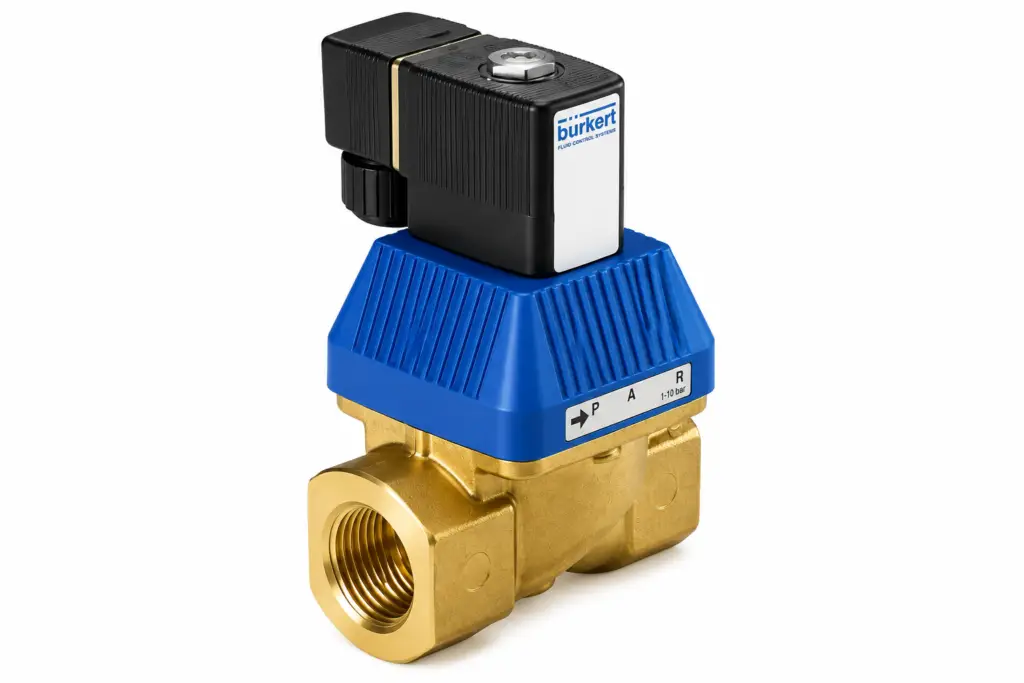
Solenoid valves are available in different sizes, pressure ratings, and port configurations to meet the requirements of various applications. They are widely used in industrial automation, HVAC systems, water treatment plants, irrigation systems, hydraulic and pneumatic equipment, medical devices, and household appliances.
Their compact design, fast response time, reliable operation, and low maintenance make solenoid valves one of the most popular fluid control devices used in modern industries.
How Does a Solenoid Valve Work?
A solenoid valve works by using an electromagnetic coil to control the opening and closing of a valve. When electrical power is applied to the coil, it creates a magnetic field. This magnetic field pulls a movable metal plunger upward or downward, depending on the valve design.
As the plunger moves, it either opens or closes the valve orifice. This action allows or blocks the flow of liquid or gas through the valve. When the power supply is switched off, the magnetic field disappears. A spring then pushes the plunger back to its original position, returning the valve to its normal state.
The working process is simple and fast:
- Electrical power is supplied to the solenoid coil.
- The coil draws current from supply source and generates a magnetic field.
- The magnetic field moves the plunger.
- The plunger opens or closes the valve orifice.
- The fluid starts or stops flowing through the valve.
- When the power is removed, the spring returns the plunger to its original position.
The exact operation depends on the valve type. A normally closed (NC) solenoid valve remains closed until it is energized. In contrast, a normally open (NO) solenoid valve stays open and closes only when power is applied.
This simple operating principle makes solenoid valves ideal for applications that require fast, automatic, and reliable control of fluid flow.
Solenoid Valve Working Principle
The working principle of a solenoid valve is based on electromagnetism. When an electrical current passes through the solenoid coil, it creates a magnetic field. This magnetic field attracts a movable iron plunger (also called the armature), causing it to move upward or downward depending on the valve design.
As the plunger moves, it either opens or closes the valve orifice. This action allows the fluid to flow, stops the flow, or redirects it to another passage. When the electrical supply is switched off, the magnetic field disappears, and a spring returns the plunger to its original position. As a result, the valve returns to its normal state, either normally closed (NC) or normally open (NO).
In direct-acting solenoid valves, the plunger directly opens or closes the flow passage. In pilot-operated solenoid valves, the solenoid controls a small pilot valve, while the fluid pressure performs the main opening or closing action. This design allows pilot-operated valves to handle higher pressures and larger flow rates with lower electrical power.
Because of this simple yet efficient operating principle, solenoid valves provide fast response, accurate flow control, and reliable automatic operation in a wide range of industrial and commercial applications.
Construction and Parts of a Solenoid Valve
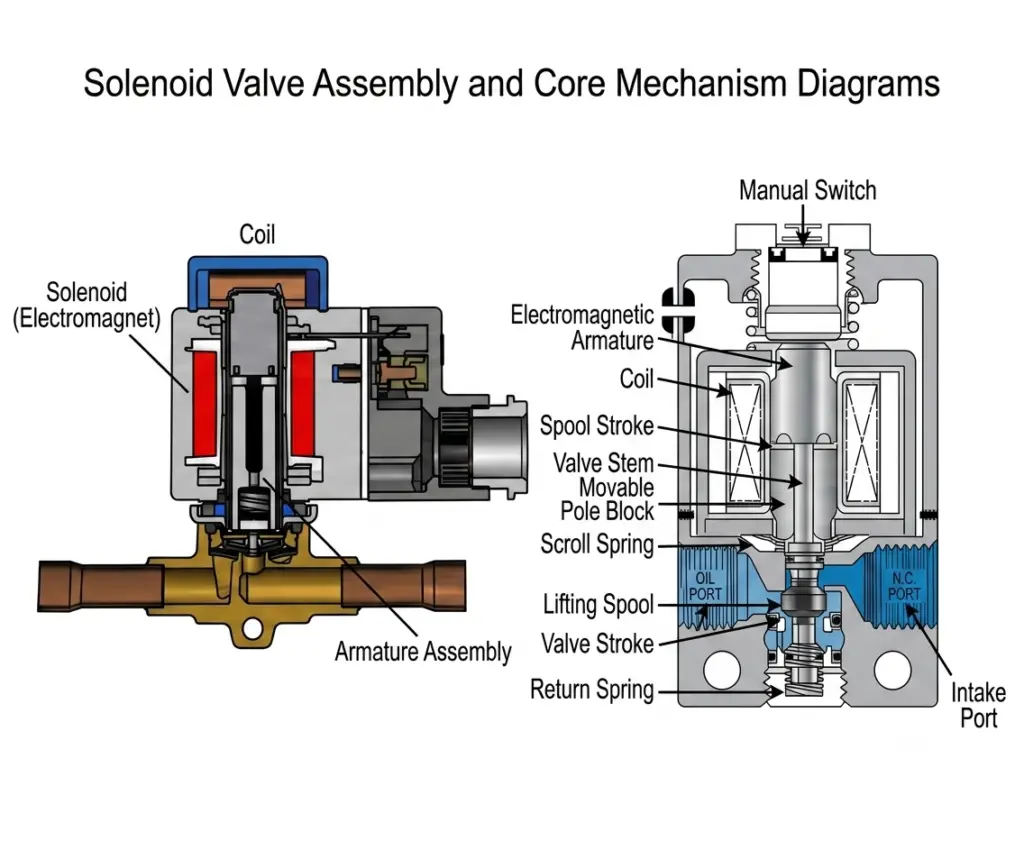
A solenoid valve consists of two main sections: the solenoid assembly and the valve body. The solenoid assembly converts electrical energy into mechanical motion, while the valve body controls the flow of the fluid. When the solenoid coil is energized, it moves the plunger, causing the valve to open or close.
The main parts of a solenoid valve are described below.
1. Solenoid Coil
The solenoid coil is a copper wire wound around a bobbin. When electric current flows through the coil, it generates a magnetic field that moves the plunger to operate the valve.
2. Plunger (Armature)
The plunger is a movable magnetic component located inside the coil. It moves up or down under the influence of the magnetic field to open or close the valve passage.
3. Return Spring
The return spring holds the plunger in its normal position when the coil is de-energized. Once the power is removed, the spring pushes the plunger back, returning the valve to its default state.
4. Valve Body
The valve body is the main housing that contains the fluid passages. It is usually made from materials such as brass, stainless steel, plastic, or cast iron, depending on the application and the type of fluid being handled.
5. Valve Seat
The valve seat is the sealing surface where the plunger or diaphragm rests. It forms a tight seal to prevent leakage when the valve is closed.
6. Diaphragm or Seal
Many solenoid valves use a flexible diaphragm or elastomer seal to control fluid flow. It helps create a leak-proof seal and improves the valve’s performance, especially in pilot-operated designs.
7. Inlet and Outlet Ports
The inlet port allows the fluid to enter the valve, while the outlet port provides the exit path. Some valves have additional ports to divert or mix the fluid flow.
8. Core Tube
The core tube guides the movement of the plunger and protects it from direct contact with the fluid. It also helps maintain efficient magnetic operation.
9. Electrical Connector
The electrical connector supplies power to the solenoid coil. Depending on the design, it may support AC or DC voltage and allows easy integration with electrical control systems.
Together, these components ensure reliable, fast, and precise operation of the solenoid valve in industrial, commercial, and residential applications.
Materials Used in Solenoid Valves
The performance and service life of a solenoid valve largely depend on the materials used in its construction. Each component is selected based on factors such as the type of fluid, operating pressure, temperature, and environmental conditions.
1. Valve Body Materials
The valve body provides structural strength and contains the fluid flow. Common materials include:
- Brass: Widely used for water, air, oil, and other non-corrosive fluids. It offers good durability and is cost-effective.
- Stainless Steel: Ideal for corrosive chemicals, steam, food processing, pharmaceutical, and marine applications due to its excellent corrosion resistance.
- Plastic (PVC, CPVC, or Nylon): Lightweight and resistant to many chemicals, making it suitable for low-pressure and chemical handling applications.
- Cast Iron or Bronze: Used in larger industrial systems that require high mechanical strength.
2. Seal and Diaphragm Materials
The sealing elements prevent fluid leakage and ensure reliable valve operation. Common sealing materials include:
- NBR (Nitrile): Suitable for air, water, oils, and fuels.
- EPDM: Best for hot water, steam, and outdoor applications. It offers excellent resistance to weather and aging.
- FKM (Viton): Designed for high temperatures, oils, fuels, and aggressive chemicals.
- PTFE (Teflon): Provides outstanding chemical resistance and performs well in harsh industrial environments.
3. Plunger and Core Tube Materials
The plunger and core tube are typically made from stainless steel or other magnetic alloys. These materials provide high mechanical strength, resist corrosion, and ensure smooth movement during valve operation.
4. Solenoid Coil Materials
The solenoid coil is usually wound with insulated copper wire. Copper offers excellent electrical conductivity, allowing the coil to generate a strong magnetic field while minimizing power loss.
Selecting the right material is essential for ensuring reliable performance, preventing corrosion, and extending the operating life of a solenoid valve.
Types of Solenoid Valves
The most common types of solenoid valves are designed to meet different flow control requirements in industrial, commercial, and residential systems. Each type has a specific working principle and is selected based on pressure, flow rate, and application needs.
The main types of solenoid valves include:
- Direct-acting and pilot-operated solenoid valves – Direct-acting valves operate directly using the solenoid force, making them suitable for low-flow and low-pressure applications. Pilot-operated valves use system pressure to assist operation, making them ideal for high-flow and high-pressure systems.
- Normally open (NO) and normally closed (NC) solenoid valves – Normally closed valves remain shut when de-energized and open when powered, while normally open valves remain open by default and close when energized. These are selected based on system safety and operational requirements.
- Two-way, three-way, and four-way solenoid valves – Two-way valves control simple on/off flow, three-way valves are used for diverting or mixing flow paths, and four-way valves are commonly used in complex pneumatic and hydraulic systems for controlling actuators and directional flow.
Each type of solenoid valve is engineered for a specific purpose. The selection depends on system pressure, flow conditions, media type, and control requirements. Choosing the correct type ensures efficient operation, longer service life, and reliable performance in industrial, commercial, and residential applications.
Solenoid Valve Symbols
Solenoid valve symbols are standardized graphical representations used in hydraulic and pneumatic circuit diagrams. They show how a solenoid valve controls the flow of liquids or gases without drawing its actual physical shape.
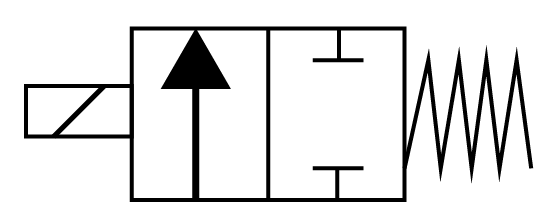
These symbols provide important information, such as the number of ports, flow paths, switching positions, and the actuation method. They also indicate whether the valve is normally open (NO) or normally closed (NC) and whether it uses a return spring or another operating mechanism.
Most solenoid valve symbols consist of squares that represent different valve positions, arrows that indicate the direction of fluid flow, and symbols for the solenoid coil and spring. This standardized representation makes circuit diagrams easier to read and simplifies system design, installation, troubleshooting, and maintenance.
Most engineering drawings follow international standards such as ISO 1219, ensuring that solenoid valve symbols are recognized and understood worldwide.
Selection Guide for a Solenoid Valve
Choosing the right solenoid valve is important for reliable performance, long service life, and efficient fluid control. Before selecting a valve, consider the following factors.
1. Identify the Type of Fluid
First, determine the fluid that will flow through the valve. It may be water, air, steam, oil, gas, chemicals, or another liquid. The valve material and seal must be compatible with the fluid to prevent leakage or corrosion.
2. Select the Valve Function
Choose the valve based on your application.
- Normally Closed (NC): The valve stays closed without power and opens when energized.
- Normally Open (NO): The valve stays open without power and closes when energized.
- Latching Solenoid Valve: Changes position with a pulse and remains in that position until another pulse is applied.
3. Check the Operating Pressure
Every solenoid valve is designed to work within a specific pressure range. Make sure the system pressure falls within the valve’s minimum and maximum operating limits.
4. Verify the Voltage Rating
Select a coil that matches your available power supply. Common voltage ratings include:
- 12 V DC
- 24 V DC
- 24 V AC
- 110–120 V AC
- 220–240 V AC
Using the correct voltage prevents coil damage and ensures reliable operation.
5. Choose the Correct Port Size
The valve port size should match the pipeline diameter. A correctly sized valve provides the required flow rate while minimizing pressure loss.
6. Select a Suitable Valve Material
The valve body material should withstand the operating environment.
- Brass: Suitable for water, air, oil, and non-corrosive fluids.
- Stainless Steel: Ideal for corrosive chemicals, steam, and food-grade applications.
- Plastic (PVC or Nylon): Best for lightweight and chemical-resistant applications.
7. Consider the Seal Material
Seal compatibility is essential for preventing leaks and extending valve life.
- NBR (Buna-N): Water, air, and oil
- EPDM: Hot water and steam
- Viton (FKM): Oils, fuels, and high-temperature fluids
- PTFE (Teflon): Aggressive chemicals and high temperatures
8. Check the Response Time
If your application requires rapid switching, choose a solenoid valve with a fast response time. This is especially important in automation and process control systems.
9. Consider the Installation Environment
Evaluate the surrounding conditions before installation.
- Indoor or outdoor use
- Ambient temperature
- Moisture or dust exposure
- Vibration levels
- Hazardous or explosive locations
Choose a valve with the appropriate enclosure and protection rating if it will operate in harsh environments.
10. Review the Duty Cycle
Some solenoid valves are designed for continuous operation, while others are intended for intermittent use. Select a valve that matches your operating cycle to avoid overheating and premature failure.
11. Check Flow Rate Requirements
Ensure the valve can handle the required flow rate. Manufacturers specify this using the Cv or Kv flow coefficient. Choosing the correct flow capacity helps maintain system efficiency.
12. Verify Certifications
For critical applications, select a valve that complies with relevant industry standards such as CE, UL, NSF, ATEX, or IP ratings, depending on your industry and location.
Quick Selection Checklist
Before purchasing a solenoid valve, verify the following:
- ✔ Type of fluid
- ✔ Valve function (NC or NO)
- ✔ Operating pressure
- ✔ Supply voltage
- ✔ Port size
- ✔ Valve body material
- ✔ Seal material
- ✔ Flow rate requirement
- ✔ Operating temperature
- ✔ Installation environment
- ✔ Duty cycle
- ✔ Required certifications
Selecting the right solenoid valve ensures reliable operation, reduces maintenance costs, and improves the overall efficiency of your fluid control system.
Technical Specifications of Solenoid Valve
This table below provides a concise technical overview of solenoid valve specifications, including electrical, mechanical, and operational features. It helps in quick selection and better understanding of key performance parameters.
| Category | Details |
| Overview | Electrically operated valve used for fluid flow control in automation systems. |
| Advantages | Fast response, easy automation, reliable operation, widely used in industry. |
| Limitations | Coil overheating risk, limited stroke, sensitive to voltage variation. |
| Voltage & Coil Types | 12–24V DC or 24–230V AC. Standard, molded, and explosion-proof coils with IP ratings. |
| Operational Modes |
NC: Normally closed, opens when energized. NO: Normally open, closes when energized. Bistable/Monostable: Maintains position with/without power. |
| Pressure & Flow | Few bar to 250 bar. Pilot type for high flow, direct type for low pressure. |
| Materials | Brass, stainless steel, or plastic body. Seals: PTFE, NBR, EPDM. |
| Temperature | -10°C to 80°C. High-temp versions available for steam applications. |
| Connections | Threaded, flanged, NAMUR. DIN, M8/M12, or terminal connections. |
| Maintenance | Depends on usage. Regular inspection of coil and seals required. |
| Special Coils | Explosion-proof for hazardous areas. Waterproof molded coils for outdoor use. |
| Acting Type | Quick acting for fast switching. Slow acting to reduce pressure shock. |
| Applications | Used in HVAC, automation, water systems, pneumatic and hydraulic control. |
| Selection | Based on voltage, pressure, temperature, media type, and operation mode. |
Applications of a Solenoid Valve
A solenoid valve is used to automatically control the flow of liquids, gases, steam, and other fluids. It offers fast operation, reliable performance, and easy automation. As a result, it is widely used in industrial, commercial, and residential systems.
Some common applications of solenoid valves include:
- Industrial automation – Controls the flow of air, water, oil, and other process fluids in manufacturing machines and automated production lines.
- Water treatment plants – Regulates water flow during filtration, chemical dosing, disinfection, and backwashing processes.
- HVAC systems – Controls the flow of refrigerants, chilled water, steam, and hot water in heating and cooling equipment.
- Irrigation systems – Automatically starts or stops the water supply to different irrigation zones using timers or smart controllers.
- Pneumatic systems – Directs compressed air to cylinders, valves, and actuators used in industrial automation.
- Hydraulic systems – Controls the flow and direction of hydraulic oil in construction equipment, presses, and industrial machinery.
- Automotive industry – Used in fuel injection systems, automatic transmissions, emission control systems, and engine management.
- Medical equipment – Provides precise control of oxygen, air, medical gases, and fluids in ventilators, anesthesia machines, and dialysis equipment.
- Food and beverage industry – Controls water, steam, milk, juices, and other food-grade fluids while maintaining hygienic operation.
- Chemical and pharmaceutical plants – Handles chemicals, acids, solvents, and other corrosive fluids safely and accurately.
- Oil and gas industry – Regulates the flow of fuel, natural gas, lubricants, and process fluids in pipelines and processing plants.
- Fire protection systems – Automatically releases water or fire suppression agents when a fire alarm is activated.
- Household appliances – Used in washing machines, dishwashers, refrigerators, coffee machines, and water purifiers to control water or gas flow.
- Agricultural systems – Automates irrigation, fertilizer injection, greenhouse climate control, and livestock watering.
- Laboratory equipment – Controls the precise flow of gases and liquids in testing, research, and analytical instruments.
Advantages of a Solenoid Valve
A solenoid valve is widely used because it is simple, fast, and highly reliable. It helps control the flow of liquids and gases with very little effort and is suitable for many automated systems.
Some key advantages of solenoid valves include:
- Fast operation – Opens and closes almost instantly, making it ideal for automatic control systems.
- Simple design – Contains few moving parts, which keeps the mechanism easy to understand and use.
- High reliability – Works consistently for long periods with stable performance.
- Easy automation – Can be directly controlled using PLCs, timers, and other electrical control systems.
- Compact size – Small and lightweight, so it fits easily in tight installation spaces.
- Low power use – Consumes only a small amount of electricity during operation.
- Quick response – Responds immediately to electrical signals for accurate flow control.
- Low maintenance – Requires minimal servicing due to its simple internal structure.
- Cost-effective – Affordable solution for both small and large-scale applications.
- Wide application range – Works with air, water, oil, steam, and many other fluids.
- Good accuracy – Provides precise on/off control of fluid flow.
- Easy installation – Simple to install and integrate into existing pipelines and systems.
Because of these advantages, solenoid valves are widely used in automation systems where fast, reliable, and energy-efficient flow control is required.
Disadvantages of a Solenoid Valve
A solenoid valve is useful for many applications, but it also has some limitations. These should be considered before selecting it for any system.
Some common disadvantages of solenoid valves include:
- Limited pressure range – Not suitable for very high-pressure applications beyond its rated capacity.
- Not ideal for very large flow rates – Performance decreases when used for high-flow systems.
- Requires continuous power (for some types) – Many solenoid valves need constant electrical power to stay in one position.
- Coil heating issue – The solenoid coil can heat up during long operation periods.
- Sensitive to voltage fluctuations – Unstable power supply can affect performance and lifespan.
- Not suitable for all fluids – Some corrosive or dirty fluids can damage internal components.
- Noise during operation – Produces a clicking sound while opening and closing.
- Limited control options – Mainly used for on/off control, not precise flow regulation.
- Clogging risk – Small orifices can get blocked if the fluid contains impurities.
- Wear and tear over time – Moving parts like the plunger and seals can degrade with long-term use.
Despite these limitations, solenoid valves are still widely used because of their simplicity, speed, and reliability in most standard applications.
Common Problems and Troubleshooting of a Solenoid Valve
A solenoid valve may face performance issues over time due to electrical faults, contamination, or mechanical wear. Understanding common problems helps in quick diagnosis and repair.
Some common issues and their troubleshooting steps include:
- Valve not opening – Check the power supply, coil condition, and wiring connections. Also ensure the correct voltage is being supplied to the solenoid coil.
- Valve not closing – Inspect for dirt, debris, or damage inside the valve. A worn-out seal or stuck plunger can also cause this issue.
- Coil overheating – Verify that the voltage matches the coil rating. Continuous energizing or poor ventilation can also cause overheating.
- Low or no flow – Check for clogging in the valve or pipeline. Ensure that the pressure is within the recommended operating range.
- Leakage from valve body – Inspect seals, gaskets, and diaphragm for wear or damage. Replace faulty components if necessary.
- Chattering or vibration noise – This may occur due to low voltage, incorrect pressure, or loose mounting. Tighten fittings and ensure stable power supply.
- Slow response time – Check for dirt buildup inside the valve or low operating pressure. Clean internal parts if required.
- Burnt coil – Usually caused by overvoltage or continuous operation beyond duty cycle limits. Replace the coil and ensure correct electrical rating.
- Valve stuck in one position – May be due to mechanical blockage or spring failure. Cleaning or replacing internal parts may be required.
Regular maintenance, clean fluid supply, and correct electrical conditions can significantly reduce these problems and extend the life of a solenoid valve.
Maintenance Tips for a Solenoid Valve
Proper maintenance of a solenoid valve helps improve performance, reduce breakdowns, and extend its service life. Regular inspection and cleaning can prevent most common issues.
Some important maintenance tips include:
- Keep the fluid clean – Use filters to remove dirt, dust, and particles that can block the valve or damage internal parts.
- Inspect regularly – Check the valve body, coil, and wiring for signs of wear, leakage, or damage.
- Clean internal parts – Periodically clean the plunger, orifice, and seals to prevent clogging and sticking.
- Check electrical connections – Ensure tight and secure wiring to avoid loose contacts or voltage drops.
- Verify voltage supply – Always use the correct voltage rating to prevent coil overheating or failure.
- Avoid continuous overload – Do not operate the valve beyond its rated duty cycle.
- Monitor coil temperature – Excess heat may indicate electrical issues or improper usage.
- Replace worn seals – Change seals and gaskets when signs of leakage or hardening appear.
- Protect from moisture and dust – Use proper enclosures when installed in harsh environments.
- Test operation periodically – Run the valve to ensure smooth opening and closing response.
With regular care and proper operating conditions, a solenoid valve can deliver reliable and long-lasting performance in any application.
Conclusion
A solenoid valve is an important device used for automatic control of fluid flow in modern systems. It works by using an electromagnetic coil to open and close the valve quickly and accurately. Because of its simple design, fast response, and reliable operation, it is widely used in industrial, commercial, and residential applications.
From automation systems and HVAC to irrigation, medical equipment, and household appliances, solenoid valves play a key role in improving efficiency and reducing manual effort.
However, proper selection, correct installation, and regular maintenance are essential to ensure long service life and stable performance. When used correctly, a solenoid valve provides a cost-effective and dependable solution for fluid control in a wide range of applications.
Frequently Asked Questions (FAQs)
A solenoid valve is used to control the flow of liquids and gases automatically. It is commonly used in automation, irrigation, HVAC, and industrial systems.
It works by using an electromagnetic coil to move a plunger. This movement opens or closes the valve to control fluid flow.
Common causes include coil burnout, dirt inside the valve, voltage issues, or worn-out seals. Regular maintenance can prevent most failures.
Yes, solenoid valves can control both gases and liquids. However, the valve material must be compatible with the specific fluid.
Read Next: