The difference between Solenoid and Actuator is that a solenoid is an electromagnetic device that converts electrical energy into short linear motion using a magnetic field, whereas an actuator is a broader mechanical device that converts electrical, hydraulic, or pneumatic energy into controlled linear or rotary motion.
Solenoids are mainly used for fast ON/OFF operations with a limited stroke length, while actuators provide precise position control, adjustable speed, longer travel, and higher force for industrial and automation applications. Although every solenoid is a type of actuator, not every actuator is a solenoid.
Linear motion is essential in many electrical and mechanical systems. Machines often need to push, pull, lift, open, or close components accurately and efficiently. Two commonly used devices for producing this motion are solenoids and actuators. Since both devices generate mechanical movement, they are often confused with each other.
Despite their similar purpose, solenoids and actuators differ significantly in their operating principles, performance, control capabilities, and applications. Understanding these differences helps engineers, technicians, and students select the right device for a specific task.
In this article, you will learn what a solenoid and an actuator are, how they work, their advantages, applications, and the major difference between Solenoid and Actuator.
What is a Solenoid?
A solenoid is an electromagnetic device that converts electrical energy directly into linear mechanical motion. It consists of a wire coil wound around a cylindrical tube with a movable iron plunger placed inside it. When electric current flows through the coil, it produces a magnetic field that attracts or repels the plunger, creating linear movement.
The movement produced by a solenoid is usually short and occurs very quickly. Because of this fast response, solenoids are widely used for switching, locking, latching, and valve control applications.
A typical solenoid consists of a coil, movable plunger (armature), return spring, and protective housing. The coil generates the magnetic field, the plunger moves due to magnetic attraction, the spring returns the plunger to its original position after the current is removed, and the housing protects the internal parts while ensuring smooth movement.
Working Principle of a Solenoid
A solenoid works on the principle of electromagnetism. When electrical current passes through the coil, it creates a magnetic field around the winding. This magnetic field attracts the iron plunger toward the center of the coil, producing linear motion. As soon as the electrical supply is disconnected, the magnetic field disappears, and the return spring pushes the plunger back to its initial position.
Since the movement depends entirely on the magnetic field, the stroke length is relatively short and the motion is generally limited to simple ON/OFF operation.
Types of Solenoids
The common types of solenoids include:
- Pull-type solenoid
- Push-type solenoid
- Rotary solenoid
- Latching solenoid
- Tubular solenoid
Advantages of a Solenoid
- Simple and compact construction
- Fast response time
- Low manufacturing cost
- Reliable operation
- Easy installation
- Requires minimal maintenance
Disadvantages of a Solenoid
- Limited stroke length
- Lower force compared to actuators
- Generates heat during continuous energization
- Not suitable for precise position control
- Reduced efficiency for continuous-duty applications
Applications of Solenoids
Solenoids are commonly used in:
- Solenoid valves
- Door locking systems
- Automotive starter motors
- Fuel injectors
- Relays and contactors
- Vending machines
- Medical equipment
- Packaging machinery
What is an Actuator?
An actuator is a device that converts electrical, hydraulic, or pneumatic energy into controlled mechanical motion. Depending on the application, an actuator can produce either linear or rotary movement. Unlike a solenoid, an actuator provides controlled motion with adjustable speed, force, and position.
Actuators are widely used wherever accurate movement, long travel distance, or high force is required. They are essential components in industrial automation, robotics, manufacturing systems, aerospace equipment, medical devices, and process control industries.
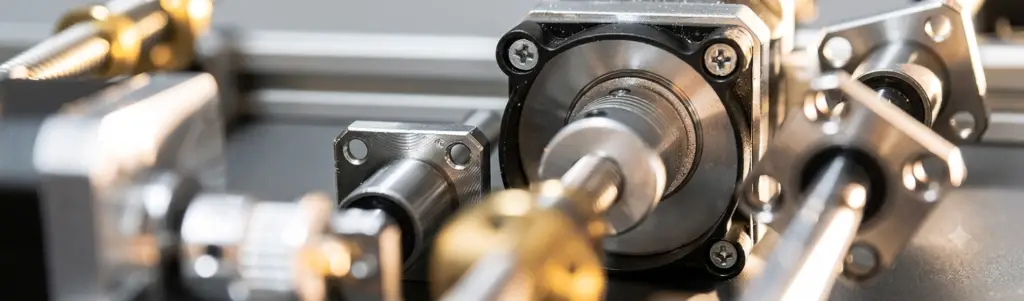
An electric actuator typically consists of an electric motor, gearbox, lead screw or ball screw, bearings, limit switches, and housing. The motor generates rotational motion, the gearbox increases torque, and the lead screw converts rotary motion into linear movement. Bearings reduce friction, while limit switches prevent excessive travel and improve operational safety.
Working Principle of an Actuator
The working principle depends on the actuator type. In an electric actuator, the motor rotates when supplied with electrical power. This rotation passes through a gearbox to increase torque before reaching a lead screw or ball screw. The screw mechanism converts the rotational movement into controlled linear motion.
Unlike a solenoid, an actuator allows continuous movement and can stop at any desired position. Modern actuators may also include sensors and feedback devices that improve positioning accuracy.
Types of Actuators
The main types of actuators are:
- Electric actuator
- Hydraulic actuator
- Pneumatic actuator
- Linear actuator
- Rotary actuator
Advantages of an Actuator
- High force capability
- Long stroke length
- Precise position control
- Adjustable operating speed
- Suitable for continuous operation
- High efficiency in automation systems
- Can handle heavy loads
Disadvantages of an Actuator
- Higher initial cost
- More complex construction
- Larger physical size
- Requires a control system
- Installation may be more complicated
Applications of Actuators
Actuators are extensively used in:
- Industrial automation
- CNC machines
- Robotic arms
- Solar tracking systems
- Conveyor systems
- Medical beds
- Aircraft control systems
- Valve automation
- Material handling equipment
Summary Table: Solenoid vs Actuator
| Feature | Solenoid | Actuator |
| Definition | Electromagnetic device for short linear motion | Device that converts electrical, hydraulic, or pneumatic energy into mechanical motion |
| Motion Type | Linear only | Linear or rotary |
| Working Principle | Electromagnetic attraction | Mechanical energy conversion |
| Energy Source | Electrical only | Electrical, hydraulic, or pneumatic |
| Stroke Length | Short | Short to very long |
| Position Control | ON/OFF operation | Precise position control |
| Speed Control | Fixed | Adjustable |
| Force Output | Low to medium | Medium to very high |
| Load Capacity | Light loads | Heavy loads |
| Accuracy | Low | High |
| Response Speed | Very fast | Moderate |
| Continuous Operation | Limited | Excellent |
| Complexity | Simple | More complex |
| Cost | Lower | Higher |
| Maintenance | Low | Moderate |
| Common Applications | Valves, locks, relays | Robotics, automation, heavy machinery |
Solenoid vs Actuator: Which One Should You Choose?
Choosing between a solenoid and an actuator depends entirely on the application’s requirements.
A solenoid is the better choice when the application requires rapid switching, short linear movement, simple ON/OFF operation, and low cost. Examples include door locks, fuel injectors, and solenoid valves.
An actuator is the preferred option when accurate positioning, adjustable speed, long travel distance, or high force is required. It is widely used in industrial automation, robotics, manufacturing equipment, and process control systems.
Before selecting either device, consider the required force, stroke length, operating speed, positioning accuracy, duty cycle, environmental conditions, and available budget.
Conclusion
Although both solenoids and actuators produce mechanical motion, they are designed for different purposes. A solenoid is a simple electromagnetic device that provides fast, short-stroke linear movement, making it ideal for switching and locking applications. An actuator, on the other hand, offers controlled linear or rotary motion with greater force, longer travel, and higher positioning accuracy.
Understanding the difference between Solenoid and Actuator allows engineers and technicians to select the most suitable device for their application. If the task requires quick ON/OFF movement at a low cost, a solenoid is the right choice. However, if precise control, heavy-load handling, or continuous operation is required, an actuator is the better solution.
Frequently Asked Questions (FAQs)
Yes. A solenoid is a specific type of electromagnetic actuator that produces short linear motion using magnetic force.
An actuator is generally more powerful because it can generate higher force and move heavier loads over longer distances.
No. A solenoid cannot replace an actuator in applications requiring long stroke lengths, continuous motion, or precise position control.
A solenoid usually responds faster because it operates directly through electromagnetic attraction without complex mechanical transmission.
Actuators are commonly used in industrial automation, robotics, CNC machines, medical equipment, aerospace systems, and automated valve control.
Read Next:
- Difference between Solenoid Valve and Motorized Valve
- What are the Types of Solenoid Valves?
- Solenoid Valve Problems and Solutions
- Common Failure Modes of Solenoid Valve
- Solenoid Actuator – Definition, Working Principle
- Spring and Diaphragm Pneumatic Actuator
- What is a Hydraulic Actuator?
- What are Different Types of Actuators?