A solenoid actuator is widely used in industrial automation and process control systems for operating valves and other mechanical devices. Its reliability, compact design, and ease of operation make it a preferred choice in a wide range of industrial applications.
From control valves and pneumatic systems to automotive and HVAC equipment, the solenoid actuator plays an important role in providing quick and efficient actuation. In this article, we will discuss the working principle, components, types, applications, advantages, and disadvantages of a solenoid actuator.
What is a Solenoid Actuator?
A solenoid actuator is an electromagnetic device that converts electrical energy into mechanical motion for operating valves and other mechanical systems. It is widely used in control valves, automation systems, pneumatic equipment, and industrial machinery where quick and reliable operation is required.
The actuator works by generating a magnetic field when electric current flows through a coil. This magnetic field moves a ferromagnetic armature, producing a linear or rotary motion that can operate a valve, switch, lock, or other mechanical device.
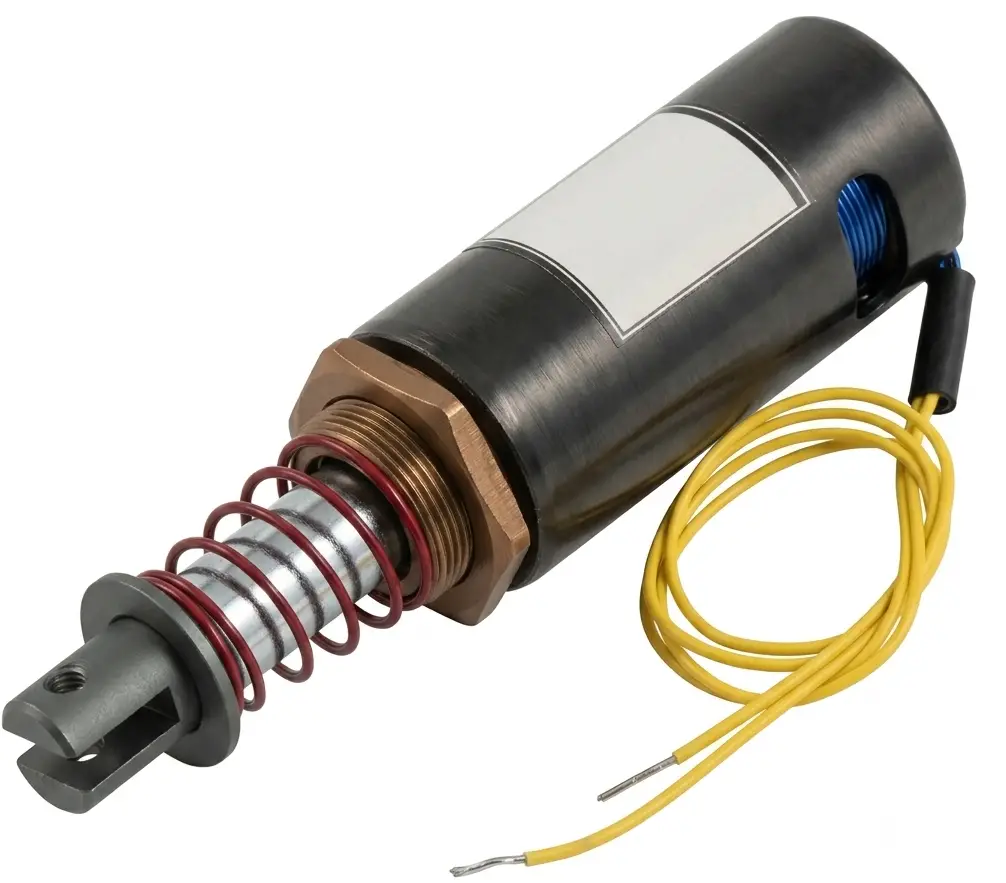
A solenoid actuators are popular because of its simple construction, fast response, compact size, and low maintenance requirements. They are commonly used for ON/OFF applications where precise positioning is not required.
Principle of Operation
A solenoid actuator works on the principle of electromagnetism. When electric current passes through the coil, a magnetic field is generated around it. This magnetic field attracts the armature toward the center of the coil, converting electrical energy into mechanical force.
The strength of the magnetic field depends on the amount of current flowing through the coil and the number of turns in the winding. As the armature moves, it performs the required mechanical operation such as opening a valve, actuating a switch, or moving a linkage.
When the power supply is removed, the magnetic field collapses and the return spring restores the armature to its original position. This enables the actuator to repeatedly perform fast and reliable ON/OFF operations.
Components of a Solenoid Actuator
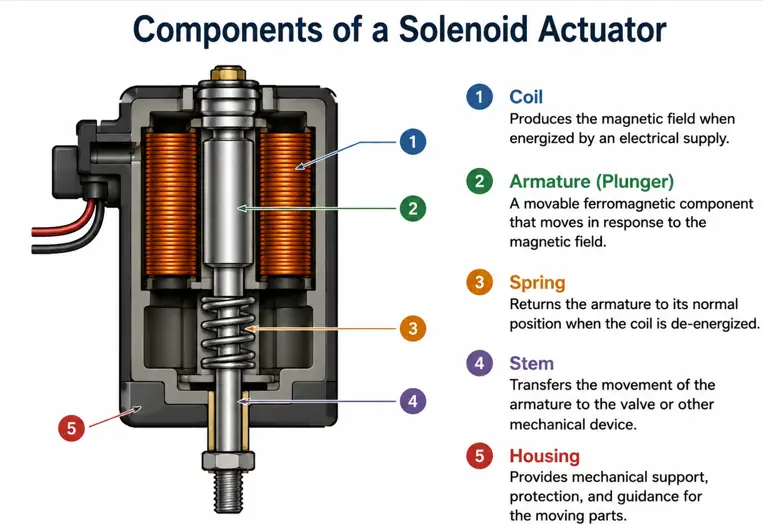
A typical solenoid actuator consists of the following components:
- Coil: Produces the magnetic field when energized by an electrical supply.
- Armature (Plunger): A movable ferromagnetic component that moves in response to the magnetic field.
- Spring: Returns the armature to its normal position when the coil is de-energized.
- Stem: Transfers the movement of the armature to the valve or other mechanical device.
- Housing: Provides mechanical support, protection, and guidance for the moving parts.
These components work together to convert electrical energy into controlled mechanical motion for operating valves and other equipment.
Working of Solenoid Actuator
An electric solenoid actuator generally consists of a wire-wound coil, armature, spring, and stem. A typical electric solenoid actuator is shown in the figure below.
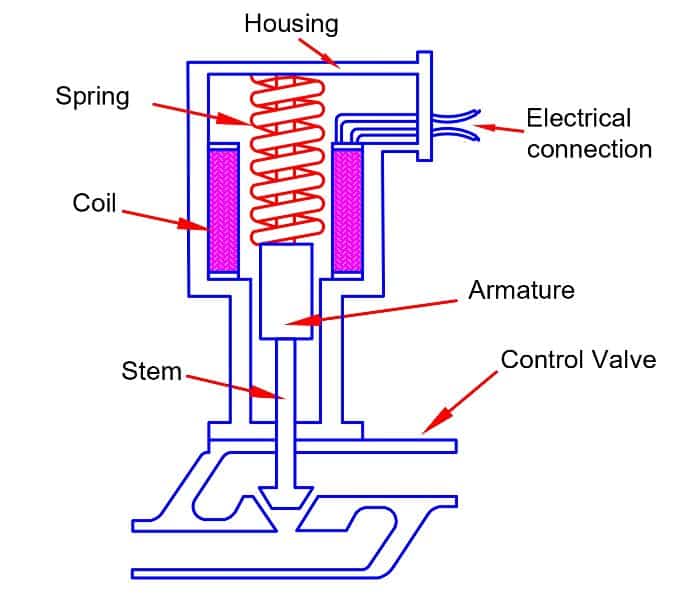
The coil of the solenoid actuator is connected to an external power supply. The spring rests against the armature, while the armature is free to move vertically inside the coil. The movement of the armature is transmitted through the stem to operate the valve.
When electric current flows through the coil, a magnetic field is generated around it. This magnetic field attracts the armature toward the center of the coil. As the armature moves, it compresses the spring and transfers motion to the valve, causing the valve to open.
When the power supply to the coil is interrupted, the magnetic field collapses. The compressed spring then expands and pushes the armature back to its original position. As a result, the valve returns to its normal position and closes.
Types of Solenoid Actuators
Solenoid actuators are available in various designs, tailored to specific motion requirements, environmental conditions, and control precision. Understanding the differences between these types is essential for selecting the right component for industrial automation and process control systems.
1. Pull-Type Solenoid Actuator
In a pull-type solenoid actuator, the magnetic field pulls the armature toward the center of the energized coil when power is applied. This linear pulling action is commonly utilized in control valves, electrical relays, and high-security locking mechanisms.
2. Push-Type Solenoid Actuator
Unlike the pull-type, the magnetic force in a push-type solenoid actuator drives the armature outward to operate the connected mechanical device. These are frequently selected for applications where a direct pushing force is required to trigger a switch or actuate a mechanism.
3. Rotary Solenoid Actuator
A rotary solenoid actuator converts electrical energy into precise rotational motion rather than linear travel. By utilizing internal mechanical linkages or ramps, these actuators are ideal for switches, indexing devices, and positioning systems that require controlled angular movement.
4. Proportional Solenoid Actuators
Proportional solenoids provide variable control over the plunger’s position. By modulating the input current, the armature position can be adjusted accurately, allowing for smooth, gradual control. These are the industry standard for flow control valves and precision metering pumps.
5. Latching Solenoid Actuators
Designed for energy efficiency, latching solenoid actuators utilize integrated permanent magnets to maintain the plunger’s position even after the electrical current is disconnected. This makes them highly effective for battery-operated devices or applications where holding a state without continuous power consumption is necessary.
6. Specialized Linear Solenoid Actuators
For challenging industrial environments, specialized linear solenoids offer enhanced durability and performance:
- Sealed Linear Solenoids: Equipped with a closed steel housing to prevent dust and debris ingress, making them perfect for dirty environments.
- Water-Resistant Solenoids: Featuring an IP65 rating, these provide protection against water spray, ideal for damp or frequent wash-down areas.
- High-Force/Laminated Solenoids: These utilize a laminated rod to minimize friction, delivering the increased force necessary for heavy-duty industrial tasks.
- Compact Linear Solenoids: Designed with a slim, thin-profile build to fit into space-constrained or narrow mechanical assemblies.
- Extended-Life Solenoids: Engineered with PTFE-coated rods to reduce wear and friction, significantly increasing service life in high-cycle, high-frequency applications.
Technical Selection Guide for Solenoid Actuators
Choosing the right solenoid depends on your specific environment, motion requirements, and duty cycle. Below is a summary of available solenoid configurations:
| Solenoid Type | Key Characteristics | Ideal Use Case |
| Sealed Linear | Closed steel housing keeps dust out. | Dirty environments requiring low maintenance. |
| Open-Frame Linear | Economical, standard design. | General-purpose, cost-sensitive automation. |
| Compact Linear | Thin, narrow profile. | Tight spaces; can be configured to push or pull. |
| High-Force Linear | Laminated rod minimizes friction. | Heavy-duty applications needing higher force. |
| Extended-Life Sealed | PTFE-coated rod for reduced friction. | High-cycle applications in dusty environments. |
| Water-Resistant | IP65 rated; protects against dust and water. | Damp, wet, or wash-down environments. |
| Rotary | Converts electrical energy into rotational motion. | Actuating valves, locks, or switches. |
Selecting by Duty Cycle
When choosing, consider how long the solenoid will be energized:
- Intermittent Duty: Designed for short bursts of operation (seconds to minutes) followed by a rest period to prevent overheating.
- Continuous Duty: Engineered to remain energized for extended periods (hours or days) without failure.
Note on Operation: > * Pull-Type: Exerts force when the rod retracts.
- Push-Type: Exerts force when the rod extends.
- Ensure you verify the voltage requirements (DC vs. AC) and your specific force (ozf) needs when selecting your model.
Difference Between Solenoid Actuator and Pneumatic Actuator
| Parameter | Solenoid Actuator | Pneumatic Actuator |
| Power Source | Electricity | Compressed Air |
| Response Time | Very Fast | Fast |
| Operating Force | Low to Medium | High |
| Position Control | Normally ON/OFF Operation | Can Provide Modulating Control |
| Installation | Simple and Compact | Requires Air Supply System |
| Maintenance | Low | Moderate |
| Applications | Small Valves, Relays, Locks | Control Valves, Heavy-Duty Automation |
Solenoid actuators are preferred for compact, fast ON/OFF applications, whereas pneumatic actuators are better suited for applications requiring higher operating force and modulating control.
Applications of Solenoid Actuators
Solenoid actuators are widely used in industrial, commercial, and domestic applications because of their simple design and fast response.
Some common applications include:
- Control valves in process industries
- Solenoid valves in pneumatic systems
- Hydraulic control systems
- Industrial automation equipment
- Water treatment plants
- Fuel control systems
- Electronic door locks and access control systems
- HVAC systems
- Medical equipment
- Automotive control systems
Their ability to provide quick and reliable actuation makes them suitable for applications requiring frequent ON/OFF operation.
Advantages & Disadvantages of an Electric Solenoid Actuator
Advantages
- Quick operation and fast response time.
- Simple construction with only a few moving parts.
- Easy installation and maintenance.
- Reliable performance for ON/OFF applications.
- Compact size and lightweight design.
- Can be operated remotely using an electrical signal.
Disadvantages
- Suitable only for short-stroke applications.
- Produces limited operating force compared to pneumatic or hydraulic actuators.
- Has no intermediate position control; it normally operates in either fully open or fully closed position.
- Continuous energization may cause coil heating and increase power consumption.
- Not suitable for operating large valves requiring high actuation force.
Conclusion
A solenoid actuator is a simple and reliable electromagnetic device that converts electrical energy into mechanical motion. It operates on the principle of electromagnetism and is widely used in control valves, automation systems, and industrial equipment.
Because of its fast response, compact construction, and ease of installation, the solenoid actuator remains one of the most commonly used actuators for ON/OFF control applications. Proper selection of the actuator helps improve system performance, reliability, and operational efficiency.
Frequently Asked Questions (FAQs)
A solenoid actuator is an electromagnetic device that converts electrical energy into mechanical motion for operating valves, switches, locks, and other mechanical equipment.
A solenoid actuator works on the principle of electromagnetism. When current flows through the coil, a magnetic field is generated that moves the armature and produces mechanical motion.
Solenoid actuators are used in control valves, pneumatic systems, hydraulic systems, HVAC equipment, automotive systems, electronic locks, and industrial automation.
Read Next: