A single phase energy meter is an electrical measuring instrument used to measure the electrical energy consumed by single-phase loads. It records energy consumption in kilowatt-hours (kWh), which is the unit commonly used for electricity billing. These meters are widely used in homes, small offices, shops, and other installations supplied by single-phase AC power supply, typically 230–240 volts.
A single phase energy meter measures the electrical energy consumed over time by sensing the voltage and current supplied to the load. Traditional meters use an electromechanical induction mechanism, while modern meters generally use electronic circuits and sensors to calculate and display energy consumption.
Construction of Electromechanical Single Phase Energy Meter
The construction of a single phase energy meter depends on its type. An electromechanical energy meter mainly consists of a current coil, pressure coil, aluminium disc, braking magnet, and registering mechanism. Electronic energy meters use voltage and current sensing circuits, a microcontroller, display, and other electronic components.
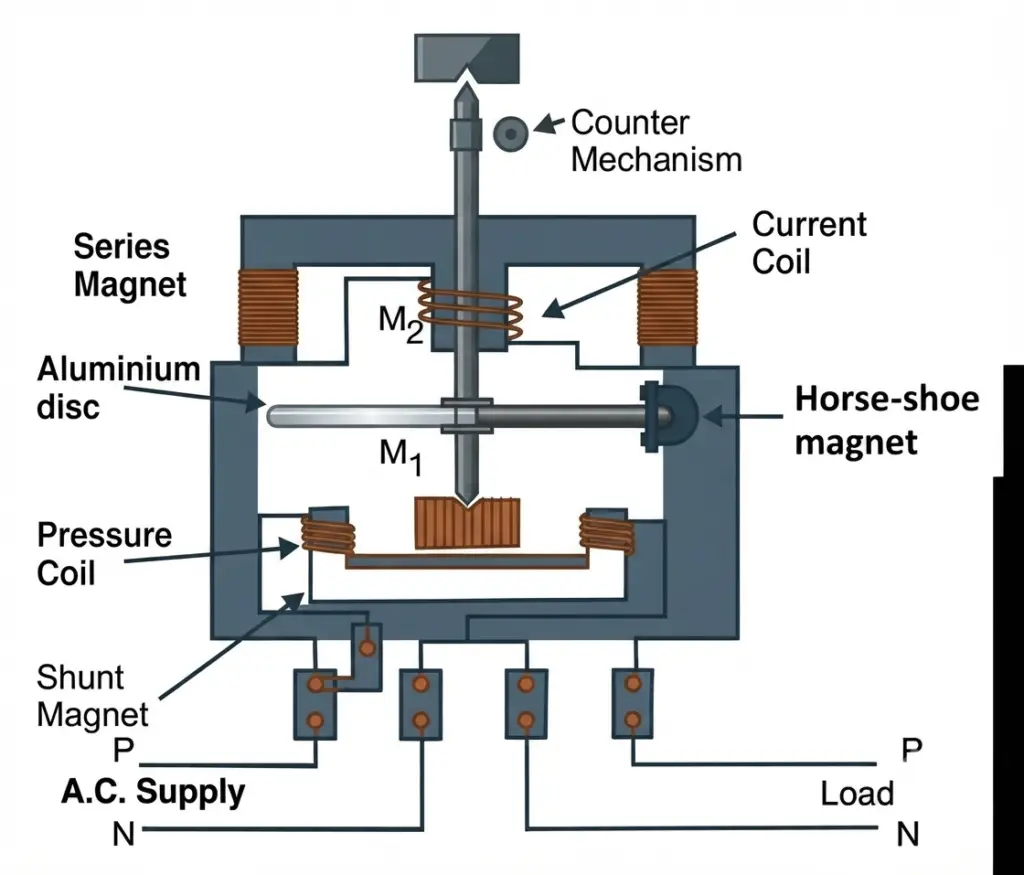
The important parts of a conventional single phase energy meter are described below.
1. Current Coil
The current coil is connected in series with the load. It carries the load current and produces a magnetic flux proportional to the current flowing through the circuit.
2. Pressure Coil
The pressure coil, also called the voltage coil, is connected across the supply. It produces a magnetic flux proportional to the applied voltage. The interaction between the fluxes produced by the current and pressure coils generates the driving torque.
3. Aluminium Disc
A lightweight aluminium disc is mounted on a spindle and placed between the magnetic fields produced by the coils. The interaction of these magnetic fields induces eddy currents in the disc and produces rotational motion.
4. Permanent Braking Magnet
A permanent magnet is positioned near the edge of the aluminium disc. As the disc rotates through the magnetic field of the braking magnet, eddy currents are produced. These currents create a braking torque that controls the speed of the disc.
5. Spindle and Bearings
The aluminium disc is mounted on a spindle supported by bearings. The spindle transfers the rotational movement of the disc to the registering mechanism.
6. Registering Mechanism
The registering mechanism consists of gears and a counting arrangement. It records the number of disc revolutions and displays the accumulated energy consumption in kWh.
7. Terminal Block
The terminal block provides electrical connections between the incoming supply, energy meter, and load. Correct connection of the line and neutral terminals is essential for proper meter operation.
In modern electronic meters, the aluminium disc and mechanical registering mechanism are replaced by electronic sensing and processing circuits. A microcontroller processes the measured voltage and current and calculates the consumed electrical energy. The result is shown on an LCD or other digital display.
Working of Single Phase Energy Meter
The working of a single phase energy meter is based on measuring the electrical power consumed by a load and integrating it over time.
Magnetic Flux and Disc Rotation
In a conventional induction-type meter, the current coil is connected in series with the load, while the pressure coil is connected across the supply. When the load operates, current flows through the current coil and supply voltage appears across the pressure coil.
The two coils produce alternating magnetic fluxes. These fluxes induce eddy currents in the aluminium disc. The interaction between the magnetic fluxes and the eddy currents produces a driving torque that rotates the disc.
The speed of the disc is approximately proportional to the power consumed by the load. Therefore, a higher load power causes the disc to rotate faster, while a lower load power causes it to rotate more slowly.
Braking and Energy Measurement
The permanent braking magnet produces a braking torque that opposes the motion of the disc. At steady speed, the driving torque and braking torque become balanced. The number of revolutions of the disc is therefore proportional to the electrical energy consumed.
The registering mechanism counts these revolutions and displays the accumulated energy in kilowatt-hours.
Electrical Energy Calculation
The electrical energy consumed can be expressed as:
where:
- = electrical energy
- = electrical power
- = time
For a single-phase AC circuit:
Therefore:
where:
- = supply voltage
- = load current
- = power factor
- = operating time
For example, if a 1 kW load operates continuously for 5 hours, the energy consumed is:
Thus, the single phase energy meter records 5 kWh of energy consumption.
Working of Electronic Single Phase Energy Meter
Modern electronic single phase energy meters use sensors or measuring circuits to sense the supply voltage and load current. A microcontroller or metering IC processes the measured signals after converting them into digital signals.
The electronic circuit continuously calculates the instantaneous power and integrates it over time to determine the total electrical energy consumed. The accumulated value is stored in memory and displayed digitally in kWh.
Electronic meters can also provide additional information such as voltage, current, power factor, instantaneous power, maximum demand, and tamper events, depending on the meter design.
Specifications of Electronic Single Phase Energy Meter
An electronic single phase energy meter uses electronic sensing and processing circuits to measure electrical energy consumption. A typical meter may have the following specifications:
| Specification | Value |
| Supply voltage | 240 V |
| Frequency | 50 Hz |
| Current range | 0–40 A |
| Accuracy class | Class 1.0 |
| Meter constant | 3200 pulses/unit |
| Display | Seven-segment LCD display |
The meter operates at a supply voltage of 240 V and a standard frequency of 50 Hz. The meter can measure load current from 0 to 40 A, depending on its rated design.
The Class 1.0 accuracy indicates the specified measurement accuracy of the meter under the applicable test conditions. The meter constant of 3200 pulses/unit means that the meter produces 3200 measurement pulses for every 1 kWh of energy recorded.
The meter uses a seven-segment LCD display to show the accumulated electrical energy consumption, generally in kWh. Depending on the model, the display may also provide other parameters such as voltage, current, power factor, and instantaneous power.
Types of Single Phase Energy Meter
A single phase energy meter can generally be classified into the following types:
- Electromechanical induction energy meter
- Electronic energy meter
- Digital energy meter
- Smart energy meter
Electromechanical meters use a rotating aluminium disc and mechanical register, whereas electronic and digital meters use semiconductor circuits for measurement. Smart meters provide additional communication and monitoring functions and can transmit meter data to the utility.
Applications of Single Phase Energy Meter
A single phase energy meter measures electrical energy consumption in single-phase supply systems. It is commonly used in residential, commercial, and small electrical installations. Typical applications include:
- Residential buildings
- Apartments and houses
- Small offices
- Shops and commercial establishments
- Small workshops
- Single-phase electrical equipment
- Temporary electrical installations
- Small industrial loads
Advantages of Single Phase Energy Meter
Some important advantages include:
- Measures electrical energy accurately.
- Provides energy consumption in kWh.
- Suitable for single-phase loads.
- Available in both electromechanical and electronic versions.
- Digital meters can provide multiple electrical parameters.
- Smart meters can support remote monitoring and communication.
- Compact electronic meters require less maintenance.
Conclusion
A single phase energy meter measures the electrical energy consumed by a single-phase load and records the consumption in kilowatt-hours. In conventional meters, the interaction of magnetic fluxes produces the rotation of an aluminium disc, while a braking magnet controls its speed and a registering mechanism records the energy consumption. Modern electronic meters use voltage and current sensing circuits with electronic processing to calculate energy more accurately and provide additional information.
Because they operate simply and serve a wide range of applications, single phase energy meters measure electricity consumption in residential, commercial, and small electrical installations.
Read Next: