The induction motor working principle is based on electromagnetic induction. When AC power is applied to the stator, it produces a rotating magnetic field that induces EMF and current in the rotor. The interaction between these magnetic fields produces torque, causing the rotor to rotate. This simple operating principle makes induction motors widely used in electrical and industrial applications.
What Is an Induction Motor?
An induction motor, also called an asynchronous motor, is an AC motor widely used in industrial, commercial, and domestic applications. It converts electrical energy into mechanical energy by using the principle of electromagnetic induction.
When an AC supply is applied to the stator winding, it produces a rotating magnetic field. This magnetic field cuts the conductors of the rotor and induces an electromotive force (EMF) in them. Because the rotor circuit is closed, current flows through the rotor conductors. The interaction between the induced rotor current and the rotating magnetic field produces the electromagnetic torque that makes the rotor turn.
Depending on its construction, the rotor of an induction motor is generally either a squirrel-cage rotor or a wound rotor. Squirrel-cage motors are particularly common because of their simple, rugged construction and relatively low maintenance requirements.
An induction motor is called an asynchronous motor because its rotor cannot normally rotate at exactly the same speed as the rotating magnetic field produced by the stator. The rotor operates at a speed slightly lower than the synchronous speed in a motor operating condition.
To understand why this speed difference is necessary for torque production, it is important to first understand what synchronous speed is and how it is determined.
Synchronous Speed
Synchronous speed is the speed at which the rotating magnetic field produced by the stator moves around the air gap of an AC machine. It is determined by two main factors: the supply frequency and the number of poles in the stator winding.
The synchronous speed can be calculated using:
where:
- = synchronous speed in rpm
- = supply frequency in Hz
- = number of stator poles
In an induction motor, the rotor normally runs at a speed slightly lower than the synchronous speed. This difference in speed is essential for producing torque. If the rotor were to rotate at exactly the same speed as the rotating magnetic field, there would be no relative motion between the magnetic field and rotor conductors, and no EMF would be induced in the rotor.
The rotating magnetic field sweeps across the rotor conductors and induces EMF and current in them. The interaction between this induced rotor current and the stator’s rotating magnetic field produces electromagnetic torque. Therefore, the rotor must maintain a small speed difference from the synchronous speed during normal operation.
Based on the type of AC supply, induction motors are broadly classified into single-phase induction motors and three-phase induction motors. Single-phase induction motors are generally not self-starting and require a suitable starting arrangement, while three-phase induction motors are self-starting because a three-phase supply naturally produces a rotating magnetic field.
Working Principle of an Induction Motor
An induction motor works on the principle of electromagnetic induction. It mainly consists of two parts: the stator, which remains stationary, and the rotor, which rotates inside the stator. Unlike a DC motor, an induction motor does not require a separate electrical supply to the rotor. The external AC supply is connected to the stator, while the rotor current is generated automatically through electromagnetic induction. For this reason, an induction motor is also called a single-excitation motor.
When an AC supply is applied to the stator winding, it establishes a magnetic field inside the motor. In a three-phase induction motor, the three stator windings are positioned 120° electrical apart. Their interaction produces a rotating magnetic field (RMF) that rotates around the stator at synchronous speed.
The rotating magnetic field continuously sweeps across the rotor conductors. Since the rotor is initially stationary, there is relative motion between the magnetic field and the rotor conductors. According to Faraday’s law of electromagnetic induction, this relative motion induces an EMF in the rotor. This voltage is commonly referred to as the rotor-induced EMF.
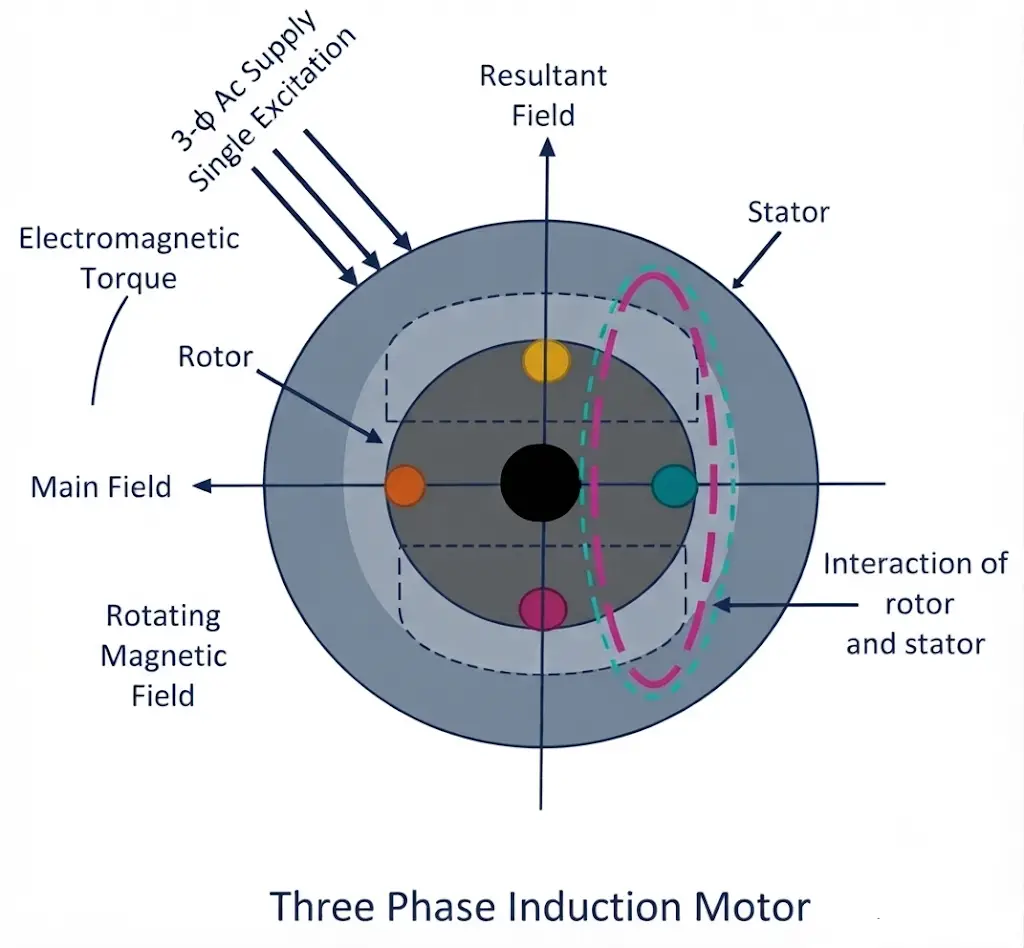
The figure below illustrates the rotating magnetic field produced by the stator when the AC supply is applied.
The rotor conductors form a closed electrical circuit. In a squirrel-cage rotor, the conductors are permanently short-circuited through end rings, whereas a wound rotor has a three-phase winding that can be connected to an external resistance through slip rings. Therefore, the induced EMF causes current to flow through the rotor conductors.
The rotor current creates its own magnetic field. The interaction between the stator’s rotating magnetic field and the magnetic field produced by the rotor current develops electromagnetic forces on the rotor conductors. The combined effect of these forces produces electromagnetic torque, causing the rotor to turn in the same direction as the rotating magnetic field.
As the rotor begins to accelerate, its speed increases and the relative speed between the rotor and the rotating magnetic field decreases. Consequently, the induced rotor EMF and current also adjust according to the operating load. The rotor continues to rotate as long as there is sufficient relative motion to induce rotor current and produce torque.
The rotor can never reach the synchronous speed during normal motoring operation. If the rotor were to rotate at exactly the same speed as the rotating magnetic field, there would be no relative motion between the field and rotor conductors. Consequently, no rotor EMF or rotor current would be induced, and electromagnetic torque would disappear.
Therefore, the rotor always runs slightly below synchronous speed. The difference between synchronous speed and rotor speed is known as slip. This speed difference is essential for maintaining electromagnetic induction and continuous torque production.
In this way, an induction motor converts electrical energy supplied to the stator into mechanical energy at the rotor without requiring a direct electrical connection to the rotor. This basic operating principle applies to both single-phase and three-phase induction motors, although their methods of producing starting torque are different.
Why Does the Rotor Never Run at Synchronous Speed?
The rotor of an induction motor always operates at a speed slightly lower than the synchronous speed. This difference is essential for the motor to produce electromagnetic torque.
Suppose the rotor were to reach the synchronous speed. In that condition, the rotor conductors would move at exactly the same speed as the rotating magnetic field produced by the stator. There would therefore be no relative motion between the magnetic field and the rotor conductors.
Without relative motion, the rotating magnetic field would no longer cut the rotor conductors. As a result, no EMF would be induced in the rotor, and the rotor current would fall to zero. Since electromagnetic torque depends on the presence of rotor current, the torque would also disappear. The rotor would consequently slow down and again develop relative motion with respect to the rotating magnetic field.
This continuous requirement for relative motion is why an induction motor cannot operate at synchronous speed. Under normal motoring conditions, the rotor speed is always slightly less than synchronous speed. The difference between these two speeds is known as slip.
How Torque Is Produced in an Induction Motor
The production of torque can also be understood by considering a single conductor on a stationary rotor.
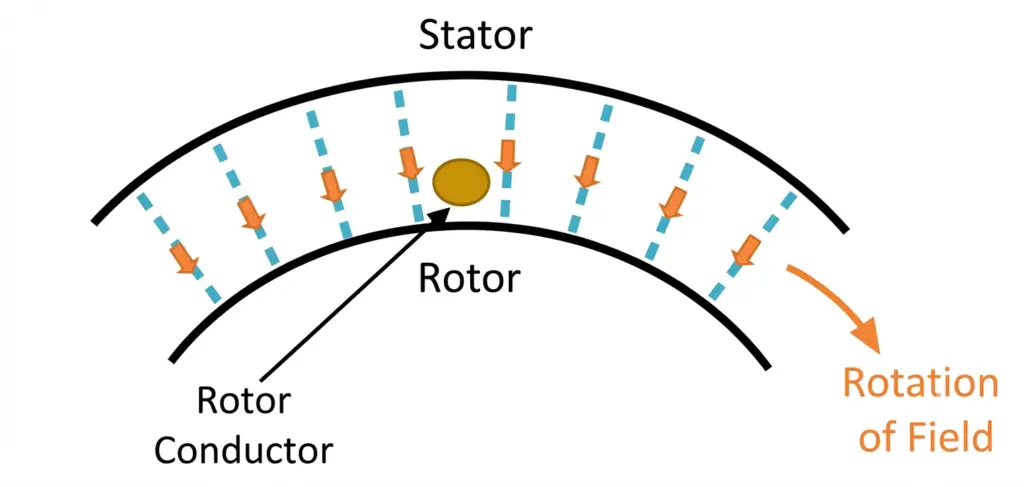
When the rotating magnetic field of the stator moves across the conductor, the conductor experiences a changing magnetic field. According to Faraday’s law of electromagnetic induction, an EMF is induced in the conductor.
Because the rotor circuit is closed, the induced EMF causes current to flow through the rotor conductor. The rotor current establishes its own magnetic field.
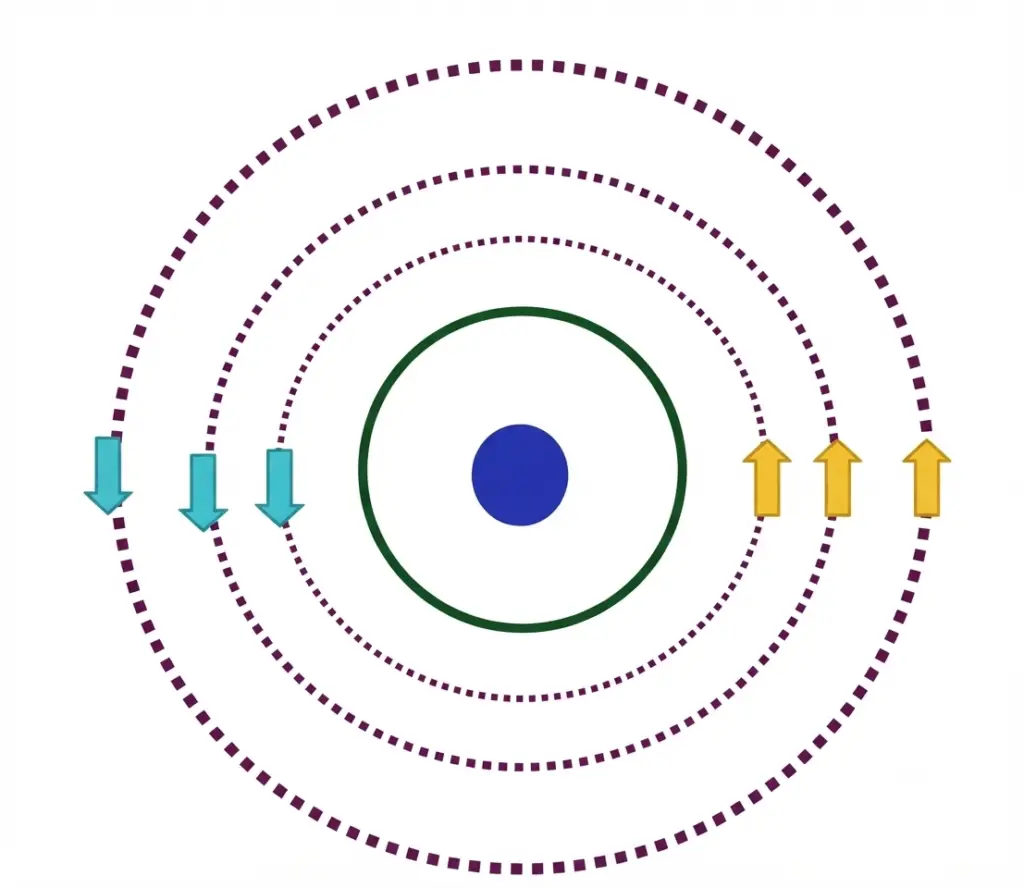
The interaction between the stator’s rotating magnetic field and the rotor magnetic field produces a force on the rotor conductors.
This force acts in a tangential direction on the rotor and consequently develops electromagnetic torque. The torque causes the rotor to accelerate in the same direction as the rotating magnetic field.
As the rotor speed increases, the relative speed between the rotor and the rotating magnetic field decreases. However, the rotor continues to remain slightly slower than synchronous speed, ensuring that EMF and current continue to be induced in the rotor. This allows the motor to maintain the torque required to drive the mechanical load.
The motor therefore does not need a separate electrical supply to the rotor. Its rotor current is produced through induction from the stator field. This characteristic is the basis for the name induction motor.
Conclusion
An induction motor is a widely used AC motor that operates through the principle of electromagnetic induction. The stator produces a rotating magnetic field when an AC supply is applied, while the changing magnetic field induces EMF and current in the rotor without requiring a separate electrical connection.
The interaction between the stator’s rotating magnetic field and the magnetic field produced by the rotor current generates electromagnetic torque, which causes the rotor to rotate. The rotor always operates slightly below synchronous speed because a certain amount of relative motion is necessary to induce rotor EMF and maintain torque production. This difference in speed is known as slip and is a fundamental characteristic of an induction motor.
Because of their simple construction, ruggedness, reliability, and relatively low maintenance requirements, induction motors are extensively used in industrial drives, pumps, fans, compressors, conveyors, and many other applications. Understanding their construction, synchronous speed, electromagnetic induction, torque production, and slip provides a strong foundation for studying the operation and performance of induction motors.
Read Next: