A Linear Induction Motor (LIM) is an electrical machine designed to generate motion along a straight path. It is particularly useful where direct linear propulsion is needed, offering an alternative to conventional motor-driven mechanical arrangements. This article explains its construction, operating principle, and major applications.
What Is a Linear Induction Motor?
A Linear Induction Motor (LIM) is a type of induction motor designed to produce straight-line motion rather than the rotary motion generated by conventional induction motors. It can be considered a modified form of a conventional induction motor in which the magnetic field travels along a linear path.
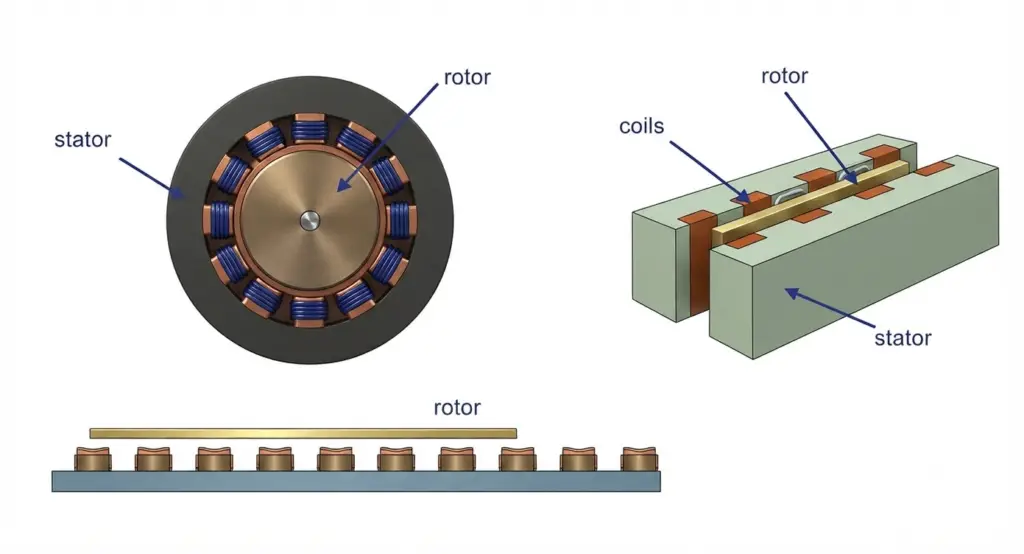
A linear induction motor uses the principle of electromagnetic induction to develop linear thrust. Its construction and operating concept are similar to those of a conventional induction motor, but the motor’s active magnetic components are arranged in a flat or linear configuration to produce translational movement.
Because it directly produces linear motion, a LIM can be used in applications where mechanical rotary-to-linear conversion would otherwise be required. Its applications include transportation systems, material-handling equipment, actuators, and other systems requiring controlled linear movement.
To understand how a linear induction motor operates, it is useful to first examine its construction and the arrangement of its primary and secondary components.
Linear Induction Motor Construction
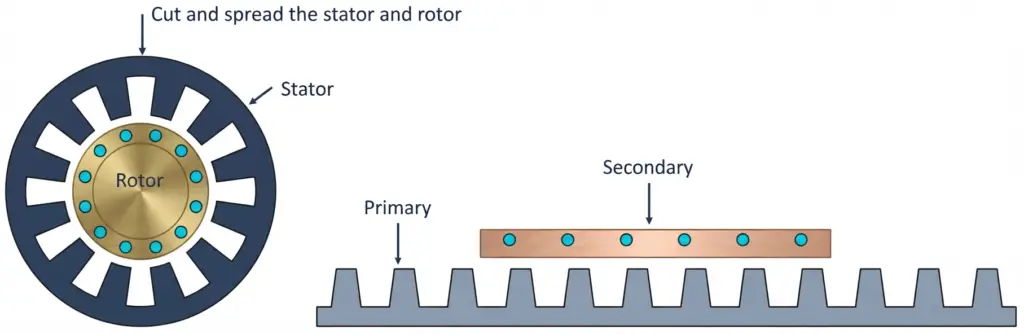
The construction of a Linear Induction Motor (LIM) is based on the same fundamental concept as a conventional three-phase induction motor, but its active components are arranged in a straight, flat configuration. Instead of producing rotational motion, this arrangement creates a magnetic field that travels linearly along the motor.
The primary section of a LIM contains the polyphase windings and can be viewed as a conventional induction-motor stator that has been cut open and laid flat. Similarly, the secondary section corresponds to the rotor of a conventional induction motor and is arranged as a flat conducting surface positioned opposite the primary.
A linear induction motor can be designed in different configurations depending on the required performance. One important arrangement is the Double-Sided Linear Induction Motor (DLIM). In this configuration, the secondary is placed between two primary sections.
The two primaries produce magnetic fields on opposite sides of the secondary, allowing the magnetic flux to interact with the secondary from both sides. This arrangement can improve the utilization of the magnetic field and provide greater linear thrust for suitable applications.
Thus, the main difference between a conventional induction motor and a linear induction motor is not the basic electromagnetic principle but the physical arrangement of the primary and secondary components and the type of motion produced.
Working Principle of Linear Induction Motor
A Linear Induction Motor (LIM) operates on the same basic electromagnetic induction principle as a conventional three phase induction motor, but instead of producing a rotating magnetic field and rotary motion, it generates a traveling magnetic field that produces linear motion.
When a balanced three-phase AC supply is applied to the primary winding, it produces a magnetic field that travels along the length of the primary. This traveling field is the linear equivalent of the rotating magnetic field found in conventional three-phase induction motors.
The traveling magnetic field moves relative to the secondary conductors. This relative motion induces an EMF in the secondary and causes electric current to flow when the secondary circuit is electrically closed. The interaction between the induced secondary current and the traveling magnetic field produces a linear electromagnetic force, commonly referred to as thrust.
If the primary is stationary and the secondary is free to move, this thrust drives the secondary along the length of the motor. The electrical energy supplied to the primary is therefore converted into mechanical energy in the form of straight-line or rectilinear motion.
The speed of the traveling magnetic field depends on the supply frequency and the linear pole pitch. It can be expressed as:
where:
- = speed of the traveling magnetic field in m/s
- = supply frequency in Hz
- = linear pole pitch, or the distance between corresponding magnetic poles, in meters
The secondary cannot normally move at exactly the same speed as the traveling magnetic field. A difference between the field speed and secondary speed is required to maintain relative motion and induce secondary EMF. This difference is expressed in terms of slip.
If is the synchronous linear speed of the traveling field and is the actual speed of the secondary, the slip is:
Therefore, just as slip is necessary for torque production in a conventional induction motor, it is necessary for thrust production in a linear induction motor. The magnitude of slip changes with the mechanical load and perating conditions of the LIM.
Applications of Linear Induction Motor
Linear induction motors (LIMs) are used in applications where direct linear motion is required. Although they are less widely used than conventional rotary motors, their ability to produce linear thrust without a separate rotary-to-linear conversion mechanism makes them useful in several specialized systems.
Some common applications of linear induction motors include:
- Electric transportation systems: LIMs can be used for propulsion in electric trains and other rail-based transport systems.
- Material-handling equipment: They can move containers, tubs, and other loads along predefined routes in industrial facilities.
- Conveyor systems: Linear induction motors are suitable for certain conveyor and material-transfer systems where controlled linear movement is required.
- Cranes and lifting equipment: LIM technology can provide controlled linear movement in specialized crane and handling applications.
- Molten-metal pumping: Linear induction motors can generate electromagnetic forces for transporting or pumping electrically conductive molten metals.
- Industrial automation: They can be used in specialized machines and automated systems that require direct, contactless linear propulsion.
Conclusion
A Linear Induction Motor (LIM) is a specialized form of induction motor that converts electrical energy directly into linear motion. Its primary produces a traveling magnetic field, which induces current in the secondary and generates the linear thrust required to move the secondary.
Unlike conventional motors, LIMs eliminate the need for mechanical arrangements such as gears, screws, or rotary-to-linear mechanisms in applications requiring straight-line movement. Their unique construction and operating characteristics make them suitable for electric transportation, material handling, conveyor systems, cranes, and electromagnetic pumping of conductive materials. Although their use is more specialized, linear induction motors provide an effective solution wherever direct and controlled linear motion is required.
Read Next: