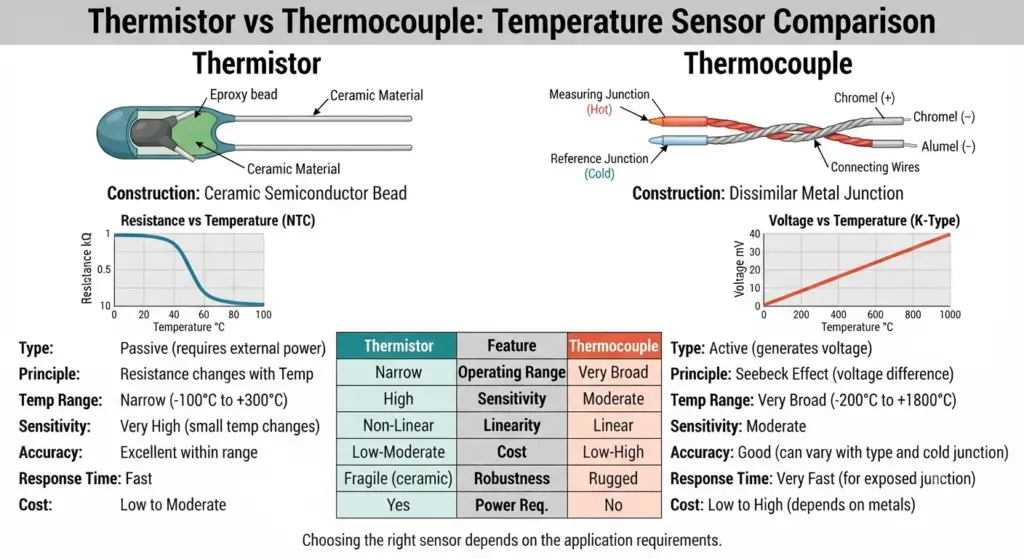
The main difference between Thermistor vs Thermocouple is their method of measuring temperature. A thermistor is a temperature-sensitive resistor whose electrical resistance changes with temperature, whereas a thermocouple generates a small thermoelectric voltage when two dissimilar metals experience a temperature difference. Thermistors are commonly used for sensitive temperature measurement within a specified range, while thermocouples are widely used for applications involving broad temperature ranges and high temperatures.
Understanding Thermistor vs Thermocouple is important because both are widely used temperature sensors, but their operating principles, output signals, temperature ranges, sensitivity, accuracy, stability, and applications are different. The appropriate sensor depends on the temperature range, measurement accuracy, response time, operating environment, and requirements of the application.
Thermistor vs Thermocouple Comparison Table
The table below highlights the major differences between Thermistor and Thermocouple.
| Feature | Thermistor | Thermocouple |
| Operating Principle | Change in electrical resistance with temperature | Seebeck effect |
| Output | Resistance | Thermoelectric voltage |
| Main Types | NTC and PTC | K, J, T, E, N, R, S, B, etc. |
| Sensitivity | Generally high within its specified range | Relatively low voltage output |
| Temperature Range | Generally narrower, depending on construction | Generally wider, depending on type |
| Linearity | Nonlinear | Nonlinear |
| Reference Junction | Not required | Required for accurate temperature measurement |
| Excitation | Measurement circuit normally required | Not required to generate thermoelectric voltage |
| Response Time | Depends on size and construction | Depends on junction size and construction |
| High-Temperature Measurement | Limited by material and construction | Widely used |
| Signal | Resistance change | Small voltage |
| Common Applications | Electronics, HVAC, batteries, appliances | Furnaces, kilns, boilers, engines, industrial processes |
| Typical Advantages | High sensitivity, compact size, low cost | Wide temperature range, rugged construction |
| Main Limitation | Limited temperature range for many constructions | Small output and reference-junction compensation |
What Is a Thermistor?
A thermistor is a temperature-sensitive resistor whose electrical resistance changes with temperature. The word thermistor is derived from thermal and resistor.
Thermistors are mainly classified into two types: NTC (Negative Temperature Coefficient) and PTC (Positive Temperature Coefficient) thermistors. In an NTC thermistor, resistance decreases as temperature increases, while in a PTC thermistor, resistance increases as temperature increases.
The resistance of a thermistor can be measured using an electrical circuit and related to temperature. Because thermistors can exhibit a relatively large change in resistance for a small change in temperature, they are useful where high temperature sensitivity is required.
Characteristics of Thermistors
Important characteristics of thermistors include:
- They are temperature-sensitive resistive components.
- NTC thermistor resistance decreases as temperature increases.
- PTC thermistor resistance increases as temperature increases.
- They generally have a nonlinear resistance-temperature relationship.
- They can provide high sensitivity within their specified temperature range.
- They are available in compact sizes and different physical constructions.
- They can provide fast response when a small sensing element is used.
- They are generally economical compared with many specialized temperature sensors.
- They are widely used in electronic and electrical systems.
- They can be used for temperature measurement, compensation, and protection.
Uses of Thermistors
Thermistors are used in a wide range of electrical and electronic applications.
Common uses include:
- Temperature measurement.
- Digital thermometers.
- HVAC systems.
- Battery temperature monitoring.
- Temperature compensation.
- Inrush current limiting.
- Overtemperature protection.
- Consumer electronics.
- Power supplies.
- Industrial temperature monitoring.
- Automotive electronic systems.
- Temperature control circuits.
A detailed explanation of thermistor construction, working principle, types, and applications is covered in the article Thermistor: Definition, Working Principle, Types & Applications.
What Is a Thermocouple?
A thermocouple is a temperature sensor made by joining two dissimilar electrical conductors. When the measuring junction and reference junction are at different temperatures, a small thermoelectric voltage is generated.
This phenomenon is known as the Seebeck effect.
The generated voltage varies with the temperature difference between the two junctions. A suitable temperature measurement instrument detects this voltage and converts it into a temperature value.
Common thermocouple types include K, J, T, E, N, R, S, and B. Each type uses a different combination of metals or alloys and is suitable for particular temperature ranges and operating conditions.
Characteristics of Thermocouples
Important characteristics of thermocouples include:
- They operate based on the Seebeck effect.
- They consist of two dissimilar electrical conductors.
- They generate a thermoelectric voltage.
- Their output voltage is relatively small.
- Different thermocouple types are available for different temperature ranges.
- They can be used for high-temperature measurement.
- Small junctions can provide fast response.
- Rugged constructions are available for industrial applications.
- They require suitable measurement electronics.
- Reference-junction compensation is required for accurate temperature measurement.
Uses of Thermocouples
Thermocouples have a wide range of applications, particularly in industrial temperature measurement.
Common uses include:
- Furnaces.
- Kilns.
- Boilers.
- Heat-treatment equipment.
- Steel and metal industries.
- Engines and exhaust systems.
- Industrial process control.
- Heating equipment.
- Ovens.
- Power plants.
- Chemical processing equipment.
- High-temperature monitoring systems.
Thermistor vs Thermocouple: Key Differences
1. Operating Principle
The most fundamental difference between Thermistor and Thermocouple is their operating principle.
A thermistor measures temperature through a change in its electrical resistance. When the temperature changes, the resistance of the thermistor also changes.
A thermocouple works on the Seebeck effect. When two dissimilar metals have a temperature difference between their junctions, a thermoelectric voltage is produced.
Therefore, a thermistor provides a resistance-based output, while a thermocouple provides a voltage-based output.
2. Output Signal
The output signal is another important difference between Thermistor and Thermocouple.
A thermistor produces a change in electrical resistance as its temperature changes. An external measurement circuit is normally used to measure this resistance.
A thermocouple generates a small thermoelectric voltage. The measurement instrument detects the voltage and converts it into temperature.
Thus, thermistors are generally associated with resistance measurement, while thermocouples are associated with low-level voltage measurement.
3. Temperature Range
Temperature range is one of the most important factors when selecting between a thermistor and a thermocouple. The suitable range depends on the sensor type, sensing material, construction, encapsulation, and manufacturer specifications.
NTC thermistors commonly operate over a range of about −50°C to 250°C. Glass-encapsulated NTC thermistors can be suitable for temperatures up to around 250°C, while some standard thermistors have a lower practical operating range.
Thermocouples generally cover a much wider temperature range. The actual range depends on the thermocouple type. For example, Type K thermocouples can cover approximately −200°C to 1370°C, while Type J can cover about −200°C to 1200°C. High-temperature types such as Type R and Type S can operate up to around 1760–1767°C, depending on the sensor and instrument specifications.
| Sensor | Typical Temperature Range |
| NTC Thermistor | About −50°C to 250°C |
| Type K Thermocouple | About −200°C to 1370°C |
| Type J Thermocouple | About −200°C to 1200°C |
| Type R/S Thermocouple | About 0°C to 1760–1767°C |
Therefore, thermistors are generally well suited to low- and moderate-temperature measurement, while thermocouples are commonly selected when a much wider temperature range or high-temperature measurement is required. Thermocouples are consequently widely used in furnaces, kilns, boilers, engines, and other high-temperature industrial applications.
The values above are typical examples, not universal limits. The actual operating temperature should always be selected according to the datasheet of the particular sensor, including its construction, accuracy requirements, and allowable continuous operating temperature.
4. Sensitivity
Sensitivity refers to the amount by which the sensor’s electrical output changes for a given change in temperature.
Thermistors generally have high sensitivity within their specified operating range. A small change in temperature can produce a relatively significant change in resistance.
Thermocouples generate a relatively small voltage for a temperature change. The voltage-temperature relationship depends on the thermocouple type.
Therefore, thermistors are commonly useful when high sensitivity to relatively small temperature changes is required.
5. Accuracy
The accuracy of a temperature sensor depends on its construction, calibration, measurement circuit, operating conditions, and temperature range. Sensor sensitivity is also important because it determines how clearly small changes in temperature are reflected in the output.
NTC thermistors can provide high measurement sensitivity within their specified operating range. A small change in temperature can produce a relatively large change in resistance, allowing the measurement circuit to detect small temperature variations. However, the resistance-temperature relationship of an NTC thermistor is nonlinear, so calibration or linearization may be required to obtain accurate temperature readings over a wider range.
Thermocouples generate a small thermoelectric voltage, typically in the millivolt range, in response to a temperature difference. The measured voltage must be converted into a temperature value by the measurement instrument. The overall accuracy therefore depends on the thermocouple type and grade, calibration, thermoelectric characteristics of the wire, reference-junction compensation, measurement electronics, and operating environment.
For this reason, neither a thermistor nor a thermocouple can be considered universally more accurate. A thermistor can be highly suitable when precise measurement of relatively small temperature changes is required within a defined range, while a thermocouple can provide accurate temperature measurement across a much wider temperature range when properly selected and calibrated.
The accuracy requirement should therefore be evaluated together with the required temperature range, sensitivity, stability, response time, and measurement conditions of the application.
6. Stability
Stability refers to the ability of a temperature sensor to maintain its measurement characteristics over long-term operation. Like other temperature sensors, thermistors and thermocouples can experience some measurement drift with time, depending on their materials, construction, packaging, operating temperature, and environmental conditions.
For NTC thermistors, stability can vary significantly with construction. According to Ametherm, an epoxy-coated NTC thermistor can exhibit a change of about 0.2°C per year, while a hermetically sealed NTC thermistor can exhibit a much smaller change of about 0.02°C per year.
Thermocouple stability also depends strongly on the thermocouple type, conductor materials, operating temperature, atmosphere, and protection. Ametherm’s comparison data indicates approximately 1°C/year or greater stability drift for thermocouples. At elevated temperatures, oxidation, metallurgical changes, contamination, and other effects can cause thermocouple output to drift over time.
| Sensor | Example Stability / Drift |
| Epoxy-coated NTC thermistor | About 0.2°C/year |
| Hermetically sealed NTC thermistor | About 0.02°C/year |
| Thermocouple | About 1°C/year or greater |
These values should be considered typical examples rather than universal limits. A properly selected and protected sensor can provide better long-term performance, while harsh conditions such as high temperature, oxidation, humidity, chemical exposure, and mechanical stress can increase measurement drift.
For applications requiring long-term measurement accuracy, periodic calibration and appropriate sensor protection can help detect and manage drift. Thermocouple drift is particularly important in high-temperature applications because prolonged exposure to elevated temperatures can alter the thermocouple materials and affect calibration.
7. Response Time
The response time of both thermistors and thermocouples depends on their physical construction.
A small thermistor can have low thermal mass and therefore respond quickly to temperature changes. Similarly, a thermocouple with a small junction can provide a fast response.
The response time depends on:
- Size of the sensing element.
- Thermal mass.
- Encapsulation.
- Protective sheath.
- Mounting arrangement.
- Air or liquid flow.
- Contact with the measured surface.
Therefore, the actual construction of the sensor can be more important than the sensor type alone when comparing response time.
8. Linearity
Both thermistors and thermocouples have nonlinear temperature characteristics.
The resistance of an NTC thermistor changes nonlinearly with temperature. Mathematical equations, lookup tables, or calibration methods can be used to convert resistance into temperature.
The voltage produced by a thermocouple also has a nonlinear relationship with temperature. Standardized voltage-temperature data or mathematical conversion methods are used to determine the temperature.
For high-accuracy measurement, appropriate calibration and signal processing may be required for both sensor types.
9. Reference Junction
A thermistor does not require a reference junction because its resistance is directly related to its temperature.
A thermocouple requires consideration of a reference junction because it measures a temperature difference between its measuring junction and reference junction.
Modern thermocouple measurement systems commonly use cold-junction compensation to account for the reference-junction temperature.
This makes reference-junction compensation an important consideration when designing a thermocouple measurement system.
10. High-Temperature Performance
High-temperature performance is one of the major differences between Thermistor and Thermocouple.
Many thermistors are designed for moderate temperature measurement, and their maximum operating temperature depends on their sensing material, encapsulation, and construction.
Thermocouples are widely used for high-temperature measurement because several thermocouple types are designed to operate at elevated temperatures.
This makes thermocouples common in furnaces, kilns, boilers, heat-treatment equipment, and other industrial processes.
11. Construction
Thermistors are generally manufactured using temperature-sensitive semiconductor materials. They are available in different forms such as beads, discs, chips, probes, and other packaged configurations.
Thermocouples consist of two dissimilar metal or alloy conductors joined at a measuring junction. The junction can be exposed or protected by a sheath depending on the application.
The construction of both sensors can be modified to provide the required temperature range, response time, mechanical protection, and environmental resistance.
12. Measurement Circuit
A thermistor is normally connected to a measurement circuit that determines its resistance. Voltage-divider circuits, bridge circuits, and other resistance-measurement arrangements can be used.
A thermocouple generates a small voltage that must be measured using suitable signal-conditioning electronics. The measurement system must also account for the reference-junction temperature.
Therefore, the interface requirements of thermistors and thermocouples are different.
Thermistor vs Thermocouple: Which Is Better?
There is no universal answer to which is better because Thermistors and Thermocouples are used for different temperature measurement requirements.
A thermistor is generally preferable when an application requires:
- High temperature sensitivity.
- Compact size.
- Low-cost temperature sensing.
- Electronic temperature monitoring.
- Battery temperature measurement.
- HVAC temperature sensing.
- Temperature compensation.
- Circuit protection.
A thermocouple is generally preferable when an application requires:
- A wide temperature range.
- High-temperature measurement.
- Rugged construction.
- Industrial temperature monitoring.
- Furnace or kiln temperature measurement.
- Boiler temperature measurement.
- Engine or exhaust temperature measurement.
- Process temperature measurement.
The correct choice depends on the required temperature range, accuracy, sensitivity, stability, response time, environment, and measurement system.
Similarities Between Thermistor and Thermocouple
Although Thermistors and Thermocouples work on different principles, they share several characteristics.
Some important similarities include:
- Both are temperature sensors.
- Both are used for temperature measurement.
- Both can be used for temperature monitoring and control.
- Both are available in different physical constructions.
- Both can provide fast response depending on their construction.
- Both can be integrated with electronic measurement systems.
- Both are used in industrial applications.
- Both are used in commercial and consumer equipment.
- Both require proper sensor selection for the intended application.
- Both can be used with control systems for temperature regulation.
Thermistor vs Thermocouple: Selection Considerations
The selection between a thermistor and thermocouple depends on several factors.
Important considerations include:
- Required temperature range.
- Required measurement accuracy.
- Temperature sensitivity.
- Long-term stability.
- Response time.
- Operating environment.
- Sensor construction.
- Installation method.
- Measurement electronics.
- Cost.
- Maintenance requirements.
- Required protection from moisture, chemicals, vibration, or mechanical damage.
A sensor should always be selected according to the specifications of the actual device rather than relying only on general characteristics of thermistors or thermocouples.
Conclusion
The comparison of Thermistor and Thermocouple shows that both are important temperature sensors, but their operating principles and characteristics are significantly different. A thermistor measures temperature through a change in electrical resistance, while a thermocouple generates a thermoelectric voltage through the Seebeck effect.
Thermistors are widely used where high sensitivity, compact size, economical temperature sensing, and electronic integration are important. They are commonly used in HVAC systems, batteries, electronic equipment, temperature compensation, and protection circuits.
Thermocouples are widely used where wide temperature capability, high-temperature measurement, rugged construction, and industrial operation are required. Different thermocouple types allow them to be selected for different temperature ranges and operating conditions.
The simplest way to understand Thermistor vs Thermocouple is that a thermistor provides a temperature-dependent resistance, whereas a thermocouple provides a temperature-dependent thermoelectric voltage. The appropriate sensor depends on the temperature range, accuracy, sensitivity, stability, response time, environment, and requirements of the application.
Frequently Asked Questions (FAQs)
The main difference between Thermistor and Thermocouple is their operating principle. A thermistor detects temperature through a change in electrical resistance, whereas a thermocouple generates a thermoelectric voltage due to a temperature difference between its junctions.
A thermocouple generally provides a wider temperature range than a standard thermistor. However, the actual range depends on the thermocouple type and the construction and specifications of the thermistor.
Thermistors generally provide higher sensitivity within their specified operating range because a small temperature change can produce a relatively large change in resistance. A thermocouple produces a comparatively small voltage change.
Neither sensor is universally more accurate. Accuracy depends on the sensor type, calibration, operating temperature, measurement circuit, installation, and environmental conditions.
A thermistor does not generate its own measurement signal. Its resistance is normally measured by applying a voltage or current through an external measurement circuit.
Read Next:
- Thermistor: Definition, Symbol, Working Principle, Types and Applications
- How to Test a Thermocouple With a Multimeter
- K Type Thermocouple- Construction, Temperature Range, Applications
- Installation precautions of RTD and Thermocouples
- Response Time Test of RTD & Thermocouple
- How to Know if Thermocouple Malfunctioning
- What is a Thermocouple Compensation Cable?
- What is a Thermocouple? Its Types & Working Principle
- Thermocouples Burnout Detection