Drift velocity is the average velocity of electrons when an electric field is applied across a conductor. This concept explains how electric current flows at the microscopic level. The drift velocity formula helps quantify this movement and is essential in understanding current flow in conductors.
The Concept of Drift Velocity
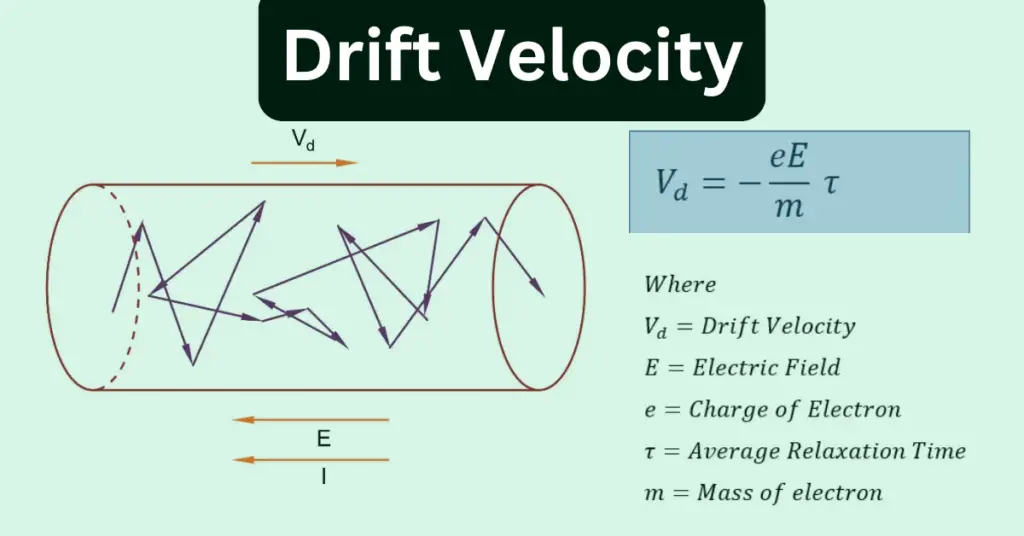
The slow movement of electrons in the conductor when an EMF is applied across the conductor is called drift velocity. The electrons do not move in a straight line because of the collision of electrons within the conductor.
Thus, the collision of electrons with the conductor surface and the collision of electrons with each other deflect the path of electrons and reduce their net velocity, and the electrons move randomly in the conductor.
The randomly moving electrons exchange energy during a collision, and the energy moves forward in the direction of electron drift (opposite to the conventional current flow)
Drift Velocity Definition
The drift velocity is the electrons’ average velocity when subjected to an electric field. Drift velocity means the slow movement of electrons in the opposite direction of the electric field.
The movement of electrons happens in the axial direction because of the movement of electrons in a plane. Thus, the electron’s velocity is considered in the axial direction for the calculation of the drift velocity.
The velocity at which free electrons move slowly and drift towards the positive supply source of external electric field is called the Drift velocity.
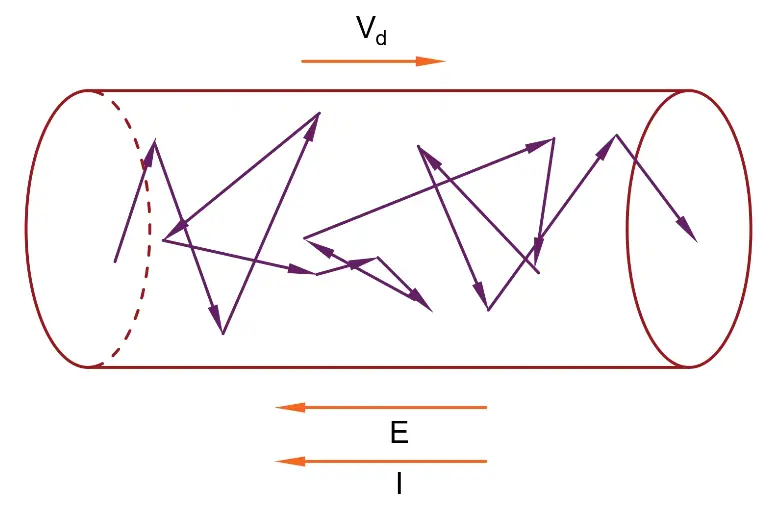
The SI unit of drift velocity is m/s. It is also measured in m2/(V.s).
Drift Velocity Formula
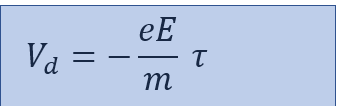
The formula for Drift Velocity is given as follows
Where:
- vd = drift velocity of the electron (in m/s)
- e= charge of the electron (approximately 1.6 × 10⁻¹⁹ C)
- E = applied electric field (in V/m)
- τ (tau) = average relaxation time (in seconds)
- m = mass of the electron (approximately 9.1 × 10⁻³¹ kg)
Drift Velocity Formula Derivation
Step1: Acceleration of Electron
When a charged particle(electron) is placed in an electric field E, the force(F) experienced by the particle is;
Acceleration of each electron is;
Where,
a= Acceleration of electron
m= Mass of electron
From equation(1) & 2, we get;
Step 2: Velocity of Electrons
The initial thermal velocity of the electron is u1, the final velocity is v1, and the time taken for this collision is t.
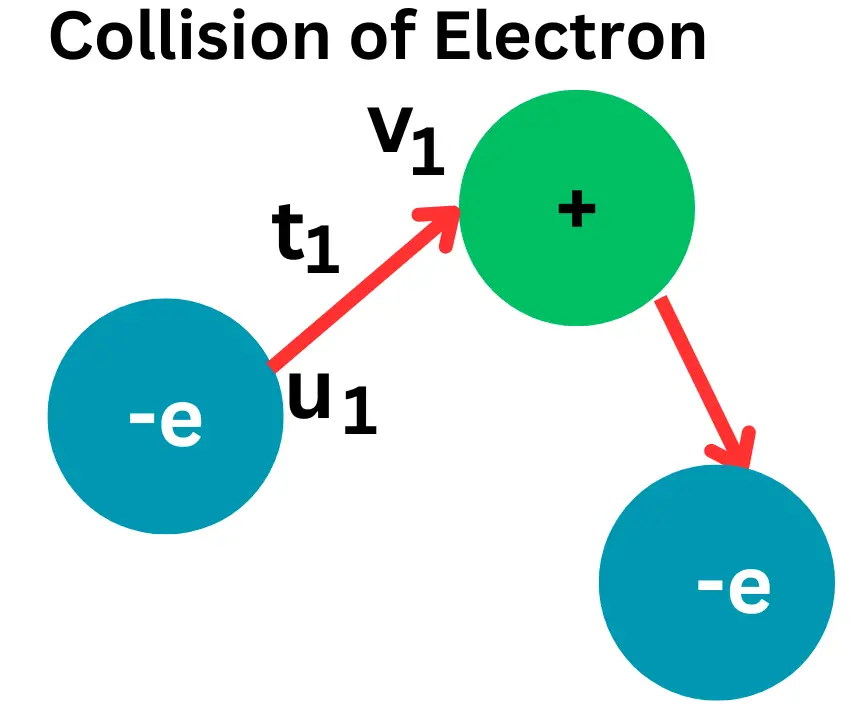
The thermal velocity u1 can be expressed as;
Similarly, the thermal velocities of other electrons are;
Step 3: Average Drift Velocity
The average velocity of all the electrons is the drift velocity and can be calculated as follows.
The average velocity is;
Putting the value of thermal velocities from equations 4,5 & 6 in equation 8, we get;
Therefore,
Step4: When No Electric Field is Applied
The average thermal velocity of electrons inside the conductor is zero when no electric field is applied to the conductor. Therefore, from the equation 10,
Therefore, equation 10 can be written as;
The equation 11 can be rewritten as;
Average relaxation time,
Therefore,
Putting the value of a from the equation 3, we get we get the final expression for drift velocity.
Thus, the drift velocity formula is,
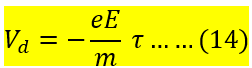
Let us understand some important terms used in the drift velocity formula.
Drift Velocity in terms of tau-τ( Average Relaxation Time)
The average time interval between two successive collisions of electrons in a conductor when an electric field is applied to it. It is denoted by τ(tau).
We can express the average relaxation time by the following formula.
Drift Velocity in terms of Mobility (μ)
The mobility of electrons depends on the applied electric field to a conductor. The mobility shows how quickly a charged particle can move through a conductor.
The electron mobility is the ratio of the drift velocity of an electron to its applied electric field.
Putting the value of Vd, we get;
Net Velocity of the Electrons
Every material above absolute zero temperature consists of some free electrons moving at random velocity. However, the net velocity is zero when no external electric field is applied.
The electrons move towards the positive potential when the external electric field is applied around a conductor.
The movement of electrons does not happen in a straight line because the electrons collide with the atom and lose their kinetic energy. But the electric field causes electrons to accelerate again, and electrons start moving in the same direction.
Thus, the net velocity of electrons will be in the same direction as the electric field.
Solved Problems on Drift Velocity
Problem 1: When a potential difference V is applied across a conductor at a temperature T, calculate the drift velocity of electrons.
Solution:
We know the basic relationship between the electric field (E), potential difference (V), and length (l) of a conductor is:
Substituting this into the drift velocity formula:
Conclusion: From the derivation above, it is clear that drift velocity is directly proportional to the applied voltage:
Problem 2: The mobility of electrons in a silver conductor is 6.9973 × 10⁻³ m2/v/s, and the Electric field along the wire(E) = 120 volts/m; calculate the drift velocity of electrons.
Solution:
Given Data:
- Formula:
Calculation: Substitute the given values into the above formula
Answer: The drift velocity of the electrons in the silver conductor is 0.8397m/s.
Read Next: