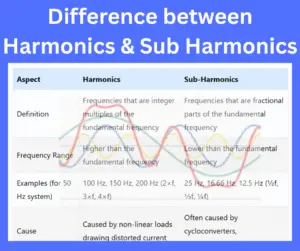
The difference between harmonics and subharmonics is based on their relation to the fundamental frequency. Harmonics are whole-number multiples of the base frequency (e.g., 100 Hz, 150 Hz for a 50 Hz system), while sub-harmonics are fractional parts of it (e.g., 25 Hz, 16.66 Hz).
In short, harmonics occur above the fundamental frequency, and sub-harmonics occur below it.
What Are Harmonics in Power Systems?
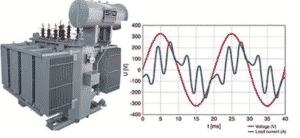
Harmonics is generated when the equipment draws current which is non linear to the applied voltage. The elctronic devices are the non linear devices which draw non linear current when sinusoidal voltage is applied. The transformer at the time of charging also draws non-sinusoidal current.
This non- linearity in the current cause harmonics in the system. The non-sinusoidal current can be resolved into sinusoidal component and integral multiples of the sinusoidal component using Fourier series.
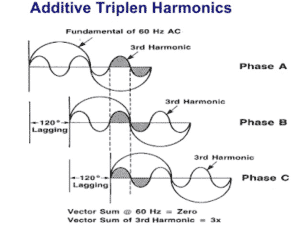
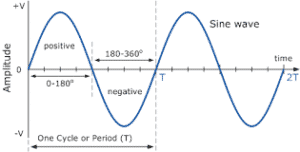
The sinusoidal component whose frequency is equal to the fundamental frequency is called the fundamental component, and the integral multiples of the fundamental frequency is called harmonics.
This means, if the frequency of fundamental component is 50 Hz, then the frequency of harmonics will be 2×50 (=100 Hz), 3×50 (=150 Hz) and so on.
These are typically referred to as “integer harmonics” and are common in industrial and power electronic systems.
Even and Odd Harmonics
The harmonic frequency which is even multiples of the fundamental is called even harmonics. Therefore, signals with frequency 100 Hz, 200 Hz, 300 Hz are the even harmonics of fundamental component with frequency 50 Hz.
The harmonic frequency which is odd multiples of the fundamental is called odd harmonics. Therefore, signals with frequency 150 Hz, 250 Hz, 350 Hz are the odd harmonics of fundamental component with frequency 50 Hz.
Read detailed article on: Harmonics and Harmonic Frequency in AC Circuits
What Are Subharmonics?
Sub-harmonic frequencies are frequencies below the fundamental frequency in a ratio of 1/n th of the fundamental frequency where, n is a positive integer number.In other words, the subharmonics are the fractional frequency component.
For example, if the fundamental frequency 50 Hz, sub-harmonics frequency is 1/n(f) = 1/2(50)=25 Hz, 1/3(50) = 16.66 Hz, 1/4(50)=12.5 Hz etc. . Thus, a frequency of 25 Hz, 16.66 Hz, 12.5 Hz etc. are sub-harmonics.

Thus, the harmonics have frequency more than the fundamental frequency and the sub-harmonics have frequency less than the fundamental frequency. sub-harmonics is having frequency of nf and harmonics is having frequency of (1/n)f ,where f is fundamental frequency.
If the harmonics is a non-integer multiple of the fundamental frequency then then it is called interharmonics.
What Causes Subharmonics in Power Systems?
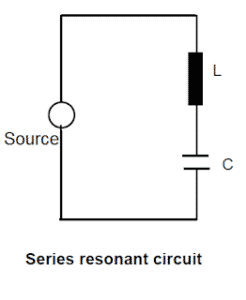
The series reactors are used to limit the amount of fault current since inductor limits the fault current. The series line capacitors are used to increase the amount of real power by improving the power factor of the electrical network.
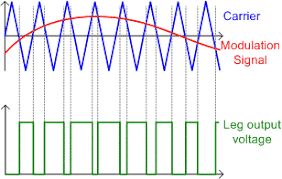
However, it creates a sub-harmonic current with frequency below the fundamental frequency.Another major source of subharmonics is PWM inverter run with asynchronous PWM (carrier wave frequency is not an integer multiple of the modulation signal) and cycloconverters.
Subharmonics can also arise due to non-linear loads, voltage regulator oscillations, and control instability in converter-fed machines.
How Sub-Harmonics Affect the Power System?
The major problems caused by Sub- harmonics are induction generator effects, torsional interactions, torque amplification, sub- synchronous resonance, and transformer saturation.
Also, Sub–harmonics generated from capacitors may introduce errors in phasor estimation. This may cause mal-operation of distance relays. Impedance over-reach and under-reach are two commonly reported conditions.
Apart from that, significantly high amount of sub–harmonics can also affect directionality of the relay.The effect of interharmonics is similar to any other harmonics i.e. they are harmful and needs to be eliminated from the system.
Why Subharmonics Can Be More Dangerous Than Interharmonics
The most of the loads are inductive in nature. The impedance of inductive load depends on the frequency. The sub-harmonic frequency offers lower reactance(XL = 2 πfL) as compared to the reactance offered at interharmonic frequencies.
As a result, sub-harmonic current will be much higher than the inter-harmonic current. This makes the sub-harmonics more severe than the interharmonics.
In other words, the lower the order of the harmonics the more severe it can become as the reactance offered also gets lowered.
Subharmonics pose more risk of transformer overheating, signal distortion, and relay misoperation due to their deeper penetration in inductive circuits.
Read detailed article on: Interharmonics in Power System
Difference Between Harmonics and Sub-Harmonics
The harmonic frequency is always more than the fundamental freeqency. The harmonic frequency is equal to nxf, where n is the order of harmonics and f is the frequency of the fundamental component.
The harmonic frequency for harmonic order 2,3,4,5,6,7,and 8 is 100Hz , 150 Hz , 200 Hz, 250 Hz, 300 Hz, 350 Hz respectively.
Thus, the frequency of even and odd harmonic order is always more than the fundamental frequency.
So, while harmonics are “overtones” above the base frequency, sub-harmonics are “undertones” occurring at fractional values like 1/2f, 1/3f. Both disrupt waveform integrity but behave differently in power systems.
Difference Between Harmonics and Subharmonics in Table Format
The table below clearly explains the difference between harmonics and subharmonics to help you understand their roles in power systems.
| Aspect | Harmonics | Sub-Harmonics |
| Definition | Frequencies that are integer multiples of the fundamental frequency | Frequencies that are fractional parts of the fundamental frequency |
| Frequency Range | Higher than the fundamental frequency | Lower than the fundamental frequency |
| Examples (for 50 Hz system) | 100 Hz, 150 Hz, 200 Hz (2×f, 3×f, 4×f) | 25 Hz, 16.66 Hz, 12.5 Hz (½f, ⅓f, ¼f) |
| Cause | Caused by non-linear loads drawing distorted current | Often caused by cycloconverters, asynchronous PWM inverters |
| Impact | Causes heating, resonance, equipment malfunction | Can lead to resonance, transformer saturation, relay maloperation |
| Mathematical Form | n × f, where n = 2, 3, 4… |
(1/n) × f, where n = 2, 3, 4… |
| Severity | Depends on order and system resonance | Generally more severe at lower orders due to lower reactance |
Conclusion
Harmonics and subharmonics both result from nonlinear behavior in electrical systems, but they differ in their relation to the fundamental frequency. Harmonics are integer multiples of the base frequency and are typically produced by nonlinear loads such as drives and converters.
Subharmonics, on the other hand, are fractional frequencies that often arise from cycloconverters, asynchronous PWM inverters, or resonance conditions. Understanding these differences is essential for identifying waveform distortions and maintaining reliable power system performance.

Related Articles:
- Effect of Harmonics on Power Factor
- Harmonics Filters – Cost and Effectiveness
- Effects of Harmonics on Transformers
- Effects of Harmonics on Capacitors
- Effects of Harmonics on Power Cable