Metadyne is a special electrical machine that consists of a motor-generator set. A metadyne is typically a cross-field DC machine that consists of an extra set of carbon brushes on its direct axis.
Metadyne utilizes the armature MMF to provide high excitation and hence high-power gain. Therefore, it is also referred to as a rotating amplifier or a transformer. The primary function of a metadyne is to manipulate its stable input voltage into a stable output current with an uneven voltage. This machine is basically designed to utilize the armature reaction.
Construction of Metadyne
The basic construction of a metadyne is shown in the following figure.
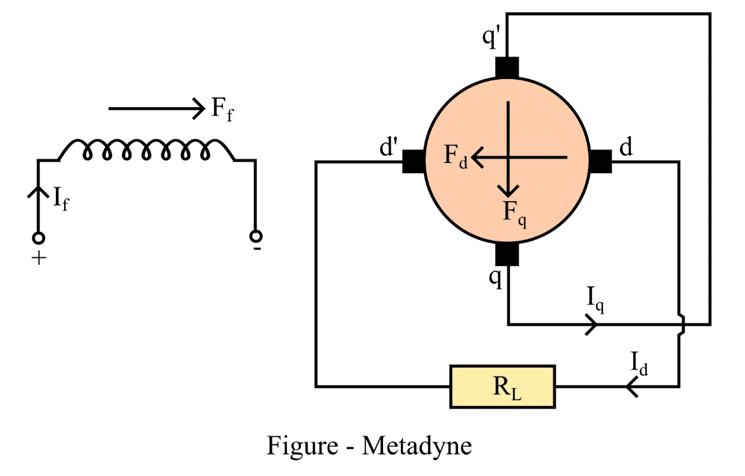
It is a specially designed dc generator with two pairs of carbon brushes. Like any other electrical machine, the metadyne also consists of two main parts namely, stator and rotor.
In the rotor construction, the two pairs of carbon brushes are arranged as, one pair dd’ on the direct axis and another qq’ on the quadrature axis. In the metadyne, the pair of brushes placed on the quadrature axis are short-circuited, while the output of the metadyne is taken through the pair of brushes on the direct axis.
In the stator construction, metadyne consists of a separately excited stator winding which produces a magnetic field in the machine when an electric current flows through it. This stator field winding is also referred to as a control field winding.
Metadyne Working Principle
As discussed above, a metadyne is basically a constant-current device that uses an armature reaction to perform its function. It is mainly designed to convert a stable input voltage into a changing voltage with a constant current as output.
When the rotor of the metadyne is made to rotate at a constant speed with the flow of an electric current If through the field winding. Then, an EMF is induced between the brushes placed on the quadrature axis and is denoted by Eq. The value of Eq is given by the following expression,
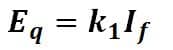
Where k2 is a constant.
It can be seen that a load is connected between the brushes placed on the direct axis. Hence, it causes an electric current Id to flow through the load. According to Lenz’s law of electromagnetic induction, the mmf Fd opposes its cause of production, i.e.the mmf Ff.
Therefore, at each stage of the voltage generation, the current produced generates a magnetic field that leads to the magnetic flux responsible for the voltage generation. Since there are two stages in the voltage generation in metadyne, hence the magnetic field generated by the direct-axis current is shifted two times by an angle of 90°, which results in a total shift of 180°. Consequently, the direct axis magnetic field opposes the magnetic field produced by the mmf Ff. Thus, the equation of the quadrature emf Eq becomes,

When the speed of the machine is constant and the condition of the magnetic saturation is neglected. Then, for a given value of the mmf Ff and the load resistance RL, currents Id, and Iq reach their steady-state values.
From the above equation of Eq, it is clear that if the current Id increases, it results in a reduction in the emf Ed. This further reduces the current Id. Thus, for a given value of excitation field current If, the direct-axis current Id is constant for a wide range of load resistance. Therefore, metadyne acts as a constant current generator.
Understanding Metadyne vs. Amplidyne
To better understand how a metadyne functions compared to similar cross-field machines like the amplidyne, it helps to look at how they handle magnetic compensation:
| Feature | Metadyne | Amplidyne |
| Compensation Winding | Uncompensated or only partially compensated | Features a full compensation winding |
| Armature Reaction | Directly utilizes armature reaction to maintain its function | Completely cancels out the armature reaction flux caused by the load current |
| Primary Output | Functions as a constant-current generator | Functions as a constant-voltage generator |
Applications
Metadyne is used in a wide range of industries where a constant current output with a variable voltage is desired. Some key applications of Metadyne are listed below:
- Metadyne is used in larger ac machines to provide necessary excitation.
- It is also used in traction systems for voltage regulation, controlling traction motors, power conversion, etc.
- Used in substations and distribution stations for voltage regulation purposes.
- Metadynes are also used in industries like mining, chemical processing, product manufacturing, etc. to control motor drives.
- Used in control systems used in aircraft and other aerospace applications.
Hence, this is all about metadyne and its applications. Metadyne is used for precise voltage regulation and power flow control in various electrical systems. The major advantages of metadynes include high reliability, strong mechanical construction, capacity to handle large amounts of power, and more. However, due to the development of efficient modern solid-state devices, metadynes are used in some specific applications.
Frequently Asked Questions (FAQ)
The primary purpose of a metadyne is to convert a stable, constant input voltage into a variable output voltage that maintains a steady, constant current. This makes it highly useful as a rotating electrical transformer or heavy-duty power amplifier.
A standard DC generator uses a single pair of brushes to deliver a constant voltage. A metadyne features an extra set of brushes (two pairs total) on its direct and quadrature axes and actively uses armature reaction to regulate its output current.
While metadynes are mechanically rugged and highly reliable, modern power electronics (like thyristors, IGBTs, and solid-state drives) are much smaller, more energy-efficient, require less maintenance, and offer faster response times.
Read Next: