Before discussing advanced arc quenching technologies, it is essential to understand the physics of the electric arc in a circuit breaker. In power systems, an arc is not just a spark; it is a complex plasma phenomenon that must be managed to prevent equipment failure.
What is an Electric Arc?
An Electric Arc is a visible plasma discharge that occurs when the medium (gas or air) between two separated contacts becomes highly ionized. This ionization creates a low-resistance conductive path, allowing current to continue flowing even after the circuit breaker contacts are physically separated.
The arc generates intense heat and light. In a circuit breaker, the current does not stop the moment contacts part; it continues through this plasma “bridge” until the arc is successfully extinguished.
Electric Arc in Circuit Breaker
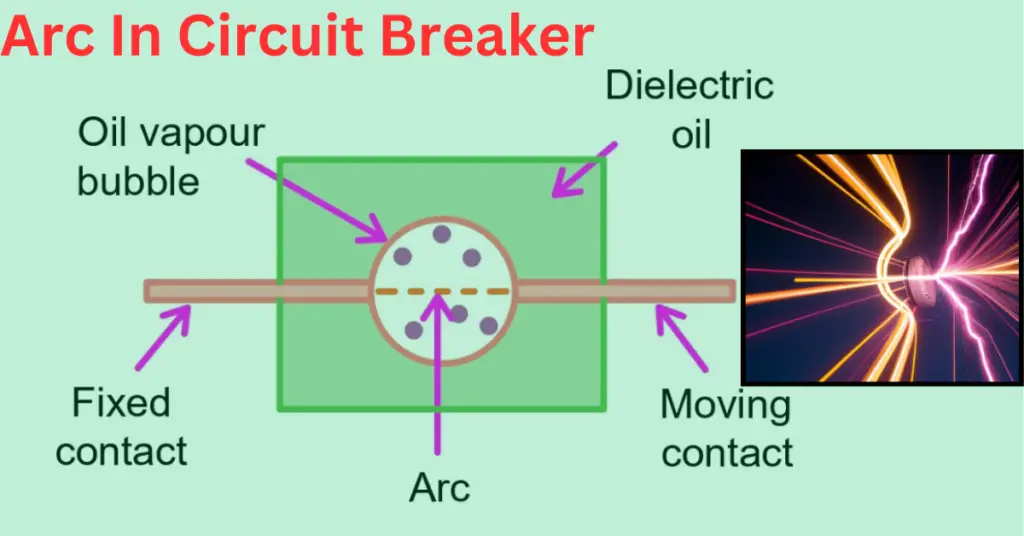
When a circuit breaker’s load current contacts open, an arc is established between the separating contacts. To ensure that the current through a circuit breaker is completely interrupted, it is important to quickly extinguish the electric arc that is created between the contacts.
The arc is a conductive path of electricity, so as long as it is sustained, the current will not be interrupted. Therefore, the main design criteria of a circuit breaker are to provide appropriate arc quenching technology that can safely and quickly interrupt current flow.
Before discussing the different arc quenching techniques used in circuit breakers, it is important to understand the theory of electric arc in circuit breaker.
Physics of Arc Formation
To understand arc quenching technology, we must first analyze the fundamental physics of arc formation. An electric arc is not merely a spark; it is a complex plasma state governed by two primary ionization mechanisms.
1. Thermal Ionization of Gas
There are limited free electrons and ions in a gas at room temperature. These particles are generated by ultraviolet rays, cosmic rays, and the earth’s radioactivity.
However, the number of free electrons and ions is so small that they are insufficient to sustain the conduction of electricity.
At room temperature, gas molecules move about randomly. For instance, an air molecule at a temperature of 300 K (room temperature) moves randomly with an average velocity of approximately 500 meters/second. It collides with other molecules at a rate of 1010 times/second. These frequent collisions are the foundation of gas conductivity when energy is added to the system.
When molecules move around, they collide with each other frequently. However, the kinetic energy of these molecules is not usually strong enough to remove an electron from the atoms that make up the molecules.
If the temperature of the air increases, the velocity of the molecules will also increase. This means that when the molecules collide, the impact will be stronger.
As a result, some of the molecules will break apart into atoms.
If the temperature continues to rise, many atoms will lose their valence electrons, and the gas will become ionized. This ionized gas can conduct electricity as it has enough free electrons. This state of a gas is known as plasma. This process is called the thermal ionization of the gas, and it is a critical factor in maintaining the arc column’s low resistance.
2. Ionization due to Electron Collision
As previously discussed, air or gas contains limited free electrons and ions that are inadequate for conducting electricity. However, when these free electrons encounter a potent electric field (between separating contacts), they tend to move toward higher potential points and acquire enough velocity. The electrons are then accelerated along the direction of the electric field due to a high potential gradient.
During their travel, these electrons collide with other atoms and molecules present in the air or gas, producing valence electrons from their orbits. This process of collision and extraction leads to the creation of an electrical current in the air or gas. This is often referred to as the Townsend Discharge or avalanche effect.
When atoms are separated, the electrons they contain will move in the direction of an electric field due to the potential gradient. As they move, these electrons may collide with other atoms, creating even more free electrons that will also be directed along the electric field. This process can continue until the number of free electrons in the gas becomes so high that the gas begins to conduct electricity. This phenomenon is known as the ionization of gas due to electron collision.
Role of Arc in Circuit Breaker
When the contacts of a circuit breaker open, an arc is established that bridges the gap between them. This provides a low-resistance plasma path, preventing a sudden, instantaneous interruption of the current.
Preventing Switching Overvoltage
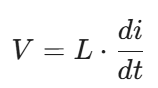
If an electric arc were not present, the current would be forced to zero abruptly. According to the laws of electromagnetism, an instantaneous change in current through the system’s inductance ($L$) creates a massive switching overvoltage.
This relationship is expressed by the fundamental formula:
Where:
- V is the induced switching voltage.
- L is the system inductance.
- di/dt is the rate of change of current with respect to time.
The Arc as a Transition Phase
Without the arc, this high voltage could severely stress or puncture the system’s insulation. The presence of the arc allows for a gradual yet rapid transition from a current-carrying state to a current-breaking state.
In Alternating Current (AC) systems, the arc is naturally extinguished at every current zero. However, it will re-establish (re-strike) unless the dielectric strength of the gap is restored. To ensure successful circuit interruption, the re-ionization between the separated contacts must be prevented immediately following a current zero crossing.
Arc Interruption and Quenching Theory
Successful current interruption depends on the competition between the restriking voltage and the dielectric strength of the gap. This is primarily achieved by deionization process.
What is Deionization of Gas?
When all the factors that cause gas ionization are removed, the ionized gas quickly returns to its neutral state by recombining positive and negative charges. This fundamental process is known as deionization.
One primary mechanism is deionization by diffusion, where negative ions (electrons) and positive ions move toward the walls of the arc chamber due to concentration gradients. Once they reach the boundaries, they complete the recombination process, effectively neutralizing the plasma.
In modern high-voltage switchgear, accelerating this deionization process is the primary goal of the arc quenching medium, as it ensures the gap recovers its dielectric strength before the restriking voltage can re-establish the arc.
Arc Column Characteristics
At high temperatures, charged particles in a gas move rapidly and randomly. However, no net motion occurs in the absence of an electric field. When an electric field is applied to the gas, the charged particles gain drift velocity, adding to their random thermal motion.
The drift velocity is directly proportional to the voltage gradient of the field and the particle’s mobility. Particle mobility depends on the particle’s mass; heavier particles have lower mobility. Mobility also depends on the mean free paths available for the particles’ random movement.
Whenever a particle collides, it loses its directed velocity and must be re-accelerated along the electric field. Therefore, the net mobility of the particles is reduced. If the gas is at high pressure, it becomes denser, and the gas molecules come closer to each other, causing collisions to occur more frequently, further lowering the mobility of the particles.
The total electric current carried by charged particles is directly proportional to their mobility. Therefore, the mobility of charged particles depends on the temperature, pressure of the gas, and the nature of the gas. The mobility of gas particles determines the degree of ionization of the gas.
The ionization process of gas depends on various factors, such as the nature of the gas (i.e., heavier or lighter gas particles), gas pressure, and temperature. To clarify, the intensity of the arc column is influenced by the presence of ionized media between separated electrical contacts.
Therefore, it is essential to reduce ionization or increase deionization of the media between contacts. This is why the main design feature of a circuit breaker is to provide different pressure control methods and cooling techniques for various arc media between the contacts.
Heat loss from an Arc
Heat loss from an arc in a circuit breaker occurs through conduction, convection, and radiation. In a circuit breaker with a plain break arc in oil, arc in chutes, or narrow slots, almost all the heat loss is due to conduction.
In an air blast circuit breaker or in a breaker where a gas flow is present between the electrical contacts, the heat loss of arc plasma occurs due to the convection process. Radiation is not a significant factor at normal pressure, but at higher pressure, it may become a very important factor in heat dissipation from arc plasma.
During the opening of electrical contacts, the arc in the circuit breaker is produced and extinguished at every zero crossing of the current. Then, it is reestablished during the next cycle. In a circuit breaker, the final stage of stopping the flow of electric current, known as arc extinction or arc quenching, occurs when the dielectric strength between the contacts increases rapidly.
This prevents the re-establishment of the arc after the current has reached zero. This increase in dielectric strength can be achieved in one of two ways: either by deionizing the gas in the arc media or by replacing the ionized gas with fresh, cool gas.
Methods to Increase Deionization
Modern circuit breakers employ specific physical methods to accelerate the deionization process and ensure successful arc extinction:
1. Deionization of Gas due to Increasing Pressure
When the pressure of the arc path increases, the density of the ionized gas also increases. This means that the particles in the gas become closer to each other, resulting in a shortened mean free path of the particles.
Consequently, the collision rate increases, and as we previously discussed, each collision causes the charged particles to lose their directed velocity along the electric field, and then they are re-accelerated towards the field.
Overall, the mobility of the charged particles is reduced, and the voltage required to maintain the arc increases. Additionally, the higher density of particles leads to a higher rate of deionization of gas, which happens because oppositely charged particles tend to recombine more frequently.
2. Deionization of Gas due to Decreasing Temperature
The rate at which gas particles ionize is directly proportional to the intensity of their collision. This intensity of impact depends on the velocity of random motions of the particles.
As the gas temperature increases, the random motion of a particle and its velocity also increases, resulting in increased ionization of the gas. Conversely, if the temperature decreases, the rate of ionization of the gas decreases, which means that the deionization of the gas is increased.
Therefore, more voltage is required to maintain arc plasma with decreased temperature. In conclusion, cooling effectively increases the resistance of the electric arc. Later in the course of circuit breakers, we will discuss different types of circuit breakers that employ different cooling techniques.
Conclusion
The arc in circuit breaker operation is a double-edged sword. While it serves as a critical “safety valve” by preventing dangerous switching overvoltages (V = L di/d$) during contact separation, it must be controlled and extinguished rapidly to protect the switchgear.
A successful interruption depends entirely on the competition between the Restriking Voltage and the Dielectric Strength of the medium. By leveraging deionization processes—such as increasing gas pressure, forced cooling, and diffusion—modern circuit breakers can safely quench high-energy arcs in milliseconds. Understanding these fundamental physics is the first step toward mastering the operation of advanced protective devices like SF6, vacuum, and air blast circuit breakers.
FAQs
The induced overvoltage is calculated using the formula V = L di/dt where L is the system inductance and di/dt is the rate of current interruption.
The two main mechanisms are thermal ionization (caused by extreme heat and high molecular collisions) and ionization due to electron collision (the Townsend avalanche effect under a high potential gradient).
pressure increases gas density and shortens the mean free path of particles. This lowers electron mobility and forces a faster recombination rate between positive ions and free electrons.
In an air blast or gas-flow breaker, heat dissipation from the arc plasma is predominantly driven by the convection process.
Read Next: