Definition: A thermostat regulates temperature by controlling the heating or cooling system. It is commonly used in HVAC (Heating, Ventilation, and Air Conditioning) systems to maintain a desired temperature within a defined range.
What is a Thermostat?
A thermostat is an automatic control device that regulates the temperature of a system. It works by continuously sensing environmental temperature, comparing it to a user-defined setpoint, and switching a heating or cooling system (like an HVAC, refrigerator, or iron) ON or OFF to maintain stability.
The word thermostat originated or derived from two Greek words. Thermos means “hot”, and statos means “stationery.” It means that a thermostat maintains the desired temperature in a stationary (stable) system.
A Thermostat typically consists of a temperature sensor and a control unit. When the temperature deviates from the desired setpoint, the heating, cooling, or the source is activated, thereby maintaining it at a set value. A simple control system controls that opens or closes an electrical circuit depending on the temperature.
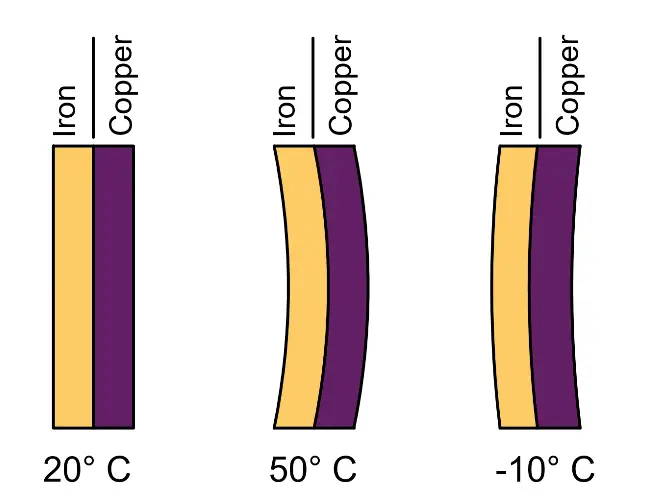
Common Bi-metal thermostat materials for construction are
- Brass-Iron
- Copper-Iron
- Steel-Copper
Thermostat sensors are prepared either by riveting or welding two strips together.
Working Principle of Thermostat
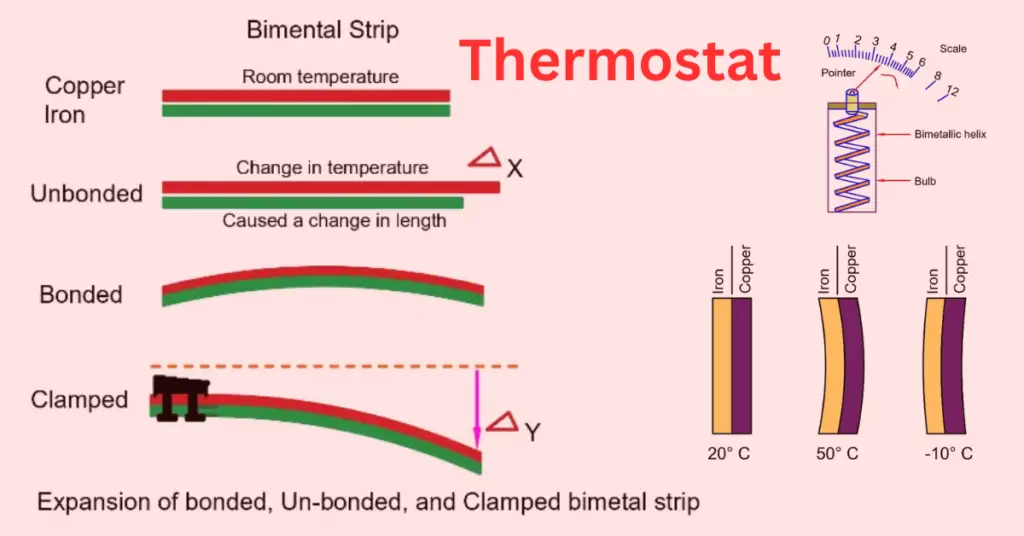
Bi-metallic thermostats are indeed based on the principle of thermal expansion. Two metals with two different coefficients of thermal expansion are bonded together; upon heating, one side expands more than the other, causing the end to deflect. This deflection drives the indicating device connected to its end.
The above principle is explained in the application of bimetallic thermometers below.
The function of the thermostat is to regulate and maintain the temperature of a system connected with it. Its stem adjusts according to temperature requirements. Its operation consists of opening or closing the circuit in a system depending on the temperature we program, so it remains ON only when needed.
If it detects that the room temperature is lower than indicated, it activates the installation circuit, causing a temperature rise to reach it, and if it detects it higher, it closes the circuit to turn OFF the heating. The thermostat working diagram is shown below,
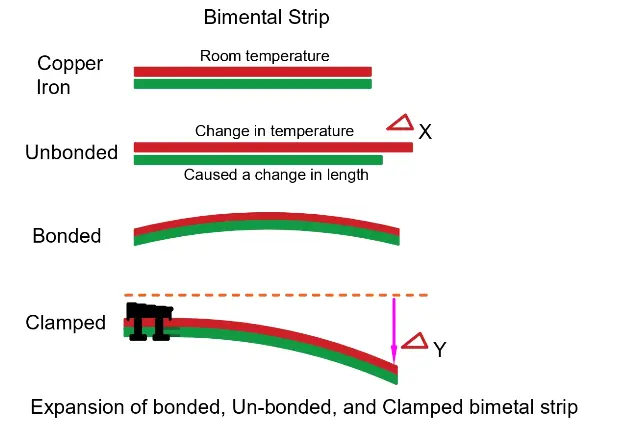
They have been widely used in regulating heating and cooling. During regulation, the application of bimetallic strips should not be ignored. Under operation, one end of the bimetal strips is mechanically fixed and connected to a power source; meanwhile, the other end is equipped with an electrical contact. In an adjustable thermostat, another contact is fixed along with an adjustable knob or lever to control the temperature, which is called a set point.
Depending on the applications, a relatively high temperature will open the contact, for example, controlling a heater. In addition, it will also lead to contact closure, for example, controlling an air conditioner or refrigerator.
Electrical contacts can directly influence power or otherwise indirectly control electricity through natural gas or fuel supply from electric relays or valves.
Summary: How a Bimetallic Thermostat Works
When the System is Cold: The bimetallic strip remains flat and straight. This maintains a solid physical connection between the electrical contacts, keeping the circuit closed and allowing power to flow continuously to the heater.
1. When the System is Cold: The bimetallic strip remains flat and straight. This maintains a solid physical connection between the electrical contacts, keeping the circuit closed and allowing power to flow continuously to the heater.
2. When the System Heats Up: As temperature rises, the metal with the higher thermal expansion coefficient expands more rapidly, forcing the entire bonded strip to warp and bend. Once it deflects past a certain point, it pulls the contacts apart, opening the circuit and automatically cutting power to the heating element.
3. When the System Cools Down: As ambient heat dissipates, the expanded metal contracts back to its baseline state, straightening the strip. The electrical contacts meet once again, closing the circuit to safely restart the heating cycle.
4. The Role of the Setpoint Dial: Adjusting the temperature knob changes the mechanical distance or pressure between the contacts. This determines exactly how much the bimetallic strip must deflect before the circuit breaks, preventing rapid, inefficient cycling.
Types of Thermostats
Understanding the different types of thermostats helps in selecting the right control system for specific HVAC or industrial applications. The most common varieties include:
- Mechanical Thermostats: Traditional, non-electronic controls relying on physical changes to break a circuit.
- Bimetallic Strip Thermostats: Use two bonded metals with different expansion rates.
- Liquid-Filled Thermostats: Rely on the expansion of liquid/vapor inside a sensing bulb.
- Pneumatic Thermostats: Control HVAC systems via air pressure signals in commercial buildings.
- Electronic & Digital Thermostats: Use solid-state components like thermistors to track temperature shifts.
- Programmable Thermostats: Allow users to pre-set schedules based on times of day.
- Smart Thermostats: Offer Wi-Fi connectivity, app controls, and automation features.
- Hybrid Thermostats: Combine mechanical safety limits with electronic digital readouts.
By Electrical Configurations:
- Line Voltage Thermostats: Connect directly to 120V or 240V circuits (common in baseboard heaters).
- Low Voltage Thermostats: Operate safely on 24V transformers typical of standard central heating/cooling systems.
Bimetallic Thermostat
These thermostats utilize a bimetallic strip as their main component. A bimetal strip is a composite material made by bonding two different metals with different coefficients of thermal expansion. The purpose of creating a bimetallic strip is to utilize the different rates at which the two metals expand or contract when exposed to changes in temperature. This results in the strip bending or curving in response to temperature variations.
There are two types of bimetallic thermostats.
- Helical strip bimetal thermometer and the
- Spiral strip bimetal thermometers
Helical Strip Bimetallic Thermostat
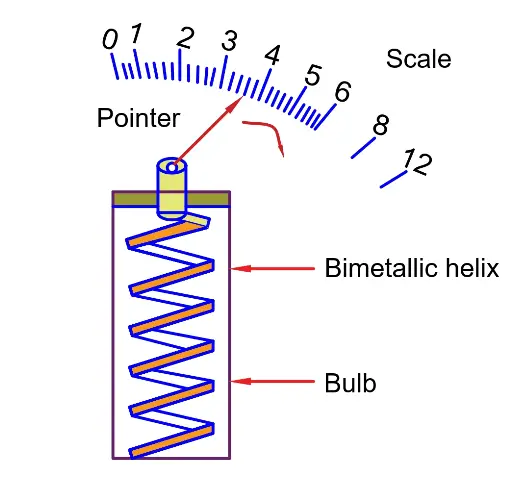
This type of thermometer uses a bimetallic strip shaped like a helix to measure temperature. The pointer is connected to the shaft at the other end of the strip. As shown in the above figure, the strip is wound helically around the seat post.
The temperature changes are sensed by a helical strip when the temperature rises. The metal strips with a higher coefficient of thermal expansion extend and roll along the seat posts, causing the axle to rotate.
This rotation causes the needle to move to its position on the scale, indicating the medium’s temperature. The metal with a lower thermal coefficient of expansion contracts as temperature decreases, and the shaft starts to rotate. The pointer then reads the lowest temperature on the scale.
Uses: They can be placed into thermal wells, which allow them to operate in high temperatures and pressures; they are used mainly for industrial applications.
Spiral Strip Bimetallic Thermostat
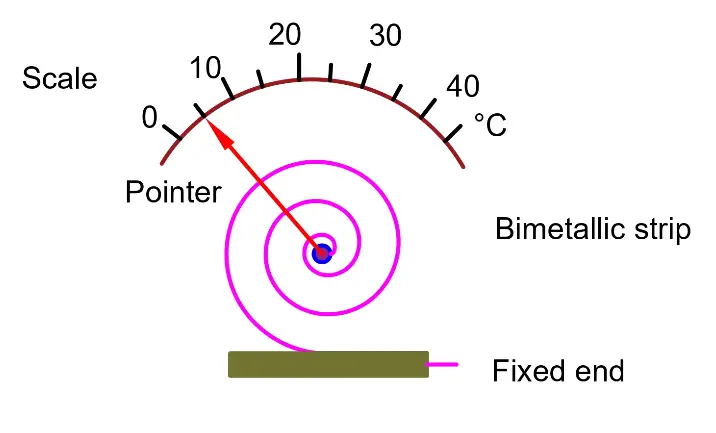
As shown in the above figure, a bimetallic spiral thermometer uses a spiral-shaped strip to measure temperature. The metal strips expand differently as the temperature rises. The expansion thereby creates a bending effect. The bonded strip is wound in such a way that the metal with the highest thermal coefficient of expansion forms the outer side of the arc.
When there is a drop in temperature, the metal with the lower thermal coefficient of expansion in the bonded strip forms the inner layer of the arc. This deformation is read with a needle and clock attached to the hairspring, indicating the medium’s temperature.
Uses: As they are sensitive to lower temperature variations, spiral thermometers are suitable for regulating the room’s temperature or measuring room temperatures.
Selection Criteria for Bimetallic Thermometers
Temperature range: the bimetallic thermometer must be within the upper and lower limit temperatures. Due to extreme temperatures, metals can reach their expansion limits and not recover their initial shape, which can permanently damage the thermometers.
The stem: the length and diameter of the bimetallic thermometer stem should be determined as required by the application. To do this, it may be necessary to determine the immersion length or depth of the tank where the thermometer will be used.
Advantages
- With the help of thermostats, one can reduce energy consumption and enhance energy efficiency.
- Mechanical and bimetallic strip thermometers are durable and provide long-lasting performance.
- Smart thermostats often have automation features.
- Programmable and digital thermometers allow users to set specific temperatures and schedules to suit their preferences.
Disadvantages
- The measurement of temperature is not precise enough.
- Thermostat probes face challenges in accurately measuring temperature in certain environments.
- Factors such as air pollution, dust, and sensor location can affect the readings.
- Regular calibration and maintenance are indeed necessary to ensure accurate performance.
Applications of Thermostat
Thermostats are used in mechanical engineering and other industrial applications for temperature control, for example, to protect a device from overheating, switch off a machine, or connect a fan for cooling.
Used for both residential and commercial purposes. They are commonly used in:
- Air-conditioning
- Control devices
- Heaters
- Ovens
- Refineries
- Oil burners.
Thermostat Heater Control Circuit Configuration
To understand how a thermostat functions as a simple automatic switch within a heating loop, consider the fundamental control circuit layout below:
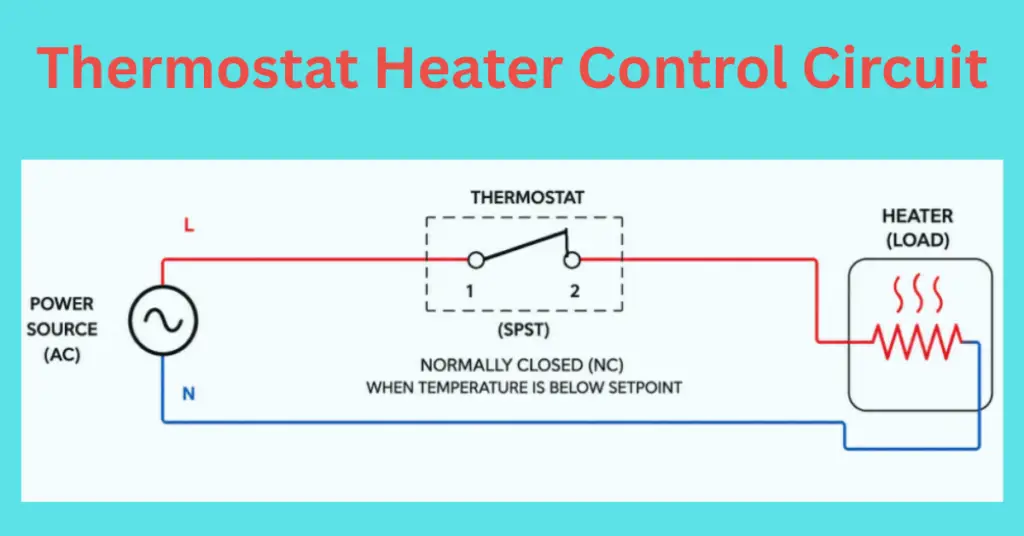
In a basic electromechanical heater control loop, the thermostat is wired directly in series with the power line feeding the heating element. When the ambient temperature falls below the desired setpoint, the internal bimetallic contact reverts to its Normally Closed (NC) state. This completes the circuit, allowing current to flow from the source through to the heater. Once the thermal threshold is met, the bimetal strip deflects, forcing the contacts into an Normally Open (NO) state, breaking the electrical circuit path and cut off the current flow.
Conclusion
Whether utilized in everyday residential HVAC units or complex industrial thermal wells, the thermostat remains an indispensable control element in modern temperature regulation.
From traditional bimetallic mechanical designs—such as helical and spiral configurations—to advanced smart digital systems, selecting the correct type of thermostat depends entirely on your system’s voltage capacity, environment, and accuracy requirements. Proper selection and routine maintenance ensure optimal energy efficiency, robust equipment protection, and stable climate control across all applications.
Frequently Asked Questions (FAQs)
The formal definition of a thermostat is an automatic control device used to regulate the temperature of a system within a defined range. It functions as a feedback mechanism that switches heating or cooling units on or off based on deviations from a desired temperature setpoint.
The literal meaning of thermostat is derived from the combination of two Greek words: thermos, which means “hot” or “heat,” and statos, which translates to “stationary” or “standing still.” Combined, the term signifies a device that keeps temperature stable or stationary within an environment.
In practical terms, the modern thermostat meaning refers to any sensor-driven interface—whether electronic, digital, or mechanical—that prevents appliances like HVAC systems, refrigerators, and ovens from overheating or overcooling, thereby ensuring optimal energy efficiency and temperature safety.
Read Next: