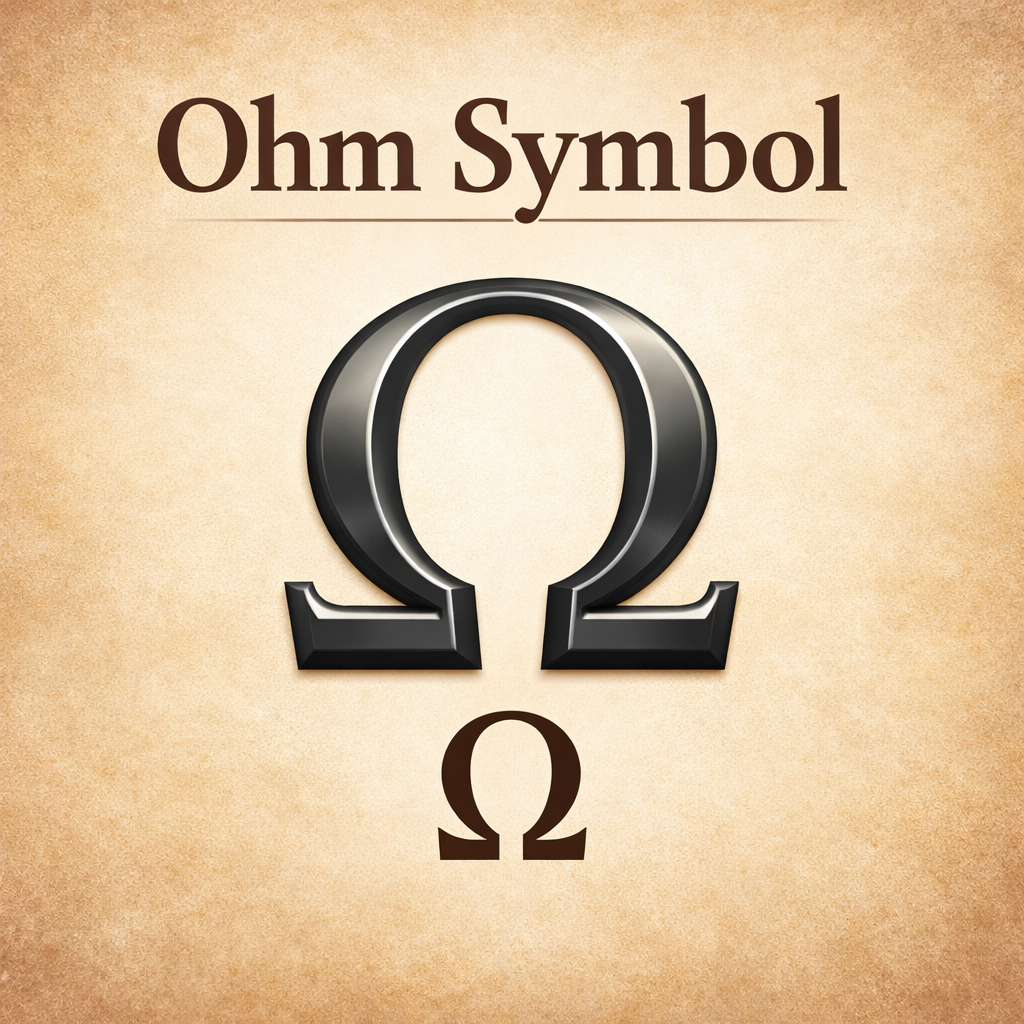
The Ohm symbol (Ω) is one of the most recognizable symbols in physics and electrical engineering. It represents electrical resistance, a fundamental concept that governs how electric current flows through a material. From basic school experiments to advanced electronics and power systems, the Ohm symbol plays a critical role in understanding and designing electrical circuits.
In this article, we’ll explore the meaning of the Ohm symbol, its history, scientific importance, and practical applications, while keeping things clear and beginner-friendly.
What Is the Ohm Symbol (Ω)?
The Ohm symbol, written as Ω, is the SI unit symbol for electrical resistance. Resistance measures how much a material opposes the flow of electric current.
- Symbol: Ω
- Unit name: Ohm
- Quantity measured: Electrical resistance
One ohm is defined as the resistance between two points of a conductor when a voltage of one volt produces a current of one ampere.
Mathematically:
1 Ω = 1 V / 1 A
This definition directly connects resistance to voltage and current, forming the basis of Ohm’s Law.
Origin and History of the Ohm Symbol
The Ohm symbol is named after Georg Simon Ohm, a German physicist who published his groundbreaking work in 1827. Ohm demonstrated the relationship between voltage, current, and resistance—an idea that was initially controversial but later became foundational in electrical science.
The Greek letter Omega (Ω) was chosen as the symbol for resistance because:
- It is the last letter of the Greek alphabet, symbolizing opposition or limit
- It was already widely used in scientific notation
- It helped distinguish resistance from other electrical quantities
In 1881, the ohm was officially adopted as a standard unit by the International Electrical Congress.
Ohm Symbol in Ohm’s Law
The Ohm symbol is most commonly seen in Ohm’s Law, which states:
V = I × R
Where:
- V = Voltage (volts)
- I = Current (amperes)
- R = Resistance (ohms, Ω)
This equation allows engineers and technicians to calculate:
- Required resistance for a circuit
- Current flow under a given voltage
- Voltage drop across components
Without the Ohm symbol and its associated unit, modern electrical calculations would be far less standardized.
Units Related to the Ohm Symbol
In real-world applications, resistance values vary widely. To express these efficiently, engineers use prefixes with the Ohm symbol:
- mΩ (milliohm) = 0.001 Ω
- kΩ (kilo-ohm) = 1,000 Ω
- MΩ (mega-ohm) = 1,000,000 Ω
For example:
- A resistor labeled 10 kΩ has a resistance of 10,000 ohms
- Insulation resistance may be measured in mega-ohms
These variations make the Ohm symbol adaptable across electronics, power systems, and materials science.
Importance of the Ohm Symbol in Electronics
The Ohm symbol is essential in nearly every area of electronics and electrical engineering, including:
1. Circuit Design
Engineers use resistance values (Ω) to control current flow, protect components, and manage power consumption.
2. Component Identification
Resistors are labeled or color-coded to indicate their resistance in ohms, kilo-ohms, or mega-ohms.
3. Troubleshooting and Testing
Multimeters measure resistance in ohms, helping technicians detect:
- Short circuits
- Broken wires
- Faulty components
4. Power and Safety Calculations
Resistance directly affects heat generation and energy efficiency, making the Ohm symbol critical for safety standards.
Ohm Symbol in Physics and Education
In physics classrooms, the Ohm symbol introduces students to:
- Electrical properties of materials
- Conductors vs insulators
- Energy transfer in circuits
It is often one of the first Greek symbols students encounter in science, making it an important gateway to advanced scientific notation.
Why the Ohm Symbol Still Matters Today
Despite advances in technology, the Ohm symbol remains just as relevant today as it was in the 19th century. Whether in renewable energy systems, microelectronics, or electric vehicles, resistance—and the Ω symbol that represents it—continues to shape how electricity is controlled and understood.
It stands as a reminder that even complex technologies rely on simple, well-defined principles.
Conclusion
The Ohm symbol (Ω) is far more than a Greek letter—it is a cornerstone of electrical science. Representing resistance, it connects voltage and current through Ohm’s Law, enabling everything from basic circuits to advanced engineering systems.
Understanding the Ohm symbol means understanding how electricity behaves, making it an essential concept for students, engineers, and anyone curious about how the modern world is powered.
Read Next: