The limitations of Faraday’s Law of electromagnetic induction are important to understand for a complete grasp of electromagnetic theory. Faraday’s Law states that an electromotive force (EMF) is induced in a circuit whenever the magnetic flux linked with it changes.
This principle is fundamental to the operation of electrical machines such as generators and transformers. However, despite its wide applicability, the law has several conceptual and practical limitations that restrict its use in advanced or specialized situations.
Brief Statement of Faraday’s Law
Mathematically, Faraday’s Law is expressed as:
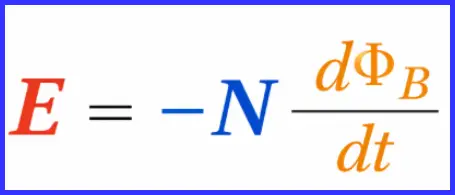
where:
- E is the induced EMF
- N is the number of turns
- ΦB is the magnetic flux
- The negative sign represents Lenz’s Law
While this equation effectively gives the magnitude of induced EMF, it does not provide a complete description of electromagnetic induction in all conditions.
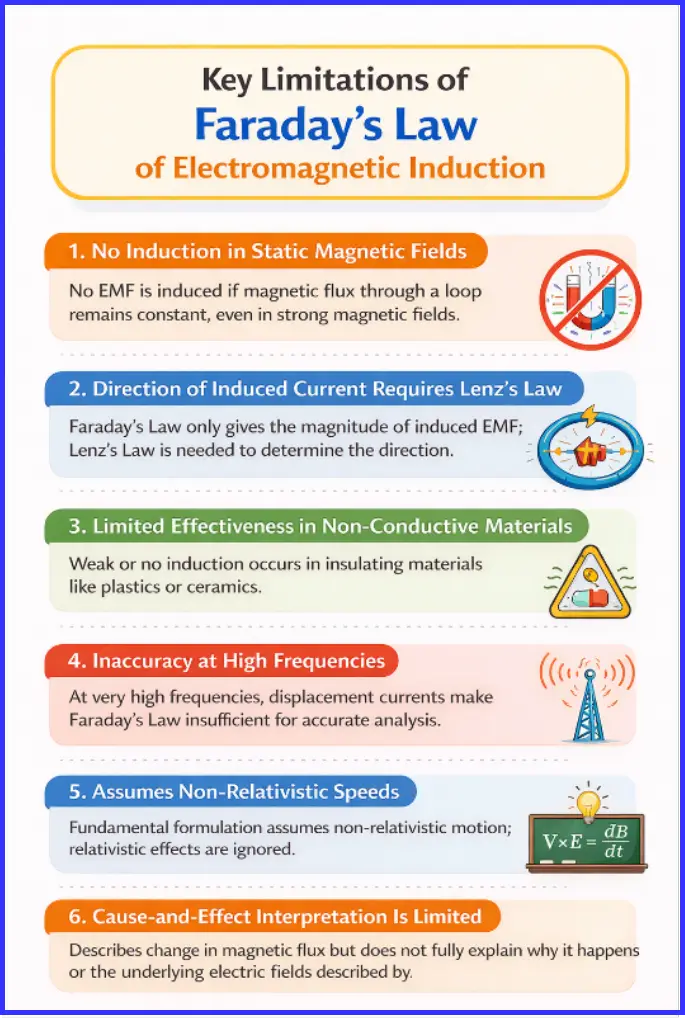
Key Limitations of Faraday’s Law of Electromagnetic Induction
1. No Induction in Static Magnetic Fields
One of the most significant limitations is that Faraday’s Law applies only to changing magnetic flux. If the magnetic flux through a loop remains constant, no EMF is induced, even if a very strong magnetic field is present. For example, a stationary magnet placed near a stationary coil will not induce current, regardless of field strength.
2. Direction of Induced Current Requires Lenz’s Law
Faraday’s Law alone only provides the magnitude of induced EMF. The direction of induced current cannot be determined without using Lenz’s Law, which states that the induced current opposes the change in magnetic flux that produces it. Thus, the law is incomplete without this additional principle.
3. Limited Effectiveness in Non-Conductive Materials
Faraday’s Law works best with good electrical conductors. In non-conductive or insulating materials such as certain plastics or ceramics, induction effects are weak or nonexistent. This limitation reduces its effectiveness in applications like induction heating when non-conductive materials are involved.
4. Inaccuracy at High Frequencies (Displacement Currents)
At very high frequencies, Faraday’s Law in its basic form becomes insufficient.
In such cases, displacement currents become significant, and Maxwell’s equations are required for accurate analysis. This is especially important in high-frequency transformers, antennas, and electromagnetic wave propagation.
5. Assumes Non-Relativistic Speeds
The fundamental formulation of Faraday’s Law assumes non-relativistic motion.
At speeds approaching the speed of light, relativistic effects become important, and the classical form of the law does not fully apply. While this is not a concern in everyday applications, it limits the law’s scope in advanced physics.
6. Cause-and-Effect Interpretation Is Limited
Faraday’s Law describes what happens when magnetic flux changes, but not fully why it happens. Some theoretical interpretations suggest that the induced EMF is better explained by the non-conservative electric field described in the Maxwell–Faraday equation, rather than a direct cause-and-effect relationship implied by changing flux alone.
Practical Significance Despite the Limitations
Despite these limitations, Faraday’s Law remains extremely useful. Its core principle—that a changing magnetic flux induces EMF—holds true for many practical devices, including:
- Electric generators
- Transformers
- Induction motors
For most engineering and everyday applications, the law provides sufficiently accurate results when combined with Lenz’s Law and circuit theory.
Conclusion
In conclusion, the limitations of Faraday’s Law of electromagnetic induction highlight that while it is a foundational and powerful principle, it is not universally complete.
It applies only to changing magnetic flux, requires Lenz’s Law to determine direction, struggles with non-conductive materials, and becomes insufficient at high frequencies or relativistic speeds. Nevertheless, when used within its valid range, Faraday’s Law continues to play a vital role in understanding and designing electromagnetic systems.
Read Next:
- Coulomb’s Law – Statement, Formula, Limitations & Applications Explained
- Faraday’s Laws of Electromagnetic Induction- Definition, Formula & Derivation
- Biot Savart Law: Statement, Derivation, Importance & Applications
- Lenz’s Law of Electromagnetic Induction: Definition & Formula
- Faraday’s Laws of Electrolysis – First and Second Laws