- Faraday’s Law Definition: Faraday’s Law of Electromagnetic Induction states that an electromotive force (EMF) is generated in an electric circuit whenever the magnetic field associated with it changes over time.
- First Law of Electromagnetic Induction: Faraday’s first law explains that any variation in the magnetic environment of a coil induces an EMF, and if the circuit is closed, an electric current is produced.
- Second Law of Electromagnetic Induction: The second law states that the magnitude of the induced EMF is directly proportional to the rate of change of magnetic flux linkage through the coil.
- Ways to Increase Induced EMF: The induced EMF can be increased by increasing the number of turns in the coil, strengthening the magnetic field, or increasing the relative speed between the coil and the magnet.
- Applications and Significance: Faraday’s Law forms the foundation of technologies such as generators, transformers, and even musical instruments, highlighting its wide-ranging influence in science and everyday applications.
Faraday’s Laws of Electromagnetic Induction explain how a changing magnetic field induces an electromotive force (EMF) in a conductor. The first law states that EMF is produced whenever magnetic flux linked with a conductor changes, while the second law states that the magnitude of the induced EMF is proportional to the rate of change of magnetic flux.
Faraday’s law of electromagnetic induction shows the relationship between magnetic field, electric current, and an electromotive force(EMF).
In the natural world, electricity and magnetism exist as two closely interconnected phenomena that rely on each other. Electromagnetism is the field of physics that explores the interaction between electric and magnetic forces and explains how they influence one another.
Today, it is widely understood that a varying magnetic field can induce an electromotive force (EMF), while moving electric charges or flowing current can generate a magnetic field. These fundamental principles were established through numerous experiments conducted by physicists and engineers over time.
Among the scientists Michael Faraday is one who developed two basic laws of electromagnetic induction in 1831. These laws are popularly known as Faraday’s First and Second Law of Electromagnetic Induction. These two laws explain how a changing magnetic field produces an EMF in a moving conductor.
What is Electromagnetic Induction?
When there is a change in the magnetic field linked to a conductor, an electromotive force (EMF) is induced in the conductor, this phenomenon is known as electromagnetic induction. Electromagnetic induction is the most fundamental principle on which today’s many electrical devices such as motors, generators, measuring instruments, etc. work.
Faraday’s Law of Electromagnetic Induction
Two physicists Michael Faraday and Joseph Henry performed a long series of experiments. From the observations of these experiments, Faraday described that when a changing magnetic field links to a conductor, an emf is induced in the conductor.
Michael Faraday formulated two fundamental principles that form the foundation of modern electromagnetism. These principles are outlined as follows:
- Faraday’s First Law of Electromagnetic Induction
- Faraday’s Second Law of Electromagnetic Induction
Faraday’s first law of electromagnetic induction describes the induction of electromotive force in a conductor, while Faraday’s second law explains the magnitude of the electromotive force induced in the conductor. Let’s discuss these in detail.
Faraday’s First Law of Electromagnetic Induction
Faraday’s first law of electromagnetic induction states that “Whenever a magnetic field linked to a conductor changes, an electromotive force (emf) is induced in the conductor.”
If the conductor circuit is closed, a current, called induced current, starts flowing through the conductor.
The change in the magnetic field linked to the conductor can be brought in two ways as follows:
- By moving the conductor relative to the stationary magnetic field.
- By moving the magnetic field while the conductor is held stationary.
Faraday’s Second Law of Electromagnetic Induction
Faraday’s second law states that “the magnitude of the induced emf in the conductor is equal to the rate of change of magnetic flux linked to the conductor.”
Faraday’s Induction Law Formula: EMF Expression
The electromotive force (EMF) generated in a coil when the magnetic flux through it varies with time is expressed as:
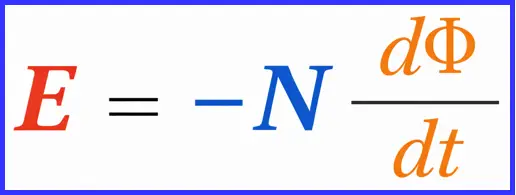
Where:
- E represents the induced electromotive force
- N is the total number of turns in the coil
- Φ denotes the magnetic flux, measured in webers
- dΦ/dt is the time rate of change of magnetic flux
The negative sign reflects Lenz’s Law, which states that the induced EMF acts in a direction that opposes the change in magnetic flux producing it. This equation highlights that the strength of the induced EMF is directly dependent on how quickly the magnetic flux changes through the coil.
Derivation of Faraday’s Induction Law Formula
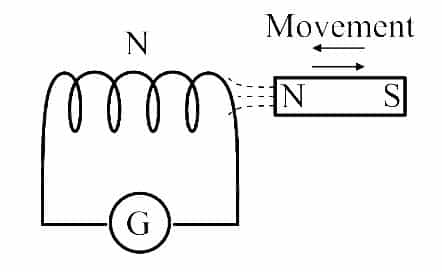
Consider a coil having N conductors and a magnetic is moving towards the coil, then
At the initial position, the flux linkage with the coil is
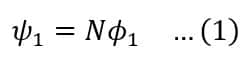
At the final condition, the flux linkage with the coil is
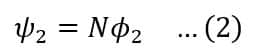
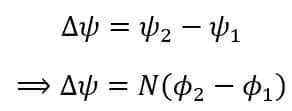
Now, the rate of change of this flux linkage is
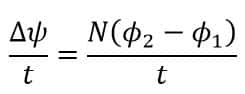
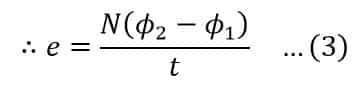
According to Faraday’s second law of electromagnetic induction, the EMF induced in the conductor is equal to the rate of change of flux linkage.
In differential form,
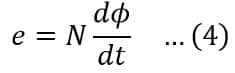
Where, 𝜙 =𝜙2-𝜙1, the total change in magnetic flux.
Taking Lenz’s Law into account, the induced EMF is always directed so as to oppose the change in magnetic flux responsible for its production. This opposing effect is represented by the negative sign in Faraday’s equation.
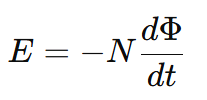
Faraday’s law of electromagnetic induction demonstrates that the induced EMF is directly proportional to both the number of turns in the coil and the rate at which the magnetic flux changes.
Summary Table: Faraday’s First Law Vs Second Law
| Aspect | Faraday’s First Law | Faraday’s Second Law |
| Focus | Existence of induced EMF | Magnitude of induced EMF |
| Nature | Qualitative | Quantitative |
| Formula | No mathematical expression | E = −N(dΦ/dt) |
How to Increase the EMF Induced in a Coil
The magnitude of electromotive force (EMF) induced in a coil can be increased using the following methods:
- Increase the Number of Turns in the Coil
The induced EMF is directly proportional to the number of turns in the coil. By adding more loops or windings, the total magnetic flux linkage increases, which results in a higher induced EMF. - Strengthen the Magnetic Field
Enhancing the magnetic field intensity around the coil increases the magnetic flux passing through it. A stronger magnetic field allows the coil to interact with more magnetic field lines, leading to a greater induced EMF. - Increase the Speed of Relative Motion
When the relative motion between the magnet and the coil is faster, the rate of change of magnetic flux also increases. As a result, the coil cuts magnetic field lines more rapidly and produce a larger induced EMF.
Faraday’s Induction Law Experiment
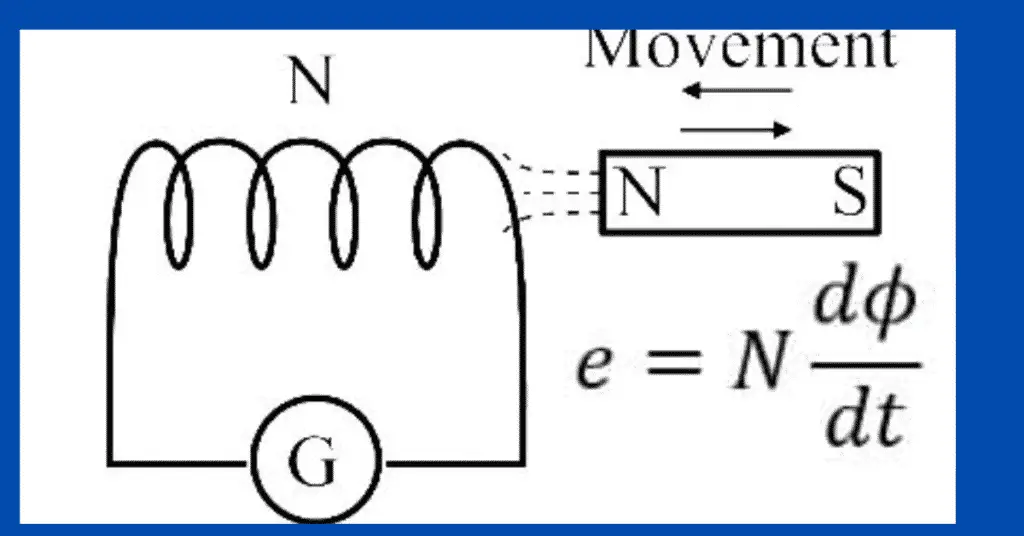
In this experiment, Faraday connected a coil to a galvanometer and placed a magnet nearby. When the magnet remains stationary, the galvanometer shows no deflection, indicating zero current in the circuit. However, as the magnet is moved closer to the coil, the galvanometer needle deflects in a particular direction, showing that an electric current has been induced.
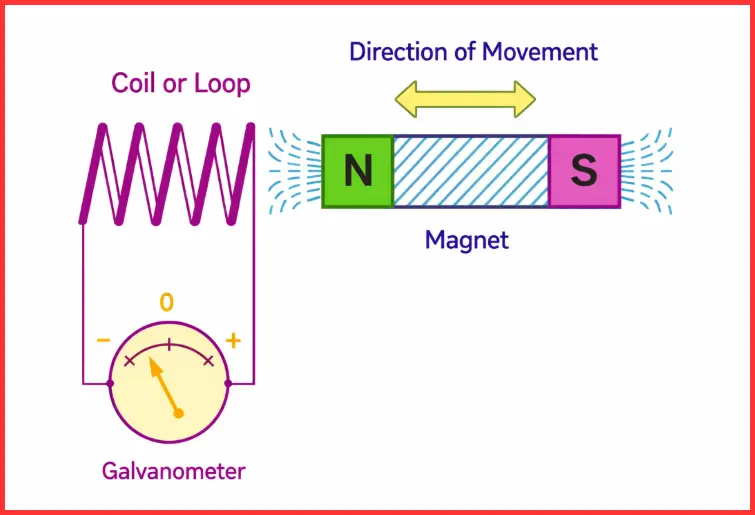
When the magnet is kept still, the galvanometer needle settles back at the zero position. As the magnet is moved away from the coil, the needle deflects in the opposite direction and returns to zero once the motion stops. A similar effect is observed when the magnet remains fixed and the coil is moved toward or away from it—the galvanometer again shows a deflection. These observations confirm that a faster change in the magnetic field produces a larger induced EMF or voltage in the coil.
| Magnet’s Position or Motion | Observation in the Galvanometer |
| Magnet remains stationary | The galvanometer shows no deflection |
| Magnet is moved toward the coil | The needle deflects in one direction |
| Magnet is kept still near the coil | No deflection is observed |
| Magnet is moved away from the coil | The needle deflects in the opposite direction |
| Magnet is held stationary away from the coil | The galvanometer returns to zero with no deflection |
Definition of Lenz’s Law
Lenz’s Law, proposed in 1834 by the German physicist Emil Lenz, explains the direction of induced current in an electrical circuit. Faraday’s Law and Lenz’s Law are closely connected and together provide a complete understanding of electromagnetic induction.
Faraday’s Law explains how much electromotive force (EMF) is induced in a conductor when the magnetic flux linked with it changes, while Lenz’s Law explains the direction in which the induced EMF and current flow.
According to Faraday’s Second Law of Electromagnetic Induction, the induced electromotive force is given by:
E = −N(dΦ/dt)
The negative sign in this equation signifies that the induced emf acts in a direction that counteracts the change in magnetic flux, which is consistent with the principle described by Lenz’s Law
Applications of Faraday’s Laws of Electromagnetic Induction
Faraday’s laws are the most fundamental law in electromagnetism. These laws are widely used in many areas of electrical engineering like electrical machines, measuring instruments, in medicine for diagnosis of disease, etc. Some common applications of Faraday’s laws are:
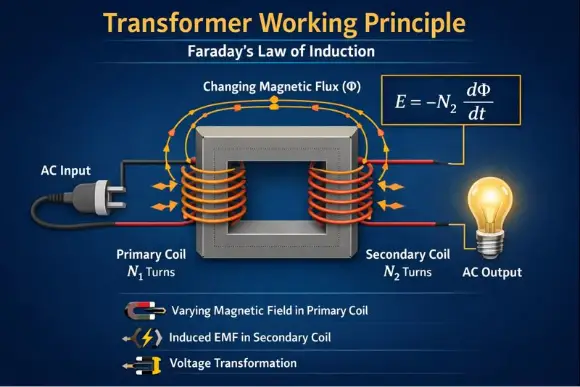
- The transformer operates on the principle of electromagnetic induction. Therefore, Faraday’s law can be for its analysis.
- The production of electricity by a generator is also based on Faraday’s laws of electromagnetic induction.
- Faraday’s laws are also the basis of the operation of many other appliances such as electric guitars, electric violins, etc.
- Induction cooktops work on the principle of mutual induction to heat food quickly and efficiently. An alternating current flows through a copper coil located beneath the cooking surface, creating a changing magnetic field that induces electric currents in the conductive cookware, producing heat directly within the container.
- Maxwell’s equations are founded on the inverse principle of Faraday’s laws, which states that a varying magnetic field induces a corresponding change in the electric field.
- An electromagnetic flow meter is a device used to determine the velocity of specific types of fluids. When a magnetic field is applied across an electrically insulated pipe carrying a conducting fluid, Faraday’s law of electromagnetic induction causes an electromotive force (EMF) to be generated, which is then used to measure the flow rate.
Solved Problems on Faraday’s Laws of Electromagnetic Induction
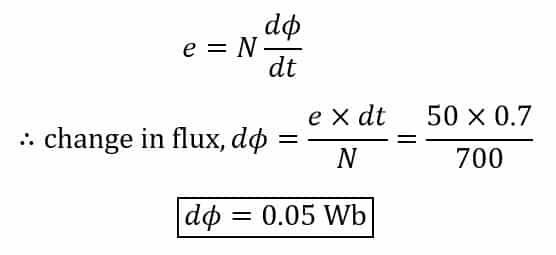
Problem1: A coil that has 700 turns develops an average induced voltage of 50 V. What must be the change in the magnetic flux occur to produce such a voltage if the time interval for this change is 0.7 seconds.
Given Data:
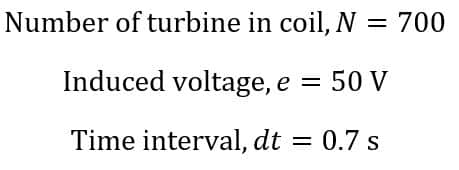
Now, by Faraday’s law, we get,
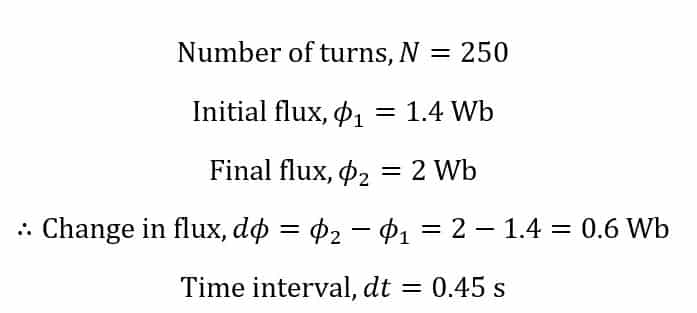
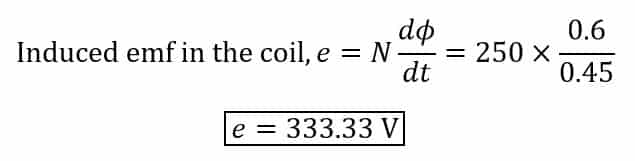
Problem 2: The magnetic flux linked with a coil having 250 turns is changed from 1.4 Wb to 2 Wb in 0.45 seconds. Calculate the induced emf in the coil.
Given data,
Now, according to Faraday’s law, we have,
Conclusion
After completing a series of experiments, Faraday concluded that whenever there is relative motion between a conductor and a magnetic field, the magnetic flux linked with the coil changes. This variation in flux results in the generation of a voltage across the coil.
In simple terms, Faraday’s induction law states that a time-varying magnetic field or magnetic flux induces an electromotive force (EMF). Based on these experimental findings, Michael Faraday went on to establish two fundamental laws of electromagnetic induction.
Frequently Asked Questions (FAQs)
Faraday’s First Law of Electromagnetic Induction explains that an electromotive force (EMF) is generated in a conductor whenever it experiences a changing magnetic field. If the conductor forms a complete circuit, this induced EMF causes an electric current to flow, known as induced current.
Faraday’s Second Law states that the magnitude of the induced electromotive force in a coil is directly proportional to the rate at which the magnetic flux linked with the coil changes. Faster changes in magnetic flux result in a stronger induced EMF.
Faraday’s laws are fundamental to understanding how electrical energy is generated from magnetic fields. They form the scientific basis for devices such as electric generators, transformers, and induction motors used in modern power systems.
The negative sign in Faraday’s law represents Lenz’s Law, which shows that the direction of the induced EMF opposes the change in magnetic flux that produces it. This opposition helps conserve energy within the system.
Electromotive force (EMF) refers to the energy supplied per unit electric charge to drive current through an electrical circuit. It is measured in volts and acts as the driving force behind electric current flow.
Related Articles:
- Why Motor rated in KW instead of KVA?
- Magnetic Flow Meter- Its Working, Uses
- Ohm’s Law-Satatement, Formula, Solved Examples
- Induced EMF- Its Definition & Types
- Limitations of Ohm’s Law
- Faraday’s Law of electrolysis
- Coulomb’s Law – Statement, Formula, Limitations & Applications Explained
- Limitations of Faraday’s Law of Electromagnetic Induction