- Definition of Electrical Measuring Instruments: Devices used to measure, indicate, record, or control electrical quantities such as voltage, current, power, and energy.
- Types of Instruments: Electrical instruments are either absolute instruments, providing readings based on physical constants, or secondary instruments, calibrated using absolute standards for practical use.
- Deflection Type Instruments: These instruments measure electrical quantities by the pointer’s deflection, which moves proportionally to the measured value.
- Null Type Instruments: Null or zero-type instruments determine quantities by balancing an unknown value against a known standard, keeping the pointer stationary for precise measurement.
- Static Characteristics: Important characteristics include accuracy, sensitivity, and reproducibility, defining how closely readings match the true value and how reliably measurements can be repeated.
Electrical Measuring Instruments are devices used to measure electrical quantities such as voltage, current, power, resistance, frequency, and energy. In electrical engineering, the measuring instruments play a vital role in testing, monitoring, and controlling electrical systems across industries, laboratories, and power networks.
Understanding electrical instruments and measurements helps engineers ensure system reliability, efficiency, and safety. Measuring instruments can be broadly classified into three main categories: electrical measuring instruments, mechanical measuring instruments, and electronic measuring instruments. Among these, our primary focus is on electrical measuring instruments, which are extensively used in electrical and electronics engineering for analyzing system performance.
This article provides a complete guide to the types of electrical measuring instruments and applications, covering absolute, secondary, deflection type, and null type instruments used in electrical engineering, along with their functions, characteristics, and a detailed electrical measuring instruments list.
What Are Electrical Measuring Instruments?
Electrical measuring instruments are devices designed to determine the magnitude of electrical quantities by comparing them with a known standard. In electrical systems, accurate measurement is critical for equipment protection, system analysis, and performance optimization.
Measurement is the process of determining the value of a physical quantity.
Measuring instruments are tools that indicate, record, or control these quantities.
An ideal meaasuring instrument should be:
- Accurate and precise
- Easy to use
- Reliable and stable
- Suitable for the required operating range
Types of Electrical Measuring Instrument
Based on operation and application, measuring instruments types are classified as:
- Absolute and Secondary instruments
- Deflection type and Null type instruments
- Indicating, Recording, and Controlling instruments
- Analog and Digital instruments
This classification simplifies instrument selection for specific electrical measurements.
1. Absolute Measuring Instruments
Absolute measuring instruments determine the value of an electrical quantity by directly relating it to the physical constants and dimensions of the instrument. These instruments do not rely on prior calibration and are mainly used for standard and laboratory measurements.
Common examples of absolute measuring instruments include Rayleigh’s current balance and the tangent galvanometer.
2. Secondary Measuring Instruments
Secondary measuring instruments give direct readings of electrical quantities and require calibration before use to ensure accuracy. Owing to their simple operation, quick response, and practical design, these instruments are widely used in day-to-day electrical measurements. Common examples include the ammeter, voltmeter, and wattmeter.
3. Deflection Type Instruments
Deflection type instruments operate by measuring electrical quantities through the angular movement of a pointer. The magnitude of the measured quantity is determined by the amount of deflection from the pointer’s zero position. A common example is the permanent magnet moving coil (PMMC) ammeter.
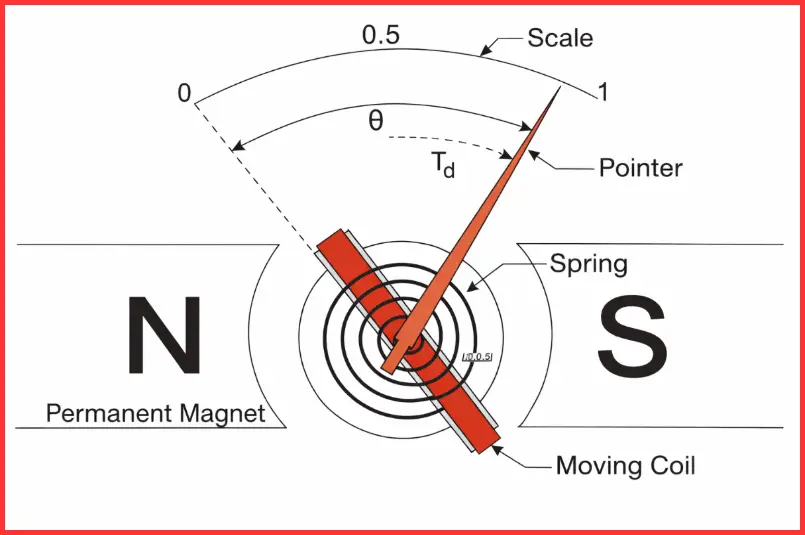
In this type of instrument, two permanent magnets form the stationary magnetic field, while a movable coil carrying a pointer is placed between them. When current flows through the coil, it interacts with the magnetic field and produces a deflecting torque. The deflection of the coil is directly proportional to the current flowing through it, which can be expressed as:
Td = K × I
where Td represents the deflecting torque, I is the current, and K is a proportionality constant that depends on the magnetic field strength and the number of turns in the coil.
The pointer movement is controlled by the opposing forces of the control spring and the magnetic field. It settles at a position where these forces balance each other. The value of the current is then indicated by the angle of deflection (θ) in relation to the constant K.
4. Null Type Instruments
Unlike deflection type instruments, null or zero type electrical measuring instruments function by maintaining the pointer at a fixed or zero position. These instruments measure electrical quantities by balancing an unknown value against a known standard. When the opposing effects are equal, equilibrium is achieved and the pointer remains stationary, indicating a null condition.
For accurate operation, the magnitude of the opposing effect must be precisely known so that the unknown quantity can be calculated. A highly sensitive detector is essential to clearly indicate both balanced and unbalanced states, and it must include a restoring mechanism to re-establish balance if the system is disturbed.
Null type instruments have very high accuracy and negligible power consumption. However, they are generally time-consuming to operate and involve more complex measurement procedures. Common examples of null type instruments include the potentiometer and the Wheatstone bridge.
The advantages and limitations of deflection type and null type measuring instruments are as follows:
- Deflection type instruments are generally less accurate than null type instruments because their accuracy depends on the instrument constant, which may not be precisely calibrated.
- Null type instruments provide higher accuracy since the opposing effect used for measurement can be calibrated with a high degree of precision.
- Null type instruments are more sensitive and can detect very small changes in electrical quantities compared to deflection type instruments.
- Deflection type instruments are better suited for dynamic or rapidly changing conditions due to their faster response.
- Null type instruments have a slower response because the measurement process involves balancing, making them less suitable for dynamic measurements.
Functions of Electrical Measuring Instruments
Electrical measuring instruments perform three essential functions,
Indicating Instruments
These instruments display information about the variable being measured, usually through the deflection of a pointer on a calibrated scale. This type of operation is referred to as the indicating function of measuring instruments.
Recording Instruments
These instruments typically use paper or chart mechanisms to continuously document the measured values over time. This operation is referred to as the recording function of the measuring instruments.
Controlling Instruments
This function is extensively used in industrial applications, where the instruments not only monitor but also control electrical processes to ensure safe and efficient operation.
Electrical measuring instruments and measurement systems are primarily characterized by two key types of characteristics, which are explained below:
Static Characteristics of Measuring Instruments
Static characteristics describe the performance of electrical measuring instruments under steady or slowly varying conditions. These characteristics determine how accurately and reliably an instrument can measure a quantity when it is not changing rapidly. The main static characteristics are explained below:
1. Accuracy:
Accuracy indicates how close the instrument’s reading is to the true value of the measured quantity. It can be expressed as:
- Point accuracy – accuracy at a specific point on the scale.
- Percentage of full-scale range – accuracy relative to the instrument’s total scale.
- Percentage of true value – accuracy relative to the actual quantity being measured.
2. Precision:
Precision refers to the instrument’s ability to produce consistent readings when the same quantity is measured repeatedly. High precision means measurements are tightly clustered, even if they are not exactly equal to the true value.
3. Sensitivity:
Sensitivity is the ratio of the change in the output to the change in the input. A highly sensitive instrument can detect even small variations in the measured quantity.
4. Resolution:
Resolution is the smallest change in the input quantity that can be detected by the instrument. Instruments with higher resolution provide finer measurement details.
5. Linearity:
Linearity indicates how closely the output of the instrument follows a straight line with respect to the input across the measurement range. Deviations from linearity can cause measurement errors.
6. Repeatability:
Repeatability is the ability of an instrument to produce the same reading when measuring the same quantity under identical conditions. High repeatability ensures reliability of the instrument.
7. Hysteresis:
Hysteresis refers to the difference in readings when the input quantity is approached from increasing versus decreasing values. Low hysteresis is desirable for accurate measurements.
Dynamic Characteristics of Measuring Instruments
Dynamic characteristics describe the behavior of electrical measuring instruments when measuring quantities that change rapidly with time. These characteristics are crucial for applications involving transients, oscillations, or time-varying signals, such as in power systems and electronic circuits. The key dynamic characteristics are explained below:
1. Speed of Response:
Speed of response refers to how quickly an instrument reacts to a change in the input quantity. Instruments with a fast response can accurately track rapidly changing signals, while slower instruments may lag behind the actual changes.
2. Fidelity:
Fidelity measures how accurately the instrument reproduces the waveform or variation of the input signal. High fidelity ensures that the output closely matches the input without distortion.
3. Lag:
Lag is the time delay between the actual change in the input quantity and the corresponding response of the instrument. Minimizing lag is important for accurate monitoring of dynamic systems.
4. Damping:
Damping is the ability of an instrument to prevent excessive oscillations of the pointer or output. Proper damping ensures that the instrument reaches a stable reading quickly without overshooting or oscillating.
Electrical Measuring Instrument List
Below is a commonly used electrical measuring instruments list:
- Ammeter
- Voltmeter
- Wattmeter
- Energy Meter
- Power Factor Meter
- Frequency Meter
- Galvanometer
- Oscilloscope
- Multimeter
- Megger
- Clamp Meter
Applications of Electrical Measuring Instruments
- Power generation and transmission
- Electrical machine testing
- Industrial automation
- Research laboratories
- Fault detection and maintenance
Conclusion
Electrical Measuring Instruments are the foundation of measuring instruments electrical engineering, enabling accurate analysis, monitoring, and control of electrical systems. A clear understanding of measurement and measuring instruments, their types, characteristics, and applications is essential for students and professionals alike. Proper use of electrical instruments and measurements improves system performance, reliability, and safety.
Read Next: