Cv and Kv relationship are very important for valve sizing and fluid flow rate. The flow coefficient Cv is the valve flow coefficient. Flow coefficient Cv and its metric unit Kv are useful for measuring the valve capacity.
In other words, Cv and Kv are useful parameters for calculating the size of the valve and fluid flow rate. The other names of the flow coefficient are the valve capacity constant or valve flow coefficient.
In practice, the flow coefficient (Cv) or flow factor (Kv) is the capacity index of a valve. By using it, the design engineer can determine the control valve size for any fluid system. As we all know, improper valve sizing may lead to cavitation within the valve.
To quickly convert between imperial and metric flow coefficients, use these relationships:
- Cv to Kv Conversion: multiply Cv by 0.865 (Kv = Cv x 0.865)
- Kv to Cv Conversion: multiply Kv by 1.156 (Cv = Kv x 1.156)
- Primary Relationship: 1.0 Cv is approximately equal to 0.865 Kv
Definition of Cv
The fluid flow passing through the control valve depends on the temperature of the fluid and the pressure drop across the valve.
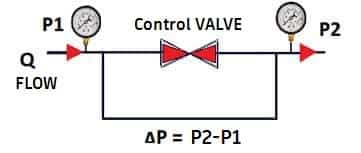
The valve coefficient(Cv in imperial unit) is the number of US gallons (3,785 liters) of water at 60 degrees F that passes through the valve, causing a pressure drop across the valve of 1 PSI.
Pressure drop consideration is most important while designing the system. This is because the velocity varies with pressure drop caused by valve structure. Considering all these factors, we evaluate the valve coefficients and performance of the control valve.
Formula of Valve Flow Coefficient(Cv)
The flow coefficient Cv is calculated using the following formula:
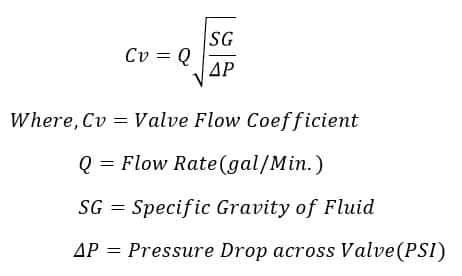
As shown in the image above, the flow coefficient Cv is calculated as the product of the flow rate in gpm multiplied by the square root of the fluid’s Specific Gravity (SG) divided by the pressure drop in psi. For precise sizing of non-water fluids, the SG must be adjusted from 1.0.
Definition of Kv
Kv is the flow of water expressed in m3/hr. At 15 degrees C, passing at a pressure difference of 1 bar. The flow factor Kv is the most critical parameter. It characterizes the flow through a valve.
Sometimes, we use the Kv coefficient in place of Cv. There is a certain relationship between Cv and Kv. The flow factor Kv is the metric system equivalent of the flow coefficient Cv.
Formula of Valve flow coefficient(Kv)
The flow coefficient Kv is calculated using the following formula:
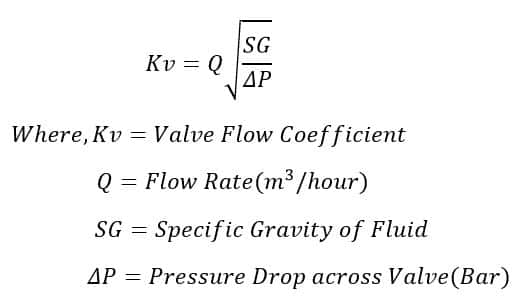
The metric equivalent is shown in the diagram above. The Kv is determined by multiplying the flow in cubic meters per hour by the square root of the Specific Gravity (SG) divided by the pressure drop in bar.
Comparison Table: Cv vs Kv
To help you choose the right coefficient for your system, use this comparison table:
| Feature | Cv (Imperial) | Kv (Metric) |
| Flow Unit | US Gallons per minute (gpm) | Cubic meters per hour (m³/h) |
| Fluid Temp | 60°F | 15°C |
| Pressure Drop | 1 psi | 1 bar |
Unit Conversion- Cv to Kv
It is easy to convert Kv into a Cv unit and vice-versa. First, we convert Cv into Kv.
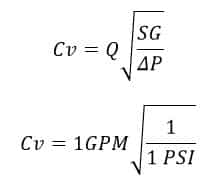
1 US gal/min = 0.227125 m3/h
0.06894757 bar= 1 PSI and 1 bar = 14.503773773 psi
1 psi = 0.06894757 bar and 1 bar = 14.503773773 psi
60 deg F = 15.5 deg C
The conversion of the Cv unit to Kv is given below,
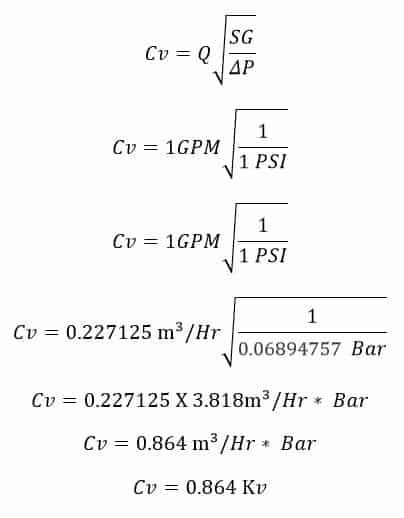
To convert Cv to Kv, multiply the Cv value by 0.865:
Calculation Example: Converting Cv to Kv
If a control valve has a Cv rating of 10, what is its equivalent Kv?
Kv = 10 X 0.865 = 8.65 m3/h
This means the valve can move 8.65 cubic meters of water per hour with a 1 bar pressure drop.
Unit Conversion- Kv to Cv
To convert Kv to Cv, multiply the Kv value by 1.156:
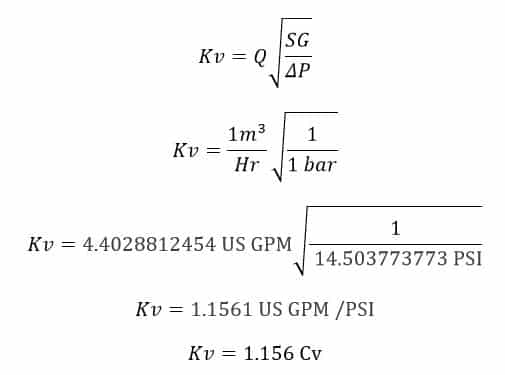
Relationship between Cv and Kv
The mathematical relationship between the imperial and metric units is:
- Cv = 1.156 Kv
- Kv = 0.865 Cv
Note: Cv is always a larger numerical value than Kvfor the same valve.
Importance of Cv and Kv
- Valve coefficient Cv and Kv is useful for determining the flow capacity of a valve.
- It is easy to compare the different valve capacities by the flow coefficient of the valves.
- We can easily determine the pressure drop across the valve after knowing the flow coefficient of the valve.
- It helps in the selection of valves.
Improper Calculation of Cv
If the Cv is not calculated correctly for a valve, the valve usually experiences poor performance in one of two ways.
The first one is – if the Cv is too small for the required process,
- The control valve will be undersized.
- The process operation can be starved for fluid.
- Undersized Cv is creating a higher pressure drop across the valve. It leads to cavitation or flashing.
The second one is – if the Cv calculated is too high for the system requirements,
- A larger-sized, oversized valve is usually selected. Significant throttling problems can occur. Very clearly, the cost, size, and weight of a larger valve size are major disadvantages.
- In the case of high Cv, the closure element, such as a disk or a plug, is located just off the seat. It leads to the possibility of creating a high-pressure drop and faster velocities. Thereby causing cavitation and erosion of the trim parts. This often leads to “hunting,” where the valve cannot maintain a steady position, leading to oscillations in the process loop.
Advantages of knowing Cv:
By understanding and knowing the flow coefficient,
- We can quickly compare different bands of valves and their flow capacities.
- Helpful in the selection of the right-sized valve.
Read Next: