- BDV Full Form: BDV stands for Breakdown Voltage, the maximum voltage transformer oil can withstand without breakdown. Knowing the BDV test full form is essential for engineers to correctly identify the test on maintenance report
- Importance of BDV Testing: Regular BDV tests ensure transformer reliability, detect moisture or contamination, and prevent insulation failure or equipment fires.
- Minimum BDV Value: According to IEC standards, transformer oil must have a minimum BDV of 30 kV.However, for utility-grade or EHV transformers, reliability targets are often set between 40 kV and 60 kV depending on the voltage class.
- Transformer Oil BDV Value: A BDV above 30 kV indicates good insulating strength; new oil usually shows BDV above 70 kV, while lower values suggest contamination, aging, or moisture.
- BDV Test Procedure: Critical steps include electrode gap verification using a 2.5 mm gauge and ensuring the oil has cooled to 27°C to avoid false high readings
- Factors Affecting BDV: Moisture, aging by-products, particles, and pressure can significantly impact the BDV value of transformer oil.
- BDV Testing Standards: Common standards include IEC 60156, ASTM D877/D1816, and IS 6792.
Regular BDV testing of transformer oil is essential for predicting transformer life, preventing insulation failure, and maintaining reliability. This test is relevant for transformers of all voltage ratings, including 11 kV, 33 kV, and 132 kV, as the minimum required BDV remains consistent to ensure dielectric integrity.
By understanding the BDV value of transformer oil and using standard testing procedures, maintenance teams can ensure operational safety and prevent costly failures.
What is BDV of Transformer Oil?
The BDV full form in electrical engineering is Breakdown Voltage. The BDV or dielectric strength of oil is the maximum voltage the oil can withstand without an electrical breakdown. BDV test of transformer oil is very important for the trouble-free operation of the transformer. Therefore, periodic testing of the transformer oil BDV is compulsory to ensure its health.
As per the IEC 60156 standard, the minimum BDV of transformer oil should be 30 kV when using a standard 2.5 mm electrode gap.

Importance of Transformer Oil BDV Test
The transformer oil is used in the transformer for insulation and cooling purposes. The different insulating materials have different dielectric strengths. The insulating material should sustain the voltage up to its dielectric strength. If the breakdown voltage drops below standards, internal arcing can occur, leading to equipment failure. Regularly monitoring the actual breakdown voltage results is the most cost-effective way to prevent transformer explosions.
If the voltage is increased above the specified dielectric strength of the insulating material, the current starts flowing through it, and eventually, the material gets permanently punctured.
The transformer oil is hygroscopic, i.e., it tends to absorb moisture quickly. The dielectric strength of the oil deteriorates with the absorption of the moisture. That is why the breather filled with silica gel (Moisture absorbent material) is used in the transformer to trap external moisture during breathing in silica gel.
Related Post: Transformer Oil – Testing, Types, and Properties
The core and winding of the power transformer are submerged in transformer oil. The heat generated inside the transformer due to iron loss and copper loss needs to be dissipated outside the transformer to limit the temperature to its safe limit.
The heat generated inside the transformer is transferred to oil, and the oil transfers the heat to the outer tank body, and the temperature is dissipated in the atmospheric air. The quality of the transformer oil is of the utmost importance for the reliable operation of a filled transformer.
Related Post: Copper loss in Transformer and How to Calculate it
The reliability of the transformer can be ensured if all the parameters of the transformer oil are as per the standard.
The one very important parameter – The dielectric strength or breakdown voltage (BDV) of the oil must be periodically checked to ensure a trouble-free operation of the transformer.
The dielectric breakdown voltage test is a quick and easy way of determining the contamination in the transformer oil. The water is the major contaminant.
However, other contaminants like conductive particles, dirt, debris, insulating particles, and by-products of oxidation and aging of the transformer oil can deteriorate the dielectric strength of the mineral-insulating transformer oil.
Purpose of BDV Test of Transformer Oil
The breakdown voltage test (BDV test) is useful for;
- Predicting the remaining life of the transformer
- Enhancing operational safety
- Preventing equipment fires
- Maintaining transformer reliability
Minimum BDV of Transformer oil
As per IEC 60156 standards, the minimum BDV (breakdown voltage) of transformer oil should be 30 kV. The BDV of transformer oil does not depend on the voltage rating of the transformer. The minimum transformer BDV value for either 11 kV, 22 kV, 33 kV, or 132 kV is the same. While 30 kV is the baseline, for high-voltage systems like a 132 kV transformer oil bdv value, it is safer to maintain the oil above 40-50 kV.
Summary Table: BDV Limits by Voltage Class
| Transformer Voltage Class | Min Standard (IEC 60156) | Reliability Target (IEC 60422/IEEE) |
| Up to 33 kV | 30 kV | > 40 kV |
| 66 kV to 132 kV | 30 kV | > 50 kV |
| 220 kV and above | 30 kV | > 60 kV |
Key Reasons for the 30 kV Minimum BDV Value
The Breakdown Voltage (BDV) of transformer oil should not fall below 30 kV when tested with a 2.5 mm electrode gap, as specified in standards such as IEC 60156 or IS 335, due to the following reasons:
- Insulation Integrity: Transformer oil serves a dual purpose: it provides electrical insulation while also dissipating heat. When its Breakdown Voltage (BDV) drops below 30 kV, it shows a decline in dielectric performance and may lead to internal discharge phenomena such as sparking, arcing, and potential short circuits.
- Contamination Threshold: A low BDV value points to contamination within the oil—such as moisture, carbon particles, cellulose fibers, or sludge. These impurities weaken its insulating capability by lowering the voltage it can safely endure. When the BDV falls below 30 kV, it indicates that contamination levels have surpassed acceptable operating limits.
- Protection Against Sudden Surges: Transformers are designed to handle transient overvoltages such as lightning strikes and switching surges. However, if the oil’s BDV falls below 30 kV, its ability to withstand these sudden voltage spikes is compromised. This can lead to dielectric breakdown of the oil, potentially resulting in internal failure, tank rupture, or even fire hazards.
- Safety Standards (IEC/IEEE): Industry standards such as IEC 60422 and IEEE C57.106 set 30 kV as the minimum acceptable BDV for in-service mineral insulating oil. When the value falls to or below this level, the oil is classified as being in poor or unacceptable condition, indicating the need for prompt corrective measures such as filtration, purification, or complete replacement.
What is BDV Tester?
The sample is taken out from the transformer tank, and the BDV of the oil is checked by the BDV tester. The BDV test kit is basically a high-voltage unit, and the voltage can be regulated from 0–70 kV.
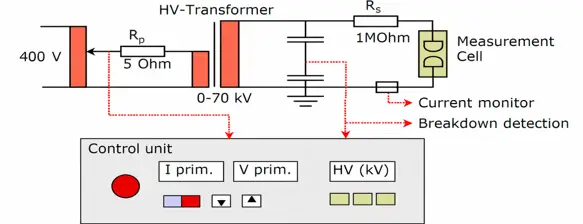
The BDV tester has two electrodes separated by a distance of 2.5 mm ( 4.00 mm separation units are also available).
It is important to note the electrode shape as it varies by standard: IEC 60156 / IS 6792 uses Spherical or Mushroom-shaped electrodes, whereas ASTM D877 uses flat-disc electrodes. Flat disc electrodes are less sensitive to moisture than mushroom-shaped electrodes, which is why choosing the correct standard is vital for EHV transformers.
Comparison of BDV Testing Standards
To provide higher accuracy for different transformer types, engineers use different standards. Here is how they compare:
| Standard | Electrode Shape | Gap Distance | Sensitivity / Best Use |
| IEC 60156 | Mushroom / Spherical | 2.5 mm | Standard for in-service oil |
| ASTM D877 | Flat Disc | 2.5 mm | Best for routine checks / carbonized oil |
| ASTM D1816 | VDE (Spherical-cap) | 1.0 mm / 2.0 mm | High sensitivity (Best for New/Filtered Oil) |
How to Test Transformer Oil BDV Value? Step-by-Step Procedure
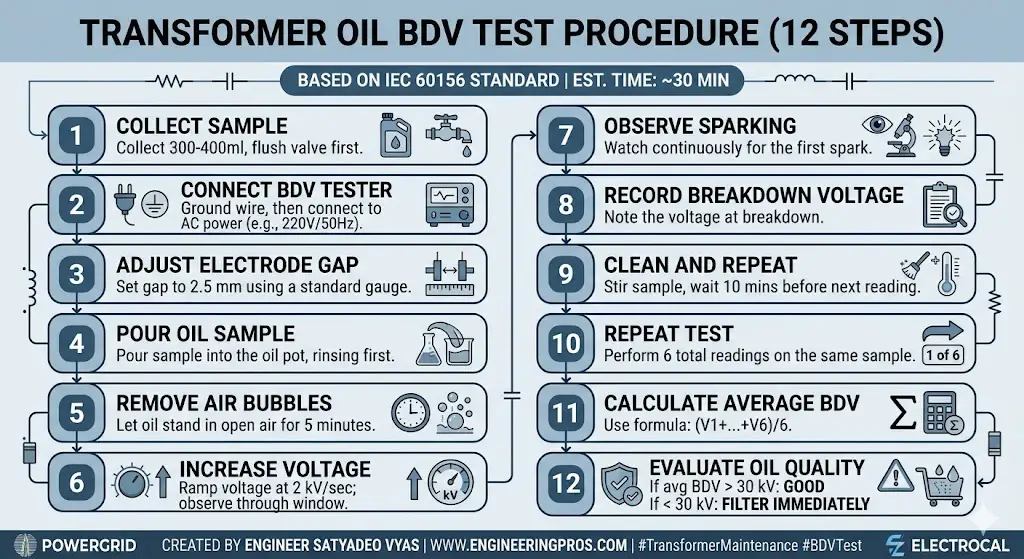
To ensure reliable transformer operation, follow these steps to determine the BDV (breakdown voltage) of transformer oil accurately. As per the standard oil BDV test procedure, it is essential that the transformer oil sample is tested at a minimum temperature of 27°C to ensure data consistency.
- Step-1: Collect Sample: Collect the 300-400 ml oil of transformer oil from the bottom valve of the transformer in a glass or plastic vessel. Always flush the drain valve by discarding the first 1-2 liters of oil to remove stagnant sediment before collecting the actual test sample.
- Step-2: Connect BDV Tester: Connect the BDV tester to a grounding wire and then to 220VAC, 50Hz, or 110VAC, 60Hz, as specified by the vendor. The high-voltage BDV tester must be properly earthed before use.
- Step-3: Adjust Electrode Gap: Adjust the air gap between the electrodes to 2.5 mm, as per IEC 60156 standard. Proper electrode gap adjustment is crucial for meeting transformer oil bdv test standards. Always verify the gap using a standard “Go/No-Go” gauge before the test.
- Step-4: Pour Oil Sample: Pour the oil sample into the oil pot of the BDV testing machine. Rinse the oil pot with the test sample once before the final filling to prevent cross-contamination.
- Step-5: Remove Air Bubbles: Keep the oil pot in open air for 5 minutes so that any air bubbles escape. Disturb the vessel gently to ensure homogeneous distribution of impurities.
- Step-6: Increase Voltage: Increase the voltage at a rate of 2 kV/sec and observe the oil through the inspection window.
- Step-7: Observe Sparking: Continuously monitor the oil sample through an inspection window and note the voltage at which sparking occurs.
- Step-8: Record Breakdown Voltage: The voltage at which sparking is observed is the breakdown voltage (BDV) of the transformer oil.
- Step-9: Clean and Repeat: Remove the cup’s safety lid, stir the oil with a small wooden stick (ensure the stick is clean and dry), and wait 10 minutes before taking the next reading.
- Step-10: Repeat Test: Repeat steps 5, 6, 7, 8, and 9 for the same sample six times, recording each BDV reading.
- Step-11: Calculate Average BDV: Calculate the average BDV from all recorded readings to determine the overall dielectric strength of the oil. Formula for Average BDV (kV) = (V1 + V2 + V3 + V4 + V5 + V6) / 6, Where V1 through V6 represent the breakdown voltage (in kV) recorded during each of the six test runs.
- Step-12: Evaluate Oil Quality: If the average BDV is above 30 kV, the transformer oil is considered good for operation. If the oil bdv value is below 30 kV, the oil must be filtered immediately.
Testing immediately after oil filtration may give false high BDV readings due to elevated temperature. Always cool the oil to 27°C before testing. Standardization of temperature ensures consistent viscosity and moisture solubility across all tests.
Additionally, if one reading in the series is significantly lower than others, it may indicate a single large particle or bubble; some standards allow for discarding the first reading and taking an additional one.
Template for BDV Test Report for Transformer Oil
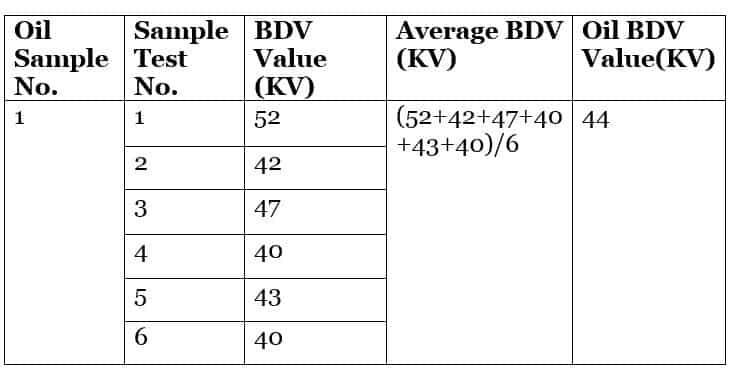
Interpretation of Oil BDV Test Results
- New Oil: New oil usually has a BDV value above 70 kV.
- In-service Oil: BDV value over 30 kV shows high insulating strength.
- Low BDV values (less than 30 kV): It indicates contamination, aging, or moisture. If low BDV is accompanied by a high “Neutralization Number” (Acidity), the oil may be nearing the end of its life.
Note: A high BDV value (e.g., >60 kV) ensures the dielectric strength is good, but it does not reveal internal chemical faults. To detect incipient faults like hot spots, partial discharge, or arcing, the Dissolved Gas Analysis (DGA) test must be performed.
How to Improve Low BDV
If the test results are consistently low, the oil must undergo a “Dehydration and Filtration” process. This involves heating the oil and passing it through a vacuum chamber to remove dissolved moisture and gas, followed by fine filters to remove solid particles. For highly degraded oil, “Regeneration” using Fuller’s earth may be required to remove acidic by-products.
If the oil’s BDV does not significantly improve after two rounds of vacuum filtration, the issue likely extends beyond the oil to solid insulation degradation. The paper insulation on the windings can hold significantly more moisture than the oil itself. As filtration dries the oil, the wet paper releases its moisture back into the oil to reach equilibrium. In such cases, standard filtration is only a temporary fix, and a more intensive dry-out process of the transformer core may be required.
If BDV is low due to moisture, filtration is the standard solution. However, if your DGA report shows high levels of combustible gases (like Acetylene or Hydrogen), filtration alone may not be enough, as the transformer may have an internal fault that is actively degrading the oil.
How Often Should You Perform a Transformer Oil BDV Test?
Deciding when to test your transformer oil is less about sticking to a rigid calendar and more about “listening” to the equipment. While a schedule gives you a baseline, real-world operation often demands a more proactive approach.
Here is how I typically break down testing intervals based on actual field experience:
1. The yearly check (your baseline)
For most distribution transformers running under normal load, a yearly check is the industry standard. It’s usually enough to track how the oil is aging and catch any slow moisture ingress through the breather before it becomes a problem.
2. After a fault: test immediately
This is where you don’t wait for the schedule. If you’ve had a through-fault, a major surge, or a protection trip (like a Buchholz or Differential relay actuation), you need to test the oil immediately.
Faults can generate intense heat in a very short time, which can degrade or carbonize the oil. Even if everything looks fine from the outside, the insulation may already be compromised. A quick BDV test is the only way to be sure.
3. High-critical systems: every 6 months
If you’re managing transformers for a hospital, a data center, or a continuous process plant, the stakes are too high for a “once a year” approach. In these high-criticality environments, I recommend semi-annual (6-month) testing to stay ahead of any potential downtime.
4. Follow the trend, not just the date
If you see a sharp drop—say your BDV falls from 65 kV to 40 kV in a single year—don’t wait another twelve months to see what happens. When the numbers start trending down, I move to quarterly or even monthly testing. This helps you pinpoint the root cause—whether it’s a leaky gasket or a saturated silica gel breather—before the oil fails completely.
Factors Affecting BDV Value of Transformer Oil
The main factors affecting the breakdown voltage of insulating oil are as follows.
- The water is the major contaminant in transformer oil. Moisture delivers charge carriers and, therefore, decreases the dielectric withstand strength of the oil.
- Aging by-products such as acids also deliver charge carriers through dissociation. Additionally, they are surface-active, decreasing the surface tension. Thus, they support bubble evolution following a decreased dielectric strength.
- Pressure influences bubble evolution, too. With increasing pressure, the breakdown voltage increases. For pressures below the atmospheric pressure, the breakdown voltage should decrease.
- Dry particles of cellulose fibers decrease the breakdown voltage since they support bubble generation. Fibrous particles are particularly dangerous because they align themselves in the electric field, creating a “bridge” for the arc to travel.
Transformer Oil BDV Test Standards
Troubleshooting FAQ: Common BDV Testing Issues
This is almost always due to temperature or air bubbles.
–Temperature: Hot oil can hold more dissolved moisture. If you test oil immediately after it comes out of a filtration machine while it’s still hot, the moisture remains dissolved. As it cools, the moisture can “precipitate,” lowering the BDV.
–Aeration: The filtration process can introduce micro-bubbles. Always allow the sample to settle for at least 10–20 minutes before starting the test.
Most standards (like IEC 60156) require you to average all six. However, a very low first reading usually indicates surface contamination on the electrodes or a stray dust particle. If the variation is extreme (more than 25% of the average), the test should be considered invalid. Thoroughly clean the test cell and restart with a fresh sample.
While the minimum safety standard is 30 kV for both, the reliability target is different. For an 11 kV transformer, 30 kV is acceptable. For a 132 kV transformer, a reading of 30 kV is a “warning” sign; you should aim for >50 kV to ensure a sufficient safety margin against high-voltage surges..
Not necessarily. BDV only measures dielectric strength (absence of moisture and particles). It does not detect chemical aging or internal faults. Oil can have a perfect BDV of 70 kV but still be highly acidic or contain dissolved gases (Acetylene, Hydrogen) from an internal arc. You must combine BDV with DGA (Dissolved Gas Analysis) and Acidity tests for a full health check.
Mushroom-shaped (spherical) electrodes create a non-uniform electric field, which is much more sensitive to moisture and impurities. Flat discs (ASTM D877) create a uniform field and are generally used for “dirty” or carbonized oil where you just want to see if the oil is basically functional. Mushroom electrodes are the “gold standard” for modern, high-precision maintenance.
Related Articles:
Should there be a waiting period after each interval of tests before commencing increasing the voltage again?
But the BDV test shouldn’t be carried out on-site more than 4 to 7 times; it should be conducted in the lab.