- Limitations of Ohm’s Law: The limitations of Ohm’s Law occur when the relationship between voltage and current is no longer linear and resistance does not remain constant.
- Validity Condition: Ohm’s Law is applicable only to metallic conductors under constant physical conditions, especially when temperature remains unchanged.
- 2 Limitations of Ohm’s Law: The 2 limitations of ohm’s law are that it is not applicable to non-linear devices and not valid for unilateral elements such as diodes.
- Non-Ohmic Devices: Semiconductor devices, incandescent lamps, electrolytes, and arc discharge lamps exhibit non-linear V–I characteristics and therefore do not obey Ohm’s Law.
- Practical Importance: Understanding the limitations of Ohm’s Law is essential for accurate circuit analysis, correct component selection, and safe real-world electrical applications.
Limitations of Ohm’s Law arise when the relationship between voltage and current is no longer linear. Ohm’s Law explains the relationship between three electrical quantities: current, voltage, and resistance. It is valid for many metallic conductors under constant physical conditions, especially temperature. However, this law does not apply to all materials and electrical devices.
In this article, we explain the limitations of Ohm’s Law, including the 2 limitations of ohm’s law, along with reasons and practical examples where the law fails.
Statement of Ohm’s Law
Ohm’s Law states that at constant temperature, the current flowing through a conductor is directly proportional to the voltage applied across it.
V=I×R
Where:
- V is the voltage in volts (V)
- I is the current in amperes (A)
- R is the resistance in ohms (Ω)
This law assumes that the resistance of the conductor remains constant. If resistance changes, Ohm’s Law is no longer applicable.
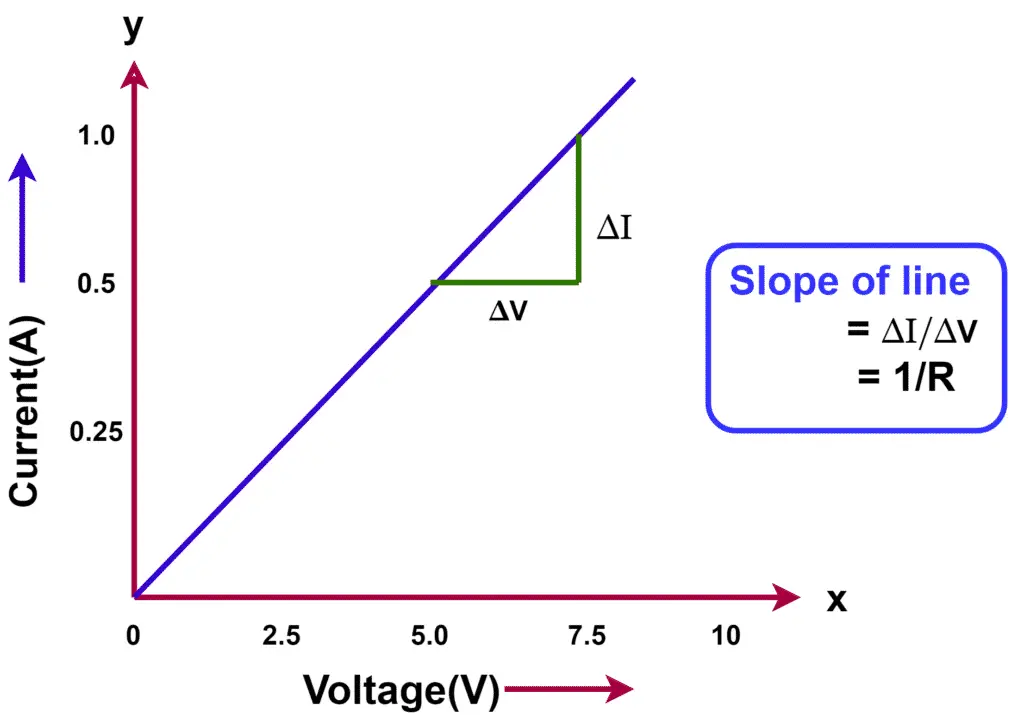
From the above graph, it is clear that Ohms’s law is applicable only when the resistance of the device remains constant.
Read detailed article: Ohm’s Law-Satatement, Formula, Solved Examples
What Are Current, Voltage, and Resistance?
Current
Electric current is defined as the flow of electric charge through a conductor. It is measured in amperes (A), where 1 ampere equals 1 coulomb per second (C/s). The symbol used for current is I.
Read detailed article: Electric Current – Definition, Symbol, Formula & Theory
Voltage
Voltage is the electrical potential difference that drives electric charges through a conductor. It is also known as electromotive force and is measured in volts (V).
Read detailed article: What is Voltage? definition, Formula, Types
Resistance
Resistance is the opposition offered by a material to the flow of electric current. It is measured in ohms (Ω). Resistance depends on factors such as temperature, material type, and physical dimensions.
Read detailed article: What is Electrical Resistance? Definition, Formula, unit
Condition for the Validity of Ohm’s Law
Ohm’s Law is valid only when the physical conditions of the conductor remain constant, especially temperature. Any change in temperature or material properties alters resistance, making the law inaccurate.
2 Limitations of Ohm’s Law (Most Important)
The 2 limitations of ohm’s law are:
- Ohm’s Law is not applicable to non-linear devices where the current is not directly proportional to voltage.
- Ohm’s Law is not valid for unilateral elements such as diodes, where current flows mainly in one direction.
Because of these limitations, Ohm’s Law cannot be applied universally to all electrical components.
Limitations of Ohm’s Law (Detailed Explanation)
Ohm’s Law is valid for many materials, but there are certain materials and electrical devices in which the proportional relationship between voltage (V) and current (I) does not exist. In such cases, Ohm’s Law fails due to the following reasons:
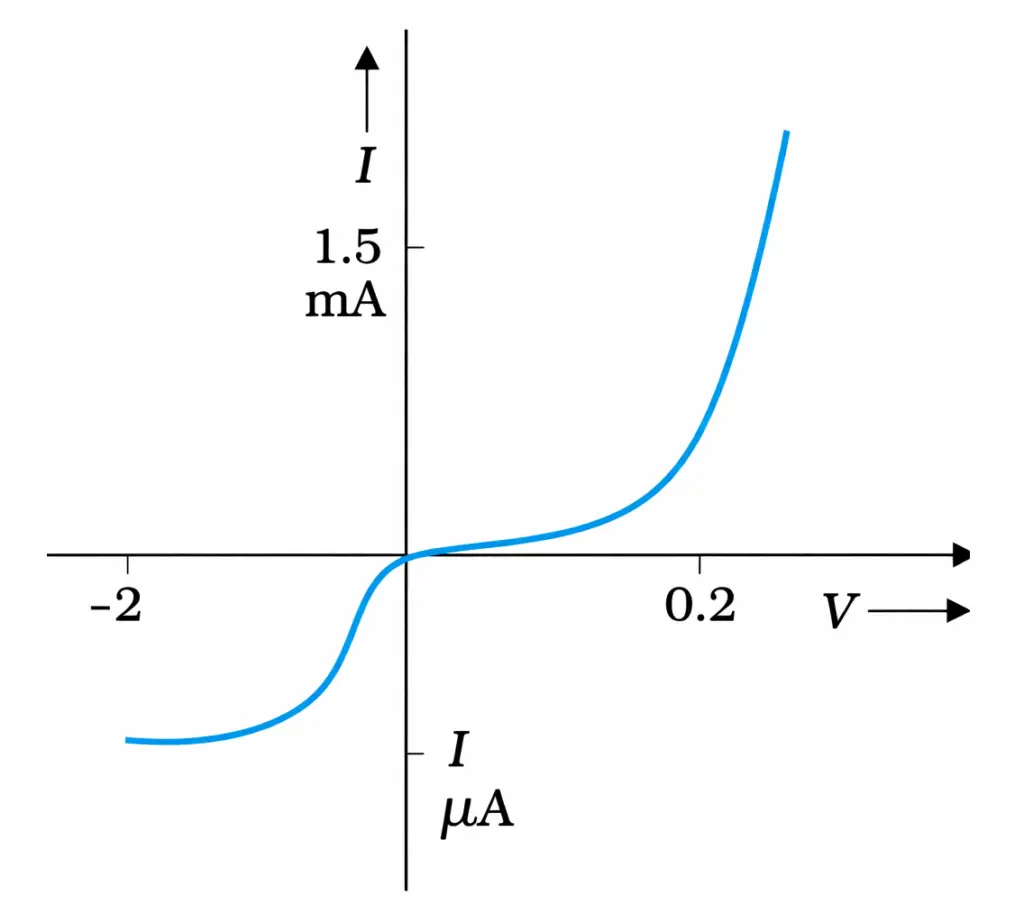
1. Non-Linear Voltage–Current Relationship
In non-ohmic materials, voltage is not directly proportional to current. The V–I characteristic curve is not a straight line, indicating that resistance changes with voltage or current.
2. Dependence on Direction of Voltage
In unilateral devices, reversing the polarity of the applied voltage does not produce the same magnitude of current in the opposite direction. A diode is a common example of this behavior.
3. Non-Unique V–I Characteristics
In some materials, a single current value may correspond to more than one voltage value. This results in a non-unique V–I relationship. Gallium Arsenide (GaAs) is an example of such a material.
4. Temperature Dependence of Resistance
Resistance changes with temperature in many materials. Since Ohm’s Law assumes constant resistance, it becomes invalid when temperature varies significantly.
Examples Where Ohm’s Law Is Not Applicable
Semiconductor Devices
Semiconductor devices such as diodes do not follow Ohm’s Law. The voltage across the PN junction remains nearly constant while the current increases rapidly, resulting in non-linear behavior.
Devices such as transistors, Zener diodes, MOSFETs, SCRs, TRIACs, and IGBTs exhibit non-linear V–I characteristics. Therefore, Ohm’s Law is not applicable to these devices.
Incandescent Lamp
In an incandescent lamp, the filament temperature rises with increasing current. This causes an increase in resistance, producing a non-linear V–I characteristic..
Unilateral Networks
Unilateral networks allow current flow in only one direction. Examples include diodes and transistors. Ohm’s Law cannot be applied because the current depends on voltage polarity.
Non-Metallic Conductors
Ohm’s Law does not apply to non-metallic conductors and insulating materials. Their V–I relationship is non-linear and can be expressed as:
V=KIm
Where k and m are constant and m<1,
Arc Discharge Lamps
In arc discharge lamps, resistance varies with voltage, temperature, pressure, and electrode condition. Since resistance is not constant, Ohm’s Law fails.
Electrolytes
In electrolytes, chemical reactions at the electrodes change resistance. As a result, current is not directly proportional to applied voltage.
Applications of Ohm’s Law in Daily Life
Despite its limitations, Ohm’s Law is widely used in electrical and electronic applications:
- Fuses and circuit breakers: To determine safe current limits
- Electrical heaters: To calculate power consumption
- Fan speed regulators: To control current and resistance
- Electrical appliances: To determine appropriate resistor values
Conclusion
Ohm’s Law is a fundamental principle of electrical engineering, but it is valid only for ohmic materials where resistance remains constant. It does not apply to semiconductors, non-linear devices, electrolytes, or systems with changing temperature. Understanding the limitations of Ohm’s Law, including the 2 limitations of ohm’s law, is essential for accurate circuit analysis and real-world electrical applications.
Related Articles: