- Eddy Current Definition: Eddy currents are closed loops of electric current induced in conductors when they are exposed to a changing magnetic field, as explained by Faraday’s and Lenz’s laws.
- Eddy Current Loss: In transformers and other electrical machines, eddy currents cause unwanted heating in the core, leading to power loss and reduced efficiency.
- Reduction of Eddy Current Loss: Eddy current loss is minimized by using laminated transformer cores made of thin, insulated sheets and high-resistivity materials such as CRGO steel.
- Properties of Eddy Currents: Eddy currents are induced only in conducting materials, are affected by defects like cracks and corrosion, and have maximum intensity at the surface that decreases with depth.
- Applications of Eddy Currents: Eddy currents are used in magnetic levitation, hyperthermia cancer treatment, braking systems, induction heating, adjustable speed drives, metal detection, data processing, and speed sensing.
- Industrial Importance: Eddy currents are vital for non-destructive testing, metal defect detection, material investigation, and applications in power, aerospace, and petrochemical industries.
Eddy currents are loops of electric current induced within conductors when they are exposed to a changing magnetic field. This phenomenon, governed by Faraday’s law of electromagnetic induction, plays a crucial role in modern electrical and electronic systems. Understanding eddy current theory helps explain how these currents generate heat, produce opposing magnetic fields, and affect the behavior of conductive materials.
What is Eddy Current?
According to Faraday’s and Lenz’s law, when varying magnetic field is subjected to a conducting loop, emf of different magnitude is induced in the conducting loop. The potential differential of the induced emf cause current to flow in the conducting loop. The current set up by this mechanism is called eddy current.
The eddy current flows in a closed loop, perpendicular to the magnetic field.The eddy current is also called Foucault’s current. The eddy current circulates in the conducting loop like swirling eddies in a stream.
These currents can be harmful in the case of electrical machines, however they can be beneficial as well.
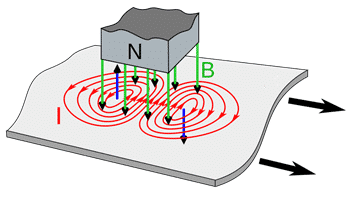
The eddy current cause undesired heating in electrical machines like transformer, induction motor and generator and, thus it lowers the efficiency of the electrical machine.
However, there are numerous applications of eddy current. The eddy current is used in various industrial process like induction heating, braking, welding. The eddy current is also used in finding the defect in the materials. Let us understand how the eddy current cause power loss in the transformer.
Eddy Current Loss in Transformer
When the primary of transformer is fed alternating ac voltage, the varying magnetic field is set up in the magnetic core. The magnetic flux gets linked to both the primary and secondary winding of the transformer.
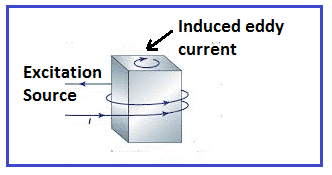
However, the varying magnetic field also induces voltage in the conductive magnetic core and cause eddy current to flow in the magnetic core.
The eddy current set up in the magnetic core depends on the resistivity of the material, frequency of the excitation source, peak value of magnetic field and thickness of the material. The resistivity of the core can be increased by use of CRGO grade steel. The eddy current loss in the core can be found by following mathematical expression.
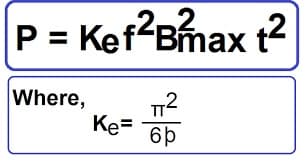
Where,
- Ke = Constant – Its value depends on the resistivity of the material
- f = Frequency of the excitation source
- Bm = Peak value of the magnetic field
- t = Thickness of the material
Read detailed article: Types of Losses in a Transformer
How to reduce Eddy Current Loss in Transformer
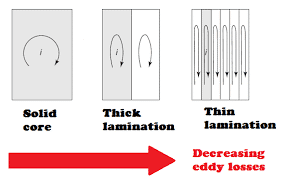
Therefore, it is necessary to reduce the eddy current loss to ameliorate efficiency of the transformer. In order to reduce the eddy current loss, the core is formed by stacking thin plates called lamination. The each plate is insulated from each other to hinder the current flowing from one sheet to another. Thus, the eddy current confined to a very small area of each plate.
Read detailed article: What is Eddy Current Loss?-Definition and Expression
Properties of Eddy Currents
- Eddy current are induced only inside the conducting materials.
- These are distorted by defects such as cracks, corrosion, edges etc.
- Eddy currents attenuate with depth with highest intensity present at the surface.
- These properties lead to numerous applications of eddy currents in power, aerospace and petrochemical industries for detecting metal cracks and damages.
Application of Eddy Current
1. Magnetic Levitation
It is a repulsive type of levitation finds application in modern high speed Maglev trains to provide friction-less transportation. Changing magnetic flux produced by a superconducting magnet placed on the moving train produces eddy currents on the stationary conducting sheet over which train levitates. The eddy currents interact with the magnetic field to produces forces of levitation.
2. Hyperthermia Cancer Treatment
Eddy current heating used for tissue heating. Eddy currents induced in the conducting tubing by proximal wire winding connected to a capacitor to form a tank circuit which is connected to a radio frequency source.
3. Eddy Current Braking
Kinetic energy converted into heat due to eddy current losses finds numerous applications in industries. For example -Braking of trains,Braking of a roller coaster and Electric saw or drill for its emergency shut-off.
4. Induction Heating
It is the process of electrically heating a conducting body by inducing eddy currents in it using high frequency electromagnet. Its main applications are induction cooking, induction furnace used to heat metals to their melting point, welding, brazing etc.
5. Eddy Current Adjustable Speed Drives
With the help of feedback controller an eddy current coupled speed drive can be achieved. It finds applications in metal forming, conveyors, plastic processing etc.
6. Metal Detector
Eddy current detects presence of metals inside rocks, soils etc. with the help of eddy current induction in the metal if present.
7. Data Processing Applications
Eddy current non destructive testing used in investigating composition and hardness of metal structures.
8. Speed Sensing Applications
Speedometer and Proximity Sensing Applications
Conclusion
Eddy currents are a fundamental electromagnetic phenomenon with both challenges and benefits in electrical systems. While they can cause energy losses and heating in transformers and machines, their unique properties—such as being confined to conductive materials and responding to defects—make them invaluable in numerous applications.
From magnetic levitation and induction heating to eddy current braking, metal detection, and speed sensing, these currents are harnessed across industries for efficiency, safety, and precision. Understanding eddy current theory not only helps in minimizing losses in electrical devices but also enables innovative uses that advance technology in medical, industrial, and transportation fields.
Read Next: