Definition of frequency-The number of periodic oscillations completed in one unit time is called the frequency. The oscillatory signal completes the number of repeating events in a definite time period. The frequency is used for defining rotation per cycle of wave, oscillation, and rotation.
What is the Unit of Frequency?
The SI unit of frequency is Hertz (Hz). Hertz is named after the German physicist Heinrich Hertz, the first to broadcast and receive radio waves. Radio waves travel at one cycle per second (1 Hz). One oscillation means one complete cycle. Therefore, we can denote the frequency by cycles/second or revolution/second which is equal to 1 Hz. The wave has a frequency of 5 HZ, which means the wave completes 5 cycles in one second.
Understanding Frequency Scaling and Metric Units
While the fundamental unit of frequency is the Hertz, practical electrical and electronics systems operate across a massive spectrum of scales. To make readings easily scannable, engineers use standard metric prefixes:
- Kilohertz (kHz): 1 kHz = 103 Hz = 1,000 Hz. This unit is typically used for variable frequency drive (VFD) carrier waves, audio processing, and ultrasonic testing.
- Megahertz (MHz): 1 MHz = 106 Hz = 1,000,000 Hz. This range is common in FM radio broadcasting, legacy microcontrollers, and magnetic resonance imaging (MRI) equipment.
- Gigahertz (GHz): 1 GHz = 109 Hz = 1,000,000,000 Hz. This scale is utilized in high-speed digital computing processors, microwave communications, and modern Wi-Fi networks.
Example: A rotor of an induction motor rotates 1500 rounds in one minute. What is the frequency of rotation?
No of cycles or rotation = 1500
Time taken to complete 1500 rotation = 1 Minute = 60 Seconds
Number of Cycles completed in one second is frequency:
Frequency = No. of Cycles/Time
= 1500/60
= 25 rotations/second
f= 25 Hz
Frequency is widely used for electrical voltage and current in electrical AC circuits.In the case of electrical voltage and current, the waveforms are sinusoidal, meaning the alternating signal continuously repeats a complete cycle over a definite time period.
A sinusoidal waveform completes one cycle going through a positive to negative half cycle. The frequency of voltage is 50 Hz in India and 60 Hz in the US. Alternating voltage and current of 50 Hz frequency mean sine wave complete 50 cycles in one second.
Frequency of AC Voltage and AC current
We can further understand the frequency of AC voltage and current with the help of a sinusoidal waveform. The various terms used for alternating voltage and current are as follows.
- Frequency Hertz (Hz) – 1 Hz = 1 Cycle/second
- Time period(T) – Time taken to complete one cycle [T= 1/f ]
- positive to negative cycle
If an alternating current or voltage has the frequency of 2 Hz (see diagram below), that indicates its waveform repeats 2 times in 1 second.
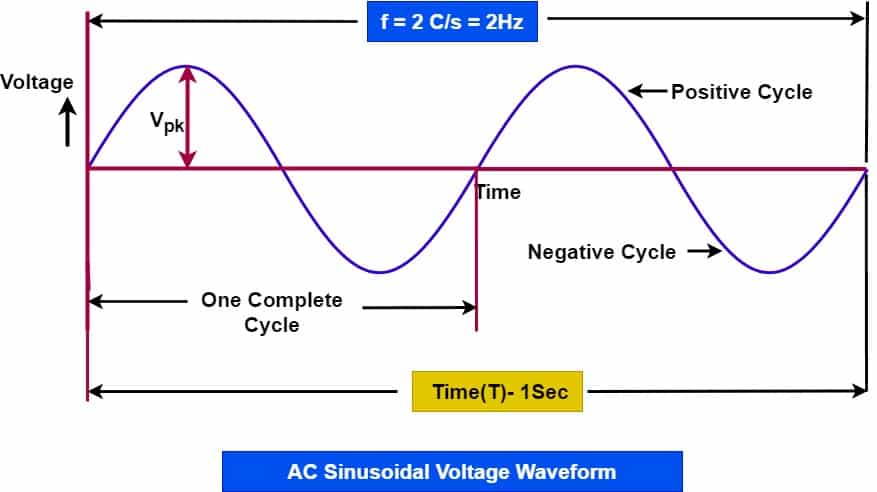
The more number of cycles per second means the more frequency.
Range of Frequency for Electrical Equipment
The various electrical equipment functions at different frequencies. The frequency used for equipment depends on the type of application. The frequency range of some of the electrical equipment are given below.
| Type of Equipment | Frequency Range |
| Power Line Frequency | 50 Hz to 60 Hz |
| Variable Frequency Drive( Carrier Frequency) | 1 Khz to 20 KHz |
| Audio Frequency Range | 15 Hz to 20 KHz |
| Very High Frequency | 30 to 300 MHz |
| Ultra High Frequency | 300 to 3000 MHz |
| Super High Frequency | 3 to 30 GHz |
| Extremely High Frequency | 30 to 300 GHz |
| Radio frequency | 30-300 kHz. |
| Low frequency | 300 kHz to 3 megahertz (MHz). |
| Medium frequency | 3-30 MHz. |
Importance of Frequency for Electrical Equipment
The frequency of AC power is very important. We design the electrical circuits and equipment to operate at a fixed frequency. The circuit components can work reliably at the frequency for which circuit components are designed. The frequency must remain within the specified range of 50 +/- 1.5 Hz.
The performance of the electrical equipment drastically deteriorated under under-frequency or over-frequency conditions. For example, an induction motor designed for 50 Hz, and if we feed more than 50 Hz frequency, then the speed of motor increase and correspondingly its torque decrease.
Types of Frequency
The frequency is broadly classified into two categories.
1. Angular Frequency
The angular frequency measures angular displacement per unit time. Its unit is radians per second (rad/second). In contrast, linear frequency is measured in Hertz (Hz). The relation between linear frequency and angular frequency is:
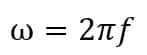
Where, ω – angular frequency in rad/second
If frequency is 50 Hz, then angular frequency is:
We can represent the sinusoidal waveform as:
Where,
ν = Instantaneous value of sine wave
V0 = Peak Value of sine wave
2. Spatial Frequency
It shows the characteristic of any structure that is the periodic cross position in space. SI unit of spatial frequency is cycles per meter. It is inversely proportional to the wavelength.
Core Formulas for Calculating Frequency
While frequency is fundamentally the number of cycles per second, it can be calculated using different parameters depending on the electrical or physical system:
- In terms of Time Period (T): If you know how long a single cycle takes, the frequency is its reciprocal:
- In terms of Angular Frequency (ω): In AC circuit analysis and rotational systems, frequency relates to angular velocity:
- In terms of Wave Speed (v) and Wavelength (λ): For radio waves and light waves moving through a medium:
Relation Between Frequency and Wavelength
In electrical engineering and telecommunications, the relationship between frequency (f) and wavelength (λ) is fundamentally inverse. For electromagnetic waves (like radio waves or light) traveling through a vacuum or air, their speed is constant and equal to the speed of light (c = 3 x 10⁸ m/s).
The mathematical relationship is expressed as:
Because the speed of light is a fixed constant, higher frequencies naturally result in shorter wavelengths, while lower frequencies result in longer wavelengths.
- Practical Application: A standard 50 Hz power line frequency has an incredibly massive wavelength of about 6,000 km. In contrast, a 2.4 GHz Wi-Fi signal has a short wavelength of just about 12.5 cm. This is why high-frequency communications require much smaller antennas than low-frequency systems.
Advanced Types of Frequency in Engineering
Beyond basic angular and spatial frequencies, engineers and technicians categorize frequencies based on system behaviors:
- Natural Frequency: The specific rate at which an electrical circuit or mechanical system naturally oscillates when disturbed, without any continuous external driving force.
- Resonant Frequency: The exact frequency at which an AC circuit’s inductive reactance balances its capacitive reactance (XL = XC). At this point, the circuit resonates, allowing maximum current or voltage amplification.
- Cut-off Frequency: The boundary point in electronic filter circuits (like low-pass or high-pass filters) where the output power drops to half of its peak value (the -3dB point), effectively blocking unwanted signals.
The Interdependence of Frequency and Energy
In advanced industrial electrical applications—particularly within optoelectronics, solid-state sensor logic, and high-voltage insulation systems—the operating frequency fundamentally governs the quantum energy profile of an electromagnetic wave. This relationship is quantified by the Planck-Einstein expression:
Where:
- E = Quantum energy of the wave (Joules, J)
- h = Planck’s constant (approximately 6.626 x 10⁻³⁴ J·s)
- f = Linear signal frequency (Hz)
Practical Power Engineering Impacts
- Insulation Breakdown (Dielectric Stress): In high-voltage engineering, harmonic distortions or rapid switching transients introduces high-frequency components to standard power systems. These high-frequency variations subject dielectric insulation grids to severe localized electrical stress, expediting material breakdown much faster than a nominal 50 Hz power grid profile.
- Ionizing vs. Non-Ionizing Thresholds: Because energy levels remain strictly proportional to signal frequency, commercial transmission frequencies like power line spans (50/60 Hz) or modern industrial Wi-Fi setups (2.4 GHz to 5 GHz) carry exceptionally small quantum energy quantities, classifying safely as non-ionizing. Highly energetic, ultra-high-frequency fields like hard ultraviolet rays or industrial radiographic X-rays carry enough payload energy to ionize atoms and demand dedicated metallic shielding arrays.
Conclusion
Understanding the concept of frequency is foundational for analyzing and designing modern electrical and electronic systems. Whether dealing with power grid transmission at 50 Hz or high-speed wireless networks operating in the gigahertz range, frequency dictates how energy moves, waves propagate, and equipment performs. Keeping frequencies within their design limits ensures system stability, maximizes efficiency, and prevents costly equipment breakdown or failure across industrial power systems.
Read Next: