Phase fault protection is used for the protection of induction motors. The protection relay trips the motor in the case of fault. Phase fault protection protects the motor against phase failure, phase imbalance, and phase-to-phase faults. It is often implemented using phase-failure relays and overcurrent relays. In this post, we will discuss in more detail about protection scheme.
The performance of the induction motor is adversely affected if the motor receives a two-phase supply. In the event of the fault in any of the phase, the motor draws negative sequence current. This current produces a magnetic field that rotates opposite to the rotor direction, creating a braking torque that opposes the motor rotation.
Thus, the net torque of the motor reduces, and the motor tends to draw even more current from the healthy phases. This heavy current causes overheating of motor winding and may lead to insulation failure. Therefore, it is necessary to protect the motor from phase faults.
At the time of fault, the motor draws abnormally high current. In the case of single phasing, the current in the healthy phases may increase to about 1.7 to 2.5 times the full-load current. If the motor keeps running in this condition, the motor may fail. Therefore, the motor needs to stop immediately by the phase fault protection system.
Phase Fault Protection Scheme
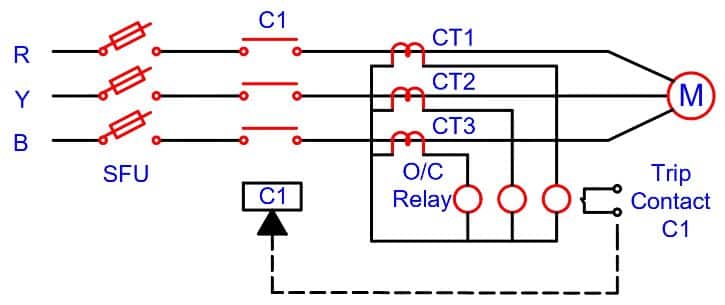
The SFU, contactor, and relay form the protection system. CT1, CT2, and CT3 sense the current of each phase. When there is no fault, the relay does not trip and motor keeps running.
Under fault condition, the phase current exceeds above the set point, and relay trips the main contactor C1. Thus, the relay protects the motor in the event of fault in any phase. Suppose a fault occurs in the R phase. The R-phase current becomes zero, while the Y and B phase currents increase significantly above their normal values. When the current exceeds the relay setting, the relay trips the main contactor and disconnects the motor. This is how the phase fault protection works.
The relay can be set for overcurrent, short circuit current, and for overload functions. Typical relay settings used for phase fault protection are:
- Over current trip setting ( % of motor full load current)
- Short circuit protection ( % of motor FLC)
- Overload protection ( % of motor FLC- IDMT Curve)
- Locked rotor current ( % of FLC)
Conclusion
Phase fault protection safeguards induction motors against single phasing, phase imbalance, and abnormal current conditions that can cause overheating and winding damage. By continuously monitoring phase currents and disconnecting the motor during fault conditions, the protection system improves motor reliability, extends service life, and prevents costly breakdowns.
Read Next: