The concept of lenz law induced current direction is fundamental in understanding electromagnetic induction. Lenz’s Law explains how the direction of induced current is determined when a conductor experiences a change in magnetic flux. This principle ensures conservation of energy and is widely applied in electrical and electronic systems such as generators, transformers, and induction devices.
What Is Lenz’s Law?
Lenz’s Law states that the direction of an induced current in a conductor is such that the magnetic field produced by the induced current opposes the change in magnetic flux that causes it. This opposition prevents the sudden creation of energy and maintains balance in electromagnetic systems.
In simple terms, nature resists change, and the induced current always acts against the reason for its generation.
Mathematical Expression of Lenz’s Law
For a coil with N turns, Faraday’s Law of electromagnetic induction mathematically represents Lenz’s Law as:
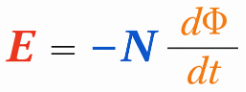
Where:
- E is the induced electromotive force (EMF)
- N is the number of turns in the coil
- Φ is the magnetic flux linked with each turn of the coil
- dΦ/dt represents the rate of change of magnetic flux
The negative sign (−) indicates lenz law induced current direction, showing that the induced EMF always opposes the change in magnetic flux responsible for its production. This negative sign is the key element that defines the direction of induced current and ensures conservation of energy in electromagnetic systems.
Read Detailed article on: Lenz’s Law of Electromagnetic Induction: Definition & Formula
Meaning of Induced Current Direction
Induced current is produced when there is a relative motion between a conductor and a magnetic field or when the magnetic field itself changes. The direction of this current depends on whether the magnetic flux through the conductor is increasing or decreasing.
Lenz’s Law helps determine whether the induced current flows clockwise or anticlockwise in a loop or coil.
Lenz’s Law explains that the induced current in a conductor always flows in a direction that resists the change in magnetic flux responsible for its generation. This behavior helps maintain energy balance and directly follows the law of conservation of energy.
When the magnetic flux through a conductor increases, the induced current produces a magnetic field opposite to the applied field, reducing the increase. Conversely, when the magnetic flux decreases, the induced current generates a magnetic field in the same direction to counteract the decrease.
To determine whether the induced current flows clockwise or anticlockwise, physicists apply the right-hand rule, also known as the clock rule.
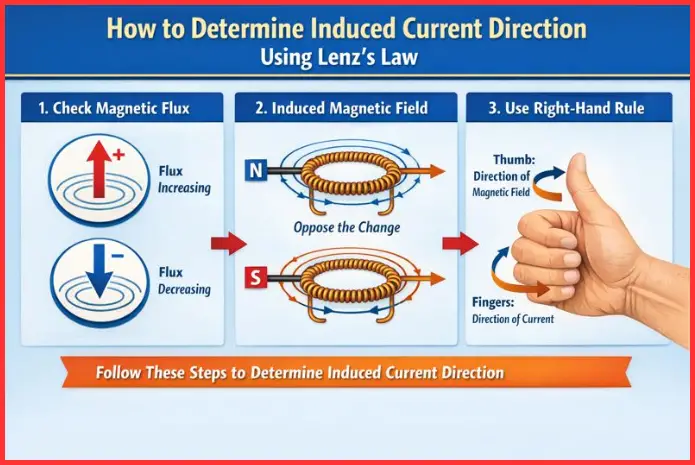
How to Determine Induced Current Direction Using Lenz’s Law
To find the direction of induced current:
- Identify whether magnetic flux is increasing or decreasing.
- Determine the direction of the induced magnetic field that will oppose this change.
- Apply the right-hand thumb rule to relate magnetic field direction to current direction.
This step-by-step method ensures accurate determination of current direction in electromagnetic problems.
Relationship Between Lenz’s Law and Faraday’s Law
Faraday’s Law calculates the magnitude of induced electromotive force (EMF), while Lenz’s Law gives the direction of the induced current. The negative sign in the formula E=−NdΦ/dt mathematically represents Lenz’s Law and explains why induced current always opposes the change in magnetic flux.
Practical Examples of Lenz’s Law Induced Current Direction
Magnet and Coil
When a magnet is moved towards a coil, the induced current flows in a direction that creates a magnetic field opposing the magnet’s motion.
Eddy Currents
Induced currents in metal plates oppose motion, which is why magnetic braking systems work efficiently.
Electric Generators
Generators use Lenz’s Law to control induced current direction while converting mechanical energy into electrical energy.
Induction Cooktops
The induced current in cookware opposes changing magnetic fields, producing heat efficiently.
Importance of Lenz’s Law
Lenz’s Law:
- Ensures conservation of energy
- Explains electromagnetic braking
- Supports electrical machine design
- Prevents unrealistic energy generation
It is an essential concept in physics and engineering.
Conclusion
Understanding lenz law induced current direction is crucial for mastering electromagnetic induction. The law explains why induced current always flows in a direction that opposes the change in magnetic flux, ensuring energy conservation and stable operation of electrical devices. This principle forms the backbone of modern electromagnetic technology and is a key topic in physics education.
Read Next:
- Limitations of Faraday’s Law of Electromagnetic Induction
- Faraday’s Laws of Electrolysis – First and Second Laws
- Coulomb’s Law in Vector Form- Formula, Derivation, Applications
- Faraday’s Laws of Electromagnetic Induction- Definition, Formula & Derivation
- Biot Savart Law: Statement, Formula, Derivation, Importance & Applications