A dry type transformer is widely used in modern power distribution systems due to its high safety, low maintenance requirements, and environmentally friendly operation. These transformers are commonly installed in commercial buildings, industrial facilities, hospitals, data centers, and other locations where reliable power distribution and fire safety are important considerations.
Advances in insulation materials and cooling technology have improved the performance and reliability of dry type transformers, making them suitable for a wide range of applications. This article explains the construction, working principle, cooling methods, types, advantages, disadvantages, applications, and important design considerations of a dry type transformer.
What is a Dry Type Transformer?
A dry-type transformer is a transformer that uses air and solid insulation materials instead of insulating oil for cooling and electrical insulation. Heat generated in the transformer is dissipated through natural air circulation or forced-air cooling systems. Many conventional transformers use insulating oil for cooling and insulation. As a result, they require regular oil testing and maintenance. Dry-type transformers, on the other hand, do not use oil and therefore require less maintenance.
Construction of Dry Type Transformer
A dry-type transformer consists of a magnetic core, primary winding, secondary winding, insulation system, enclosure, and cooling arrangement. Unlike oil-filled transformers, it does not use insulating oil. Instead, air and solid insulation materials are used for cooling and electrical insulation.
The following dry transformer diagram highlights the key components:
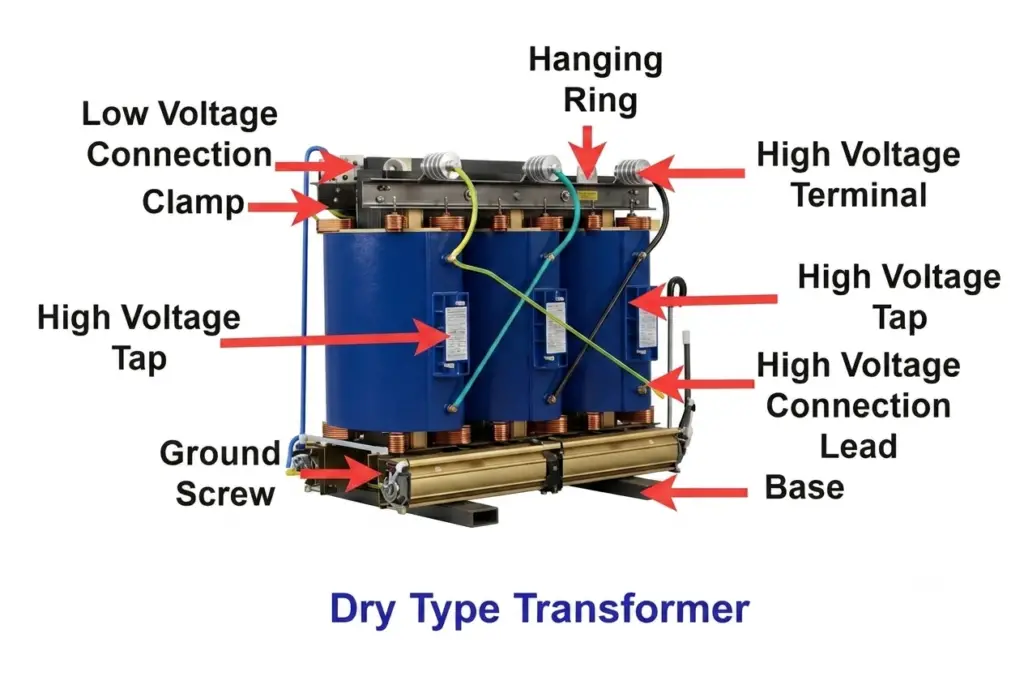
The main components are:
- Magnetic Core: Usually made of CRGO steel laminations to provide a low-loss path for magnetic flux.
- Primary Winding: Receives electrical power from the supply system.
- Secondary Winding: Delivers electrical power to the load at the required voltage level.
- Insulation System: Consists of epoxy resin, varnish, or other insulating materials that separate conductive parts and prevent electrical breakdown.
- Cooling System: Natural air (AN) or forced air (AF) cooling is used to dissipate heat generated during operation.
- Protective Enclosure: Protects the transformer from dust, moisture, and accidental contact while ensuring adequate ventilation.
The exact construction varies between Cast Resin (CRT) and Vacuum Pressure Impregnated (VPI) transformers, but the basic components remain similar.
Working of Dry Type Transformer
A dry-type transformer works on the principle of electromagnetic induction. When an alternating current (AC) flows through the primary winding, it produces a changing magnetic flux in the transformer core. This magnetic flux links with the secondary winding and induces an electromotive force (EMF) according to Faraday’s law of electromagnetic induction.
Depending on the turns ratio between the primary and secondary windings, the transformer either steps up or steps down the voltage. Unlike an oil-filled transformer, a dry-type transformer uses air and solid insulation materials for cooling and insulation. The heat generated during operation is dissipated through natural air circulation or forced-air cooling systems.
Types of Dry Type Transformers
There are two types of dry-type transformers. They are:
- Cast Resin Dry Type Transformer (CRT)
- Vacuum Pressure Impregnated Transformer (VPI)
These two transformer types differ mainly in their insulation system, manufacturing process, cooling characteristics, and application requirements.
Cast Resin Dry Type Transformer (CRT)
The primary and secondary windings of the transformer are encapsulated with epoxy resin. This encapsulation of the winding prevents the possibility of penetration of the moisture in the winding. Thus, a Cast resin dry type transformer (CRT) can be safely used in the high moisture-prone areas.
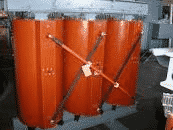
Cast resin dry type transformers provide excellent protection to the winding against dust, corrosion, and other environmental contaminants. The epoxy resin encapsulation improves insulation reliability and helps maintain consistent performance under challenging operating conditions.
Due to their robust insulation system, these transformers are suitable for indoor installations, high-humidity environments, and locations where fire safety is an important consideration. They also offer good resistance to partial discharge, which contributes to longer service life and dependable operation.
CRT transformers are commonly manufactured in ratings ranging from 25 kVA to 12,500 kVA and are generally designed with Class F insulation systems having a temperature rise of 90°C, ensuring reliable operation under normal loading conditions.
Vacuum Pressure Impregnated Transformer (VPI)
In a vacuum impregnated transformer, the primary and secondary windings are impregnated with resin within a vacuum chamber. The winding is made in the form of foil or strip. For higher voltage applications the winding is made in the form of a disc.
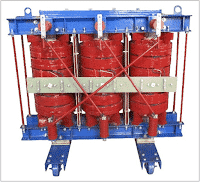
The winding can be physically seen by opening the door of the transformer enclosure. But in a CRT dry type transformer, the primary and secondary winding is molded. The winding of the CRT dry type transformer becomes a solid mass after mold casting. Thus opening the door of the transformer one can see three molds for three different limbs of the transformer.
VPI transformer winding can be repaired in case there is some winding fault, but cast resin transformer (CRT) is a solid mass and can not be repaired. CRT has higher mechanical rigidity than VPI which gives a higher short circuit withstand capability. The insulation of the winding is of grades F(155˚C) and H(180˚C). This type of transformer is available from 5kVA to 30MVA ratings and can be provided with enclosure protection up to IP56.
The vacuum pressure impregnation process enhances the bonding between the winding conductors and insulation, resulting in improved dielectric performance and insulation reliability.
Due to its rugged winding construction and impregnated insulation system, the VPI transformer can withstand mechanical stresses caused by vibration and system disturbances. It performs reliably under varying ambient temperatures and loading conditions.
When provided with a suitable enclosure, the transformer can also be installed in outdoor locations where protection against moisture and environmental contaminants is required. The robust insulation structure further improves its ability to withstand fault currents and enhances long-term operational reliability.
Cooling Methods of Dry Type Transformers
Unlike oil-filled transformers, dry-type transformers use air to dissipate the heat generated in their core and windings. The cooling method plays an important role in maintaining the transformer’s operating temperature and ensuring reliable performance.
1. Air Natural (AN) Cooling
Air Natural (AN) cooling is the most widely used cooling method in dry-type transformers. In this method, heat is removed through the natural circulation of air around the transformer.
As the windings and core heat up during operation, the surrounding air becomes warmer and rises. Cooler air then replaces it, creating a continuous natural convection process that removes heat from the transformer.
Advantages of AN Cooling
- Simple and reliable operation
- No moving parts
- Low maintenance requirements
- Lower operating cost
- Quiet operation
AN cooling is commonly used for small and medium-capacity dry-type transformers.
2. Air Forced (AF) Cooling
Air Forced (AF) cooling uses electric fans to increase airflow around the transformer windings and core. The forced circulation of air improves heat dissipation and allows the transformer to operate at higher load levels.
The cooling fans are typically controlled automatically and start operating when the transformer temperature exceeds a preset limit.
Advantages of AF Cooling
- Higher cooling efficiency
- Improved temperature control
- Increased loading capability
- Higher transformer capacity without increasing physical size
AF cooling is generally used in large-capacity dry-type transformers and applications requiring temporary overload capability.
Comparison of Dry-Type Transformer Cooling Methods
| Parameter | Air Natural (AN) | Air Forced (AF) |
| Cooling Method | Natural air circulation | Forced air circulation using fans |
| Cooling Efficiency | Moderate | High |
| Maintenance | Very low | Moderate |
| Initial Cost | Lower | Higher |
| Loading Capacity | Standard rating | Increased rating |
| Noise Level | Lower | Higher due to fan operation |
The choice between AN and AF cooling depends on the transformer rating, load requirements, and operating environment. AN cooling is suitable for most standard applications, while AF cooling is preferred where higher capacity and enhanced thermal performance are required.
Dry Type Transformer vs Oil Filled Transformer
Both dry-type and oil-filled transformers perform the same basic function of transferring electrical energy between circuits through electromagnetic induction. However, they differ significantly in their cooling method, insulation system, maintenance requirements, safety characteristics, and applications.
| Parameter | Dry Type Transformer | Oil Filled Transformer |
| Cooling Medium | Air is used for cooling. | Mineral oil or insulating liquid is used for cooling. |
| Insulation | Solid insulation such as epoxy resin, varnish, or cast resin. | Insulating oil provides both cooling and insulation. |
| Fire Risk | Very low because no flammable oil is used. | Higher due to the presence of combustible insulating oil. |
| Environmental Impact | Environmentally friendly with no risk of oil leakage. | Oil leakage can cause environmental contamination. |
| Maintenance | Requires minimal maintenance. | Requires regular oil testing, monitoring, and maintenance. |
| Installation Location | Suitable for indoor installations and occupied buildings. | Generally preferred for outdoor installations. |
| Cooling Efficiency | Lower cooling efficiency compared to oil-filled transformers. | Better heat dissipation and cooling performance. |
| Overload Capacity | Limited overload capability. | Higher overload capability due to superior cooling. |
| Size | Larger for the same rating. | More compact for the same rating. |
| Initial Cost | Higher initial cost. | Lower initial cost. |
| Operating Life | Long service life with proper maintenance. | Long service life but depends heavily on oil condition. |
| Noise Level | Generally higher operating noise. | Generally lower operating noise. |
| Power Rating | Commonly used for low to medium ratings. | Suitable for medium to very high power ratings. |
| Installation Cost | Lower fire-protection and civil work requirements. | Additional provisions may be required for oil containment and fire protection. |
| Applications | Hospitals, schools, data centers, commercial buildings, underground substations. | Power plants, utility substations, transmission and distribution networks. |
Which Transformer is Better?
Neither transformer is universally better; the choice depends on the application.
- Dry-type transformers are preferred where safety, environmental protection, and low maintenance are important.
- Oil-filled transformers are preferred for high-power applications where maximum efficiency, compact size, and superior cooling performance are required.
In commercial buildings, hospitals, airports, and data centers, dry-type transformers are often the preferred choice because they eliminate the risks associated with insulating oil. For utility substations and large industrial power systems, oil-filled transformers remain the most economical and widely used solution due to their higher efficiency and better thermal performance.
Advantages of Dry Type Transformer
Dry-type transformers provide reliable performance, reduced fire risk, and lower maintenance requirements, making them suitable for a wide range of applications. Some of the key advantages are listed below:
- Provides a high level of safety for both personnel and equipment.
- Does not use insulating oil, eliminating the risk of oil leakage and contamination.
- Requires minimal maintenance compared to liquid-filled transformers.
- Occupies less installation space due to reduced clearance requirements.
- Environmentally friendly and free from hazardous liquid insulation.
- Capable of handling temporary overload conditions effectively.
- Reduces expenses associated with fire protection and civil construction works.
- Delivers reliable performance even in earthquake-prone regions.
- Eliminates fire hazards associated with flammable insulating liquids.
- Offers excellent resistance to short-circuit stresses.
- Has a long service life because of low thermal and dielectric losses.
- Performs well in humid, dusty, and polluted environments.
- Can be installed close to load centers, minimizing cable runs and reducing power losses.
- Suitable for indoor locations where oil-filled transformers are not permitted or preferred.
- Ensures dependable operation due to the absence of oil-related issues such as leaks, aging, and disposal requirements.
- Reduces environmental impact throughout its operational life.
- Available in compact designs, making installation easier in space-constrained areas.
- Generates low operating noise, making it suitable for offices, schools, and residential buildings.
- Simplifies transportation and installation because there is no need for oil filling or oil handling procedures.
- Provides consistent performance under varying load conditions.
Disadvantages of Dry Type Transformer
There are some disadvantages of a dry-type transformer. They are:
- The dry-type transformer is long-lasting and has a lower chance of winding failure. However, if a major winding fault occurs, repair is often difficult and may require replacement of the complete winding assembly along with the core limb.
- For the same power and voltage rating, a dry-type transformer is costlier than an oil-filled transformer.
- The cooling capability of a dry-type transformer is lower than that of an oil-filled transformer, which can limit its suitability for very high power ratings.
- Dry-type transformers generally require more installation space because of their larger physical dimensions for a given rating.
- Their performance can be affected if excessive dust, moisture, or other contaminants accumulate on the insulation surfaces, making periodic inspection and cleaning necessary in harsh environments.
- Noise levels are generally higher than those of oil-filled transformers due to core vibration and magnetic forces during operation.
- The overload capacity of a dry-type transformer is generally lower because heat dissipation relies mainly on air circulation rather than insulating oil.
Application of Dry Type Transformer
Dry-type transformers are widely used in the following applications because of their oil-free design, reduced fire risk, and dependable performance.
- Chemical, oil, and gas industry – Used for power distribution in facilities where flammable materials and hazardous processes are present.
- Environmentally sensitive areas (e.g., water protection areas) – Preferred in locations where the risk of oil leakage must be eliminated to protect the surrounding environment.
- Fire-risk areas (e.g., forests) – Suitable for installations where fire safety is a major concern because they do not use insulating oil.
- Inner-city substations – Commonly installed in densely populated urban areas where safety, compactness, and reduced environmental impact are important.
- Indoor and underground substations – Ideal for enclosed locations due to their low fire risk and minimal maintenance requirements.
- Renewable energy generation (e.g., offshore wind turbines) – Used to step up or step down voltage levels for efficient integration of renewable energy sources with the power system.
- Commercial and public buildings – Frequently installed in hospitals, schools, airports, shopping centers, and office complexes where reliable and safe power distribution is required.
- Data centers and industrial facilities – Provide dependable power supply for critical equipment and processes that require continuous operation.
Important Design Considerations for Dry Type Transformers
The important design parameters for a dry-type transformer are given below. These parameters influence the transformer’s efficiency, thermal performance, voltage regulation, reliability, and overall service life. Careful consideration of each design factor helps ensure that the transformer operates safely and delivers the required performance under various operating conditions.
1. Choice of Insulation Type
The insulation classes F and H have temperature withstand capacities of 155˚C and 180˚C respectively, and generally, F and H classes of insulation are used to insulate the primary and secondary winding. The other factors like mechanical strength, thermal shock, and dielectric strength of insulation must be considered while designing the dry-type transformer.
The insulation system plays a critical role in maintaining electrical separation between conductive parts and preventing short circuits. In addition to temperature resistance, the insulation should be capable of withstanding electrical stresses, vibration, and repeated heating and cooling cycles throughout the transformer’s operating life. Proper selection of insulating materials helps improve reliability, reduces the risk of premature failure, and ensures safe operation under varying load and environmental conditions.
2. Selection of Winding Material
Copper and aluminum are commonly used to manufacture transformer windings. Even though copper is a better conductor, the aluminum conductor wound transformer has lower cost and weight. The transformer winding with a copper conductor has less cross-section area for the same current rating as compared to the aluminum conductor. The copper coils also provide more mechanical strength compared to the aluminum coil.
The selection of winding material affects not only the electrical performance of the transformer but also its physical size and long-term durability.
Lower winding resistance helps reduce power losses and improves efficiency, while adequate mechanical strength enables the winding to withstand thermal expansion and electromagnetic forces during operation. Therefore, the choice between copper and aluminum is generally based on a balance between performance requirements, installation constraints, and overall project cost.
3. Selection of Core Material of Low Hysteresis Loss
The core of the transformer must have high permeability and less hysteresis loss in order to have better efficiency. The CRGO steel is used for the core material. The CRGO steel core offers higher permeability and minimum hysteresis loss.
Since the transformer core provides the path for magnetic flux, its magnetic properties have a significant impact on overall performance. A properly selected core material helps reduce magnetizing current and energy losses during operation. Modern transformer designs may also utilize advanced magnetic materials for applications requiring exceptionally high efficiency and reduced energy consumption. Careful core design contributes to improved operational reliability and lower operating costs throughout the transformer’s service life.
4. Regulation
Transformer regulation is the percentage ratio of the voltage drop at full load to the transformer’s no-load voltage. The formula of voltage regulation is:

The leakage reactance of the transformer must be as minimum as possible to get better voltage regulation of the transformer. The leakage reactance is generally kept within 2 % during transformer design.
Good voltage regulation ensures that the secondary voltage remains close to its rated value even when the load changes. Excessive impedance within the transformer can lead to larger voltage variations and reduced performance of connected equipment. Therefore, proper winding arrangement and optimized magnetic design are important to limit internal voltage drops and provide stable output voltage over the entire operating range of the transformer.
5. Life Expectancy
The life of the transformer depends upon the useful life of the insulation. The life of the insulation is dependent on the temperature. The rise in temperature cause deterioration in the insulation value which may further cause the breakdown of the insulation. Insulation class B, F, and H is preferred for the dry-type transformer to withstand higher temperature. The temperature rise must be calculated during the design stage of the transformer to get a higher life expectancy of the transformer.
Apart from temperature, environmental conditions such as dust accumulation, humidity, and exposure to contaminants can also affect insulation performance over time. Therefore, the insulation system should be selected not only for its thermal capability but also for its ability to maintain dielectric strength under varying operating conditions. Proper thermal design and adequate ventilation help ensure that the winding temperature remains within permissible limits, thereby enhancing transformer reliability and extending its service life.
6. Losses
The no-load losses of the transformer depend on the eddy current and hysteresis loss. The no-load losses can be minimized by the use of the CRGO core and by keeping the leakage reactance as minimum as possible. The load losses depend on the resistance of the conductor. Thus, by keeping the winding resistance within moderate value losses, voltage regulation and the efficiency of the transformer can be improved.
Transformer losses directly influence operating temperature, cooling requirements, and overall performance. While no-load losses remain relatively constant regardless of load conditions, load losses increase with the current flowing through the windings. Therefore, proper selection of core material, conductor size, insulation system, and winding design is essential to achieve high efficiency and reliable operation throughout the transformer’s service life. This helps reduce energy wastage and improves the long-term economic performance of the transformer.
7. Overloading
If the load on the transformer increases above its rated kVA, the transformer is said to be overloaded. The overloading cause rise in the temperature of the transformer which reduces the useful life of the transformer. The cooling system should be designed to cater to the temporary overloading of the transformer
Prolonged operation under overload conditions can accelerate insulation aging and increase the risk of winding damage. Transformer overloading may occur due to sudden increases in load demand, poor load management, harmonic-rich loads, or abnormal operating conditions.
Therefore, dry-type transformers should be designed with adequate thermal capacity and effective heat dissipation arrangements to safely withstand short-duration overloads without affecting their performance or reliability. Temperature monitoring and proper ventilation can further help in preventing excessive overheating during overload conditions.
8. K-factor
The K-factor is a rating that indicates a transformer’s capability to withstand the additional heating caused by non-sinusoidal currents in its windings. These currents are typically produced by electronic devices that introduces harmonics into voltage and current waveforms.
Harmonics lead to increased losses, extra heating, and waveform distortion in the transformer. A higher K-factor means the transformer is better equipped to handle elevated harmonic levels without overheating or experiencing performance degradation.
If the dry type transformer is to be used for supplying the current to non-linear loads the temperature rise takes place due to harmonics in the current waveform. The transformer for such applications must be assigned K-factor.
9. Insulation Level
In transformer design, insulation level adjustment is an important factor. Generally, insulation level is chosen as per basic impulse level and system overvoltage. A strong insulation level increases the life of a transformer.
10. Modern Instrumentation & Protection
A critical design factor often overlooked is the integration of PT100 temperature sensors directly into the windings. These sensors connect to a digital protection relay to monitor real-time thermal loading, providing an automated “trip” signal to prevent premature insulation degradation during overloading.
Conclusion:
Dry-type transformers are widely used in commercial, industrial, and critical power applications because of their reliable operation, minimal maintenance requirements, and reduced fire risk. Depending on the application, Cast Resin (CRT) and Vacuum Pressure Impregnated (VPI) transformers provide reliable and efficient power distribution. Their oil-free design makes them an ideal choice for indoor installations where safety, reliability, and environmental protection are critical.
Frequently Asked Questions (FAQs)
The typical lifespan of a dry-type transformer ranges from 20 to 30 years or more when operated within its rated limits and maintained properly. Factors such as loading conditions, ambient temperature, ventilation, and insulation quality significantly influence its service life.
Yes, a dry-type transformer can be installed outdoors when provided with a suitable weatherproof enclosure. The enclosure protects the transformer from rain, dust, moisture, and other environmental contaminants that could affect its performance and insulation system.
A dry-type transformer does not use flammable insulating oil for cooling and insulation. As a result, it eliminates the risk of oil leakage, environmental contamination, and oil-related fire hazards. This makes it a preferred choice for indoor installations such as hospitals, schools, data centers, and commercial buildings.
The choice depends on the application. CRT transformers provide superior protection against moisture, dust, and corrosive environments, making them ideal for harsh conditions. VPI transformers offer good thermal performance, lower weight, and easier repairability, making them suitable for industrial and commercial applications.
The main difference is the cooling and insulation medium. Dry-type transformers use air and solid insulation, while oil-filled transformers use insulating oil. Dry-type transformers are safer and require less maintenance, whereas oil-filled transformers offer better cooling and are suitable for higher power ratings.
Dry-type transformers are commonly used in hospitals, schools, airports, data centers, industrial facilities, commercial buildings, and underground substations where safety and reliability are important.
Read Next:
1 thought on “Dry Type Transformer: Construction, Types, Working and Applications”