Understanding the structure of the atom is a cornerstone of chemistry and physics. Over time, scientists have proposed multiple models to describe the atom, each improving upon the last. Among the earliest models are the Plum Pudding Model and the Nuclear Model of the Atom. These models mark important milestones in the history of atomic theory and help explain how our understanding of atoms evolved.
In this article, we will explore the difference between the Plum Pudding Model and the Nuclear Model, their features, limitations, and significance in modern science.
Introduction to Atomic Models
Atoms are the basic building blocks of matter. Although invisible to the naked eye, scientists have long tried to understand their structure. Early models were based on experiments and theoretical ideas about subatomic particles like electrons, protons, and neutrons.
- Atomic models provide a visual or conceptual representation of the structure of an atom.
- They help explain properties like chemical behavior, electrical neutrality, and mass distribution.
Two of the most historically significant models are:
- Plum Pudding Model – proposed by J.J. Thomson
- Nuclear Model – proposed by Ernest Rutherford
The Plum Pudding Model of the Atom
Historical Context
In 1897, J.J. Thomson discovered the electron, a tiny negatively charged particle within the atom. This discovery challenged the notion that the atom was indivisible and prompted Thomson to propose a new atomic model in 1904.
Key Features
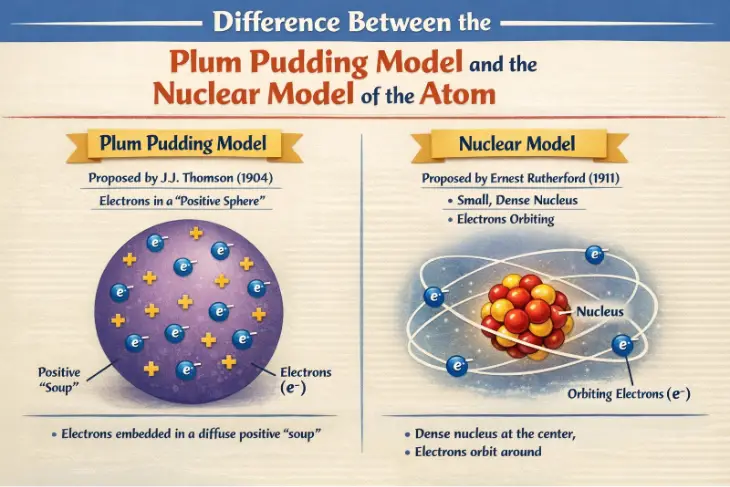
- The atom is a uniform sphere of positive charge.
- Electrons are embedded inside this sphere, similar to raisins in a plum pudding or chocolate chips in a cookie.
- The atom as a whole is electrically neutral, as the positive charge balances the electrons’ negative charge.
- No nucleus or empty space is considered; the atom is thought to be a solid mass of positive charge.
Representation
Visually, the Plum Pudding Model looks like a soft sphere with scattered electrons inside it.
Limitations
Despite being a revolutionary idea for its time, this model had several problems:
- Could not explain why some alpha particles bounced back in experiments.
- Failed to account for the concentration of mass and positive charge in an atom.
- Could not explain chemical properties and atomic spectra accurately.
The Nuclear Model of the Atom
Historical Context
In 1911, Ernest Rutherford conducted the gold foil experiment, which involved firing alpha particles at a thin sheet of gold. Surprisingly:
- Most particles passed through the foil.
- Some particles deflected at large angles, while a few even bounced back.
These observations could not be explained by the Plum Pudding Model, leading Rutherford to propose a new model.
Key Features
- The atom consists of a small, dense, positively charged nucleus.
- Electrons orbit the nucleus, somewhat like planets orbiting the sun.
- Most of the atom is empty space, which allows alpha particles to pass through.
- Almost all the mass of the atom is concentrated in the nucleus.
Representation
The Nuclear Model visualizes the atom as:
- A tiny nucleus at the center
- Electrons moving around it in empty space
Advantages
- Explained the results of the gold foil experiment.
- Introduced the concept of a nucleus, which was previously unknown.
- Laid the foundation for Bohr’s atomic model and modern quantum mechanics.
Limitations
- Did not explain why atoms are stable despite electrons revolving around a nucleus.
- Could not account for discrete energy levels of electrons, which Bohr later addressed.
Detailed Comparison: Plum Pudding Model vs Nuclear Model
Why the Plum Pudding Model Was Rejected
The gold foil experiment by Rutherford showed that:
- Some alpha particles were deflected at large angles, meaning the atom’s positive charge was not spread uniformly.
- Most of the atom is empty space, allowing most alpha particles to pass through.
These observations contradicted the Plum Pudding Model, making it scientifically untenable.
Importance of the Nuclear Model
The Nuclear Model was a milestone in atomic theory because it:
- Provided the first accurate representation of the atom’s nuclear structure.
- Paved the way for Bohr’s model, which explained electron energy levels.
- Helped scientists understand radioactivity, chemical bonding, and atomic interactions.
- Laid the foundation for modern atomic physics and quantum mechanics.
Evolution of Atomic Models: A Timeline
- 1803 – Dalton’s Model: Atoms are indivisible solid spheres.
- 1897 – Thomson’s Model (Plum Pudding): Electrons embedded in positive sphere.
- 1911 – Rutherford’s Model (Nuclear): Nucleus with orbiting electrons.
- 1913 – Bohr Model: Electrons in discrete energy levels.
- 1926 – Quantum Mechanical Model: Electron clouds around nucleus.
Conclusion
The Plum Pudding Model and the Nuclear Model highlight the evolution of our understanding of atomic structure. While the Plum Pudding Model introduced the concept of electrons, it failed to explain experimental observations. Rutherford’s Nuclear Model corrected this by introducing the nucleus, empty space, and mass concentration in atoms.
Understanding the difference between the Plum Pudding Model and the Nuclear Model is crucial for students, teachers, and anyone studying chemistry or physics. It also provides insight into how scientific models evolve as new evidence becomes available.
Frequently Asked Questions (FAQs)
J.J. Thomson proposed the Plum Pudding Model in 1904 after discovering the electron.
Rutherford’s gold foil experiment in 1911 revealed the concentrated positive nucleus.
It explains the concentration of mass, the empty space in the atom, and the deflection of alpha particles.
No, Bohr’s model later refined this by introducing discrete electron orbits.
Read Next:
- What is Electric Charge? – Definition, Types, Unit and Properties
- Difference between Charge and Mass
- Difference between Electron and Proton
- Coulomb Constant: Definition, Formula, Value, and Determination
- Coulomb’s Law in Vector Form- Formula, Derivation, Applications
| Feature | Plum Pudding Model | Nuclear Model |
| Proposed by | J.J. Thomson | Ernest Rutherford |
| Year | 1904 | 1911 |
| Structure of atom | Positively charged sphere with embedded electrons | Small, dense nucleus with orbiting electrons |
| Distribution of positive charge | Spread throughout the atom | Concentrated in the nucleus |
| Empty space | Not considered | Atom is mostly empty space |
| Experimental basis | Discovery of electrons | Gold foil experiment |
| Mass distribution | Evenly spread | Concentrated in nucleus |
| Accuracy | Incorrect | More accurate, but incomplete |
| Significance | Introduced electrons into atomic theory | Introduced the nucleus concept |