A PLC (Programmable Logic Controller) is a rugged industrial computer designed to automate electromechanical processes in manufacturing and process industries. PLCs are widely used to control machines, production lines, conveyor systems, chemical plants, power stations, and many other industrial applications where reliability and real-time control are critical.
What Is a Programmable Logic Controller (PLC)?
A Programmable Logic Controller (PLC) is a specialized, microprocessor-based industrial controller designed to operate reliably in harsh environments such as extreme temperatures, high electrical noise, vibration, and dusty or humid conditions. PLCs are widely used to automate and manage industrial processes in sectors such as manufacturing, water and wastewater treatment, power generation, and material handling.
At its core, a PLC functions by continuously monitoring input signals from field devices like sensors, switches, and pushbuttons. These signals are processed by the PLC’s CPU according to a stored control program that performs logic, sequencing, timing, counting, and arithmetic operations. Based on the program results, the PLC then activates output devices such as motors, solenoids, indicator lamps, valves, and relays to control machines and processes.
While PLCs share some fundamental components with personal computers—including a power supply, central processing unit (CPU), memory, input/output (I/O) interfaces, and system software—their design and purpose are significantly different. PLCs are engineered for deterministic, real-time control rather than general computing, using operating systems and hardware optimized for industrial automation tasks.
A key advantage of PLCs is their ability to handle both discrete control (on/off operations) and continuous control (analog signal processing) with high reliability. Unlike standard PCs, PLCs are built to withstand harsh industrial conditions without performance degradation. For this reason, a PLC is often described as a ruggedized industrial computer that serves as the control backbone of electromechanical systems.
In modern automation architectures, PLCs act as the central intelligence within larger systems such as SCADA (Supervisory Control and Data Acquisition) networks. Their software-based control approach replaces traditional hard-wired relay circuits, making it easy to modify control logic as operational requirements change. This flexibility is especially valuable in manufacturing environments, where production processes are frequently updated to improve efficiency or adapt to new products.
For engineers and technicians looking to enter the field of industrial automation, learning PLC programming is a critical skill. Formal training programs and online PLC courses provide practical knowledge of control logic, industrial communication, and system integration, helping professionals build a strong foundation in control engineering.
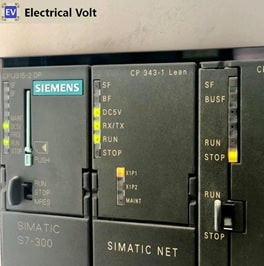
Why PLCs Are Used in Industrial Automation
PLCs are preferred in automation because they offer:
- High reliability in harsh environments
- Fast real-time processing
- Easy reprogramming and scalability
- Minimal maintenance compared to relay systems
- Seamless integration with SCADA and HMI systems
Industries such as manufacturing, oil & gas, power generation, food processing, water treatment, and automotive production rely heavily on PLCs.
How Does a PLC Work? (PLC Scan Cycle)
A Programmable Logic Controller (PLC) functions through a continuous operating loop known as the scan cycle. This cycle allows the PLC to constantly monitor field conditions, process control logic, and update outputs in real time, ensuring reliable and predictable automation performance.
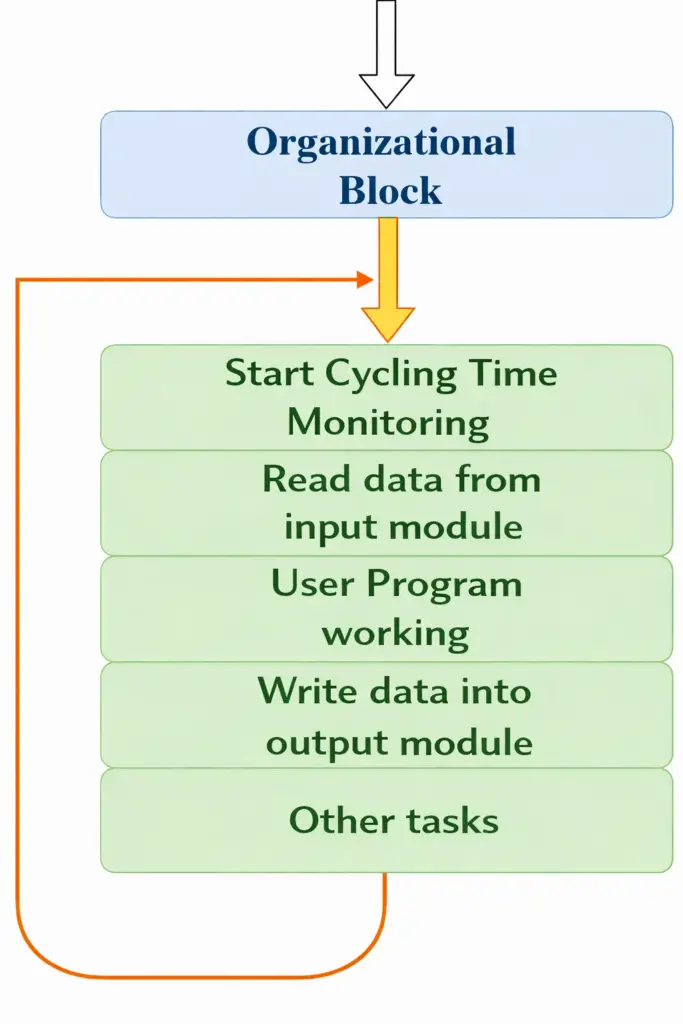
PLC Scan Cycle Operation
- Input Monitoring
The PLC begins each cycle by reading the current status of all connected input devices, including sensors, pushbuttons, and switches. These input states are stored in memory for processing. - Logic Processing
Using the stored input data, the CPU executes the user-defined control program. The logic may be written in ladder logic, function block diagrams, structured text, or other supported PLC programming languages. - Output Updating
After the control logic is evaluated, the PLC refreshes the output modules. Based on the program results, output devices such as motors, relays, solenoids, and valves are turned ON or OFF. - Internal and Communication Tasks
The PLC performs internal diagnostics, manages memory, handles timing functions, and exchanges data with external systems such as HMIs, SCADA platforms, or other PLCs.
Once these steps are completed, the scan cycle immediately restarts. This loop continues as long as the PLC remains in RUN mode, with most modern PLCs completing each cycle within milliseconds, enabling fast and dependable control of industrial processes.
Read detailed article: PLC Scan Time- Types, Theory
PLC Block Diagram and Architecture
A typical PLC system consists of the following main components:
- Rack or chassis
- Power Supply Module
- Central Processing Unit (CPU)
- Input & Output Module
- Communication Interface Module
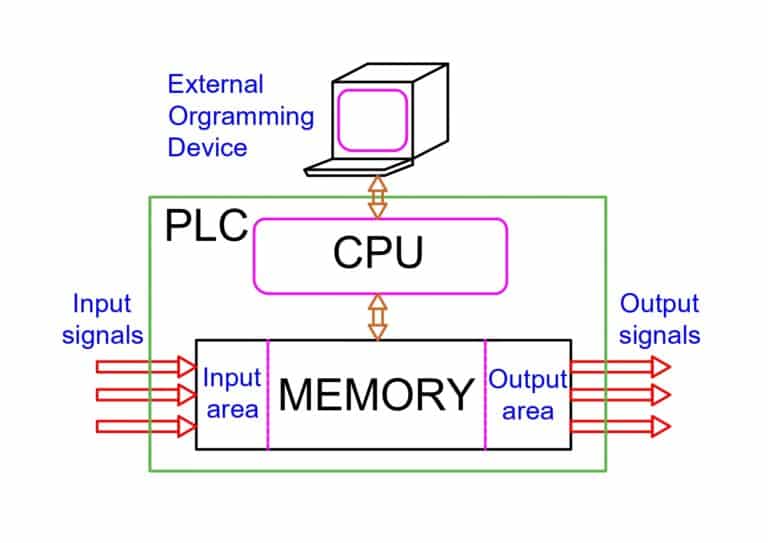
PLC Rack or Chassis
In any programmable logic controller (PLC) system, the PLC rack or chassis is a critical component that serves as the structural and functional backbone. It houses and supports all major PLC modules, ensuring proper communication and power distribution across the system. PLC racks are designed in various sizes and configurations to meet different automation requirements.
For simple automation tasks, compact PLCs often come with a fixed I/O configuration. However, as control applications become more advanced and require greater flexibility, modular PLC rack systems are preferred. These racks allow multiple input/output (I/O) modules to be easily inserted using a slide-in or plug-in mechanism.
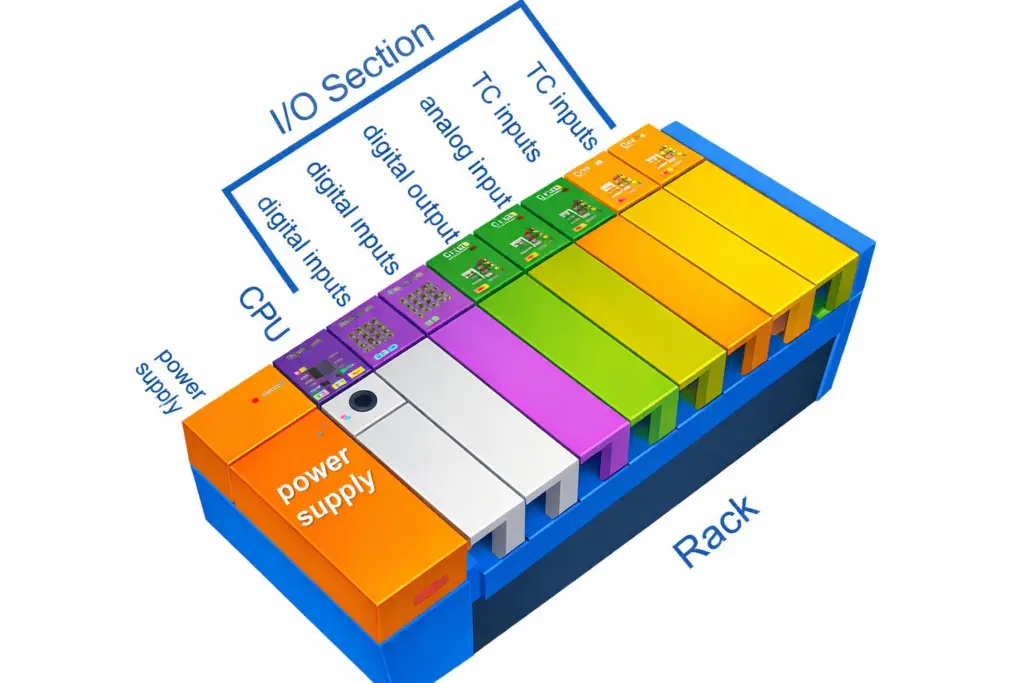
The modular PLC chassis enables seamless expansion and customization, as different types of I/O modules—digital, analog, or specialty—can be installed within the same rack. This design improves scalability, simplifies maintenance, and supports complex industrial automation systems efficiently.
Power Supply Module
The power supply module is a vital component of a PLC system, responsible for supplying electrical power to all internal modules. It transforms the incoming AC voltage into a regulated DC output, typically 24V DC, which is essential for the reliable operation of the CPU and I/O modules.
In some PLC systems, an isolated power supply is used to provide additional protection against voltage disturbances and electrical noise. By delivering stable and controlled power, the power supply module ensures consistent performance, safety, and long-term reliability of the PLC system.
CPU Module and Memory
The CPU module is the central element of a PLC system, acting as its control and decision-making unit. It houses a microprocessor along with ROM and RAM memory. The ROM contains the operating system, system drivers, and firmware required for PLC operation, while the RAM stores user-defined control programs, runtime data, and temporary process values.
As the core of the PLC, the CPU executes the control program, manages memory resources, and handles communication with I/O modules and external devices. Being microprocessor-based, it replaces conventional control components such as relays, timers, and counters, offering greater speed, flexibility, and reliability.
PLCs may incorporate either bit processors or word processors. Bit processors are primarily used for logical and discrete control operations, whereas word processors support numerical computations, text handling, data recording, and advanced process control tasks.
During operation, the CPU continuously reads input signals from sensors, processes them according to the programmed logic, and transmits output commands to actuators and control devices. In addition, the CPU module includes electrical interfaces and connection points that enable secure wiring and seamless integration with other PLC modules.
PLC Input and Output Modules
Input Modules
The input and output (I/O) modules of a PLC play a vital role in enabling communication between the controller and real-world industrial processes. These modules allow the PLC to monitor physical variables such as temperature, pressure, flow, and position, and to control field devices accordingly.
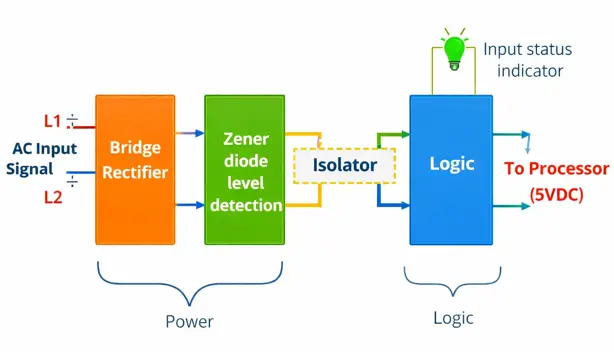
Input devices include components like pushbuttons, limit switches, proximity sensors, and start–stop controls, while output devices may consist of relays, solenoid valves, electric heaters, motors, and indicators. The I/O modules act as an interface between these field devices and the PLC’s microprocessor, ensuring compatible signal levels and safe operation.
The input module performs several key functions. It receives high-voltage signals from process devices, typically around 220 V AC, and converts them into a low-voltage DC signal (usually 5 V DC) suitable for PLC processing. An isolation stage is incorporated to protect the PLC from voltage surges, noise, and fluctuations before the conditioned signal is transmitted to the CPU.
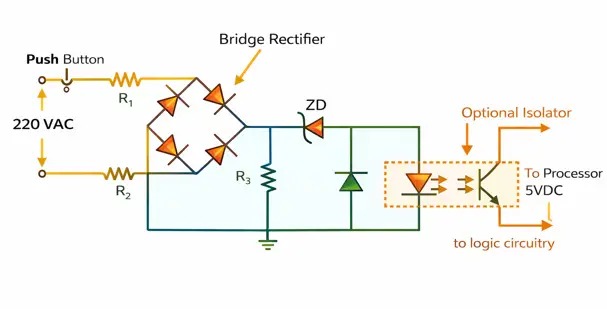
Internally, the input module is divided into two electrically isolated sections: the power section and the logic section. When an input device such as a pushbutton is activated, AC power is applied to a rectifier circuit through current-limiting resistors. A bridge rectifier converts the AC input into DC, and a Zener diode regulates the voltage supplied to an LED. The LED illuminates a phototransistor, which then switches to conduction mode and delivers a clean 5 V DC signal to the processor.
Output Modules
The output module operates on the same principle but in the opposite direction. It connects the PLC processor to external output loads. In this case, the logic section comes first, followed by the power section.
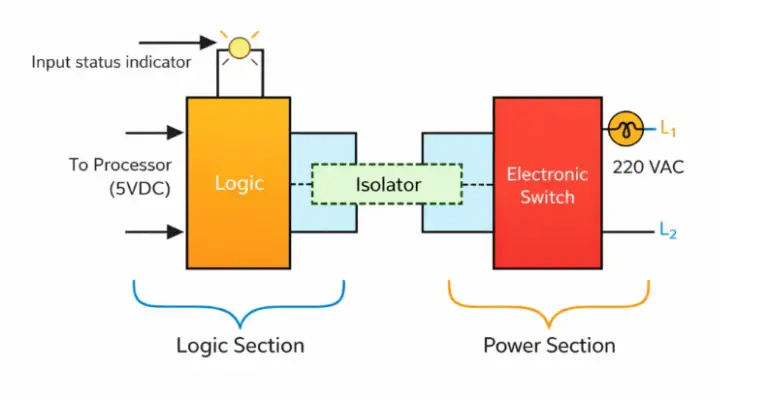
When the CPU generates a logic-high signal, an internal LED is energized, causing a phototransistor to conduct. This action triggers a switching device, such as a Triac, allowing power to flow to the output device. As with the input module, an isolation block separates the low-voltage logic circuitry from the high-power control section, ensuring safe and reliable operation.
Read detailed article: PLC Digital input and Output Module
Communication Interface Module
The communication interface module facilitates seamless data exchange between the PLC CPU and external communication systems. Using intelligent I/O and dedicated communication hardware, it enables reliable information transfer across industrial networks.
This module allows PLCs to communicate with other PLCs, human–machine interfaces (HMIs), SCADA systems, and industrial computers, even when they are located at remote sites. By supporting standard industrial communication protocols such as Ethernet/IP, Profibus, Modbus, and Profinet, the communication interface module plays a crucial role in networking, remote monitoring, data acquisition, and coordinated control within modern automation systems.
Read detailed article: Components of PLC
Types of PLCs
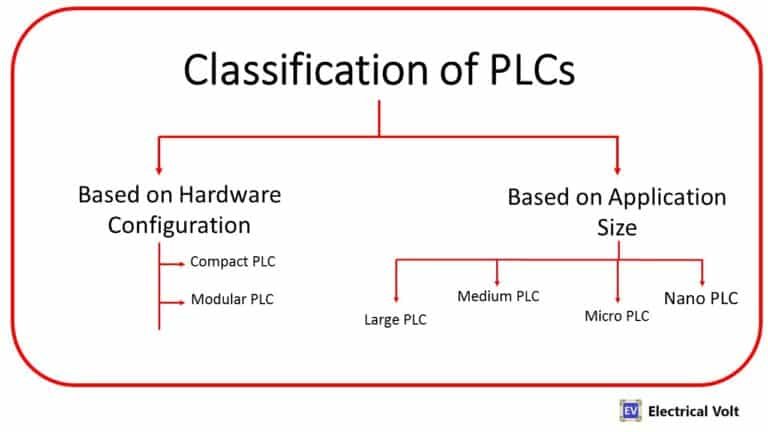
Programmable Logic Controllers (PLCs) are commonly classified based on their hardware structure into Compact (Fixed) PLCs and Modular PLCs. Each type offers distinct advantages depending on application size, flexibility, and system complexity.
Compact (Fixed) PLC
A compact PLC is a single, self-contained unit that integrates the power supply, CPU, and a fixed number of I/O points within one enclosure. Since all components are built into one housing, the I/O configuration is predefined by the manufacturer and cannot be expanded.
Compact PLCs are further categorized by their output type, including relay output, transistor output, and triac output PLCs. Relay output PLCs support both AC and DC loads, transistor output PLCs are suitable for high-speed switching applications, and triac output PLCs are commonly used for AC load control.
Advantages of Compact PLCs:
- Low cost
- Easy installation
- Minimal wiring
- Ideal for small automation tasks
Limitations of Compact PLCs:
- Limited expandability
- Fixed input and output configuration
Due to these characteristics, compact PLCs are best suited for simple, small-scale industrial applications with stable control requirements.
Modular PLC
A modular PLC is built using separate, independent modules mounted on a rack or chassis. These modules typically include the power supply, CPU, and multiple I/O cards, all of which can be added or replaced as needed.
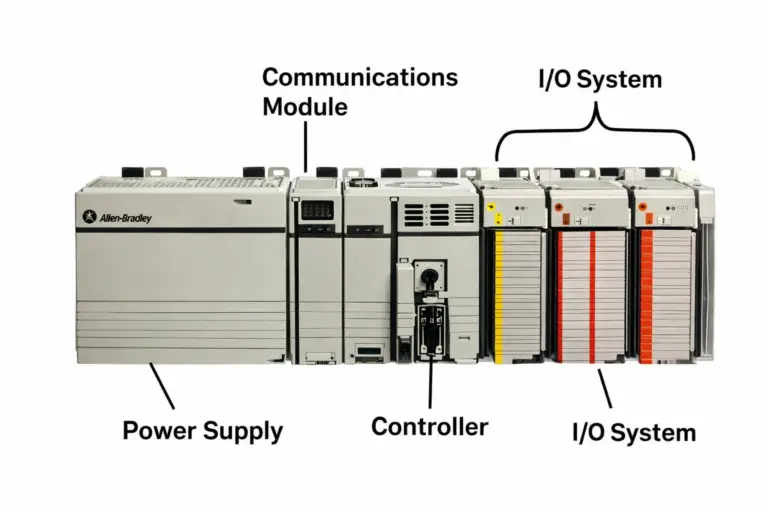
Advantages of Modular PLCs:
- High expandability
- Flexible system configuration
- Easy maintenance and upgrades
Because of their scalable design, modular PLCs are widely used in large manufacturing plants, process industries, and distributed control systems where complex automation and future expansion are required.
Read detailed article: Difference between Compact PLC and Modular PLC
Classification of PLCs by Size
Programmable Logic Controllers (PLCs) are also classified based on their physical size, processing capability, and input/output (I/O) capacity. This classification helps in selecting the right PLC for specific automation requirements, ranging from simple control tasks to complex industrial systems.
Nano PLC
Nano PLCs are the smallest type of programmable logic controllers and are designed for very basic automation needs. They typically have a limited number of built-in I/O points and minimal processing power. Nano PLCs are cost-effective, easy to install, and commonly used in standalone or simple control applications such as lighting systems, small pumps, and basic machine control.
Applications:
- Simple on/off control
- Small machines
- Home and building automation
Micro PLC
Micro PLCs are slightly larger than nano PLCs and offer increased functionality and I/O capacity. They are suitable for small automation tasks that require more logic operations, timers, and counters. Micro PLCs may support basic communication interfaces and limited expansion options.
Applications:
- Packaging machines
- Conveyor control
- Small process automation systems
Mini PLC
Mini PLCs are designed for medium-scale industrial applications and provide higher processing speed, memory capacity, and expanded I/O support. They often support modular expansion, networking capabilities, and multiple communication protocols, making them suitable for more demanding automation environments.
Applications:
- Manufacturing assembly lines
- Material handling systems
- Batch process control
Large PLC
Large PLCs are powerful controllers used in complex and large-scale industrial systems. They support a high number of I/O points, advanced communication networks, redundancy features, and sophisticated control functions. Large PLCs are typically used in mission-critical applications where reliability, scalability, and performance are essential.
Applications:
- Large manufacturing plants
- Process industries (oil & gas, chemical, power plants)
- Distributed control systems (DCS)
Top PLC Manufacturers and Vendors Worldwide
Choosing the right PLC manufacturer is critical for building reliable and efficient industrial automation systems. Several global companies dominate the PLC market by offering robust hardware, advanced software platforms, and long-term technical support. Below are some of the best PLC vendors in the world, trusted by automation engineers across industries.
Siemens
Siemens is widely regarded as the global leader in PLC technology, holding an estimated 30–40% share of the worldwide PLC market. The company is known for producing highly reliable and scalable PLC systems suitable for both small and large automation projects.

One of Siemens’ key strengths is its powerful TIA Portal (Totally Integrated Automation) software, which allows engineers to program, configure, and monitor PLCs, HMIs, and drives within a single unified platform. Siemens PLCs are extensively used in manufacturing, process industries, and infrastructure projects.
Rockwell Automation (Allen-Bradley)
Rockwell Automation, through its Allen-Bradley brand, is the dominant PLC manufacturer in the North American market. The company offers a wide range of PLCs, from compact and micro PLCs to high-performance controllers for complex industrial systems.

Allen-Bradley PLCs are well known for their strong integration with industrial networks and their compatibility with Rockwell’s automation software ecosystem, making them a preferred choice in automotive, food and beverage, and discrete manufacturing industries.
ABB
ABB is a global technology leader with a strong presence in industrial automation and robotics. As one of the world’s largest manufacturers of industrial robots, ABB also provides a comprehensive range of PLC and control solutions designed for high-performance and mission-critical applications.

ABB PLCs are widely used in power generation, oil and gas, process automation, and large-scale industrial environments where reliability and advanced control are essential.
Schneider Electric
Schneider Electric is another major player in the global PLC market. Its Modicon brand made history by producing the first PLC in the United States in 1968. Over the years, Schneider Electric expanded its automation portfolio through strategic mergers and acquisitions, establishing itself as a global automation powerhouse by 1999.

Schneider Electric PLCs are known for their flexibility, energy efficiency, and strong integration with industrial IoT and smart manufacturing solutions.
PLC vs Microcontroller: Key Differences
| Feature | PLC | Microcontroller |
| Operating Environment | Designed for harsh industrial conditions | Best suited for controlled, low-noise environments |
| Programming Languages | Ladder Logic, FBD, Structured Text | C, C++, Assembly |
| I/O Handling | Built-in industrial-grade I/O modules | Requires external interfacing circuitry |
| Reliability | Very high, designed for continuous operation | Moderate, depends on design and protection |
| Cost | Higher initial cost | Lower cost |
PLC Programming Languages (IEC 61131-3 Standard)
PLC programming is governed by the international standard IEC 61131-3, which defines a structured framework for developing reliable and portable control programs. This standard specifies five PLC programming languages, categorized into graphical and text-based methods, allowing engineers to choose the most suitable language for their application.
Graphical PLC Programming Languages
Graphical languages present control logic in a visual format, making them easier to understand, debug, and maintain—especially for professionals with electrical and automation backgrounds.
Ladder Logic (LD)
Ladder Logic is the most widely used PLC programming language. It closely resembles traditional relay-based control circuits, which makes it intuitive for electricians and technicians. Its rung-and-rail structure simplifies troubleshooting and is ideal for discrete control applications.
Function Block Diagram (FBD)
Function Block Diagram programming represents control logic using interconnected functional blocks. Each block performs a specific operation, and the output of one block can be linked to another. FBD is especially effective for process control systems, where multiple variables and continuous functions must be managed.
Sequential Function Chart (SFC)
SFC is used to design programs that follow step-by-step sequences, making it suitable for batch processes, machine cycles, and automated production sequences.
Text-Based PLC Programming Languages
Text-based languages use written instructions and logical expressions, making them ideal for advanced control logic and mathematical operations.
Structured Text (ST)
Structured Text is a high-level PLC programming language similar to Pascal or C. It is commonly used for complex calculations, data processing, and algorithm-based control, offering flexibility and readability for advanced automation tasks.
Instruction List (IL)
Instruction List is a low-level, assembly-style language that uses concise commands to execute control functions. Although less common in modern systems, it is still referenced within the IEC 61131-3 framework.
By following the IEC 61131-3 PLC programming standard, automation engineers can create scalable, portable, and maintainable control programs that meet modern industrial requirements.
Read detailed artcile: Top 5 Most Popular Types of PLC Programming Languages
PLC Applications
PLCs are widely used in the following sectors:
- Manufacturing Automation – Employed in automated production lines, machine control, and assembly operations.
- Oil and Gas Processing Plants – Used for controlling drilling operations, refining processes, and safety systems.
- Power Generation and Distribution – Applied in thermal power plants, substations, and boiler control systems for efficient energy management.
- Food and Beverage Processing – PLCs ensure hygienic operation, accurate batching, and packaging automation.
- Cement, Steel, and Heavy Industries – Used to control kilns, crushers, furnaces, and material handling systems.
- Water and Wastewater Treatment Plants – Manage pumping systems, filtration, and treatment processes.
- Automotive Assembly Lines – Coordinate robotic systems, conveyor belts, and quality inspection processes.
- Packaging and Conveyor Systems – Provide precise motion control and high-speed material handling.
Read detailed article: Rockwell PLCs for Large Scale Applications
Advantages of PLCs Over Conventional Relay Control
- Reduced wiring complexity
- Easy troubleshooting
- Lower power consumption
- High flexibility through software
- Compact control panels
- Faster response time
A PLC-based system typically consumes up to 90% less power than an equivalent relay-based control system.
Conclusion
Programmable Logic Controllers (PLCs) are a cornerstone of modern industrial automation, delivering reliable, flexible, and real-time control for a wide range of industrial processes. Their ability to operate in harsh industrial environments, adapt easily to changing control requirements, and integrate seamlessly with SCADA systems and industrial communication networks makes them far superior to traditional relay-based control systems. As industries continue to move toward smart manufacturing and advanced automation, PLCs will remain an essential technology for efficient, safe, and scalable industrial control.
Read Next: