- Ohm’s Law in Vector Form Definition: Ohm’s law in vector form relates current density and electric field in a three-dimensional medium, including both magnitude and direction of current flow.
- Vector Form Formula: The Ohm’s law in vector form formula is J= σE, showing that current density is directly proportional to the electric field and aligned in the same direction.
- Physical Interpretation: An increase in electric field increases current density, while higher conductivity allows greater current flow for the same applied field.
- Derivation Basis: The Ohm’s law in vector form derivation is based on microscopic charge transport, using drift velocity, carrier mobility, and charge carrier density.
- Scalar vs Vector Form: Unlike the scalar form V = IR, the vector form applies to 3D, field-based, distributed systems and accounts for directional effects.
- Importance and Applications: The vector form is vital in electromagnetic theory, Maxwell’s equations, semiconductor devices, biomedical engineering, and power transmission analysis.
Ohm’s law in vector form is a fundamental concept in electromagnetism that extends the basic scalar form of Ohm’s law into a more realistic, three-dimensional representation of electric current flow in materials. Unlike the simple relation V=IR, the vector form accounts for the direction of current density(J) and electric field(E) , making it essential for advanced physics, electrical engineering, and material science applications.
What is Ohm’s Law in Vector Form?
The traditional Ohm’s law relates voltage (V), current (I), and resistance (R). However, in real conductive materials, current does not flow in a single line—it flows throughout a volume. To describe this physically and mathematically, we use vector quantities:
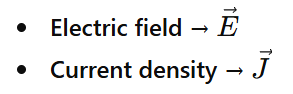
This leads to the Ohm’s law in vector form formula:
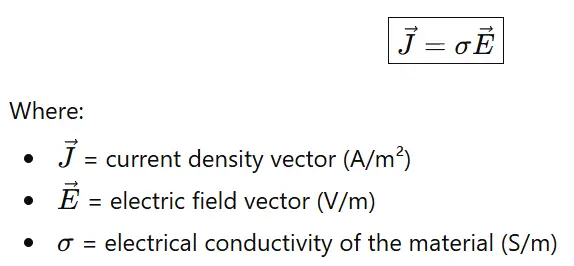
This equation states that current density is directly proportional to the electric field, and both have the same direction.
Physical Meaning:
- If the electric field increases → current density increases
- If conductivity is high → more current flows for the same field
- Direction of current flow = direction of electric field
This is crucial in:
- Semiconductor physics
- Electromagnetic field theory
- Maxwell’s equations
- Material conductivity analysis
Ohm’s Law in Vector Form Formula Derivation
Step 1: Start with microscopic current relation
Drift velocity of electrons:
vd=μE
Where:
- = mobility of charge carriers
- = electric field
Step 2: Current density definition
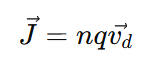
Where:
- n = number of charge carriers per unit volume
- q = charge of electron
- vd = drift velocity
Step 3: Substitute drift velocity
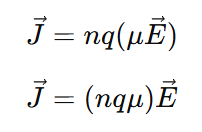
Step 4: Define conductivity
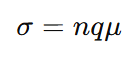
So,
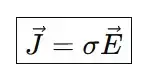
This is the vector form of Ohm’s law
Scalar Form vs Vector Form
| Scalar Form | Vector Form |
| V = IR | J = σE |
| 1D model | 3D model |
| Circuit-based | Field-based |
| Lumped system | Distributed system |
| No direction | Direction included |
Importance of Ohm’s Law in Vector Form
The vector form is essential because it:
- Describes current flow in 3D materials
- Works with Maxwell’s equations
- Applies to anisotropic and isotropic media
- Used in electromagnetic wave propagation
- Critical for plasma physics, semiconductors, and conductors
Applications
- Electric field modeling
- Semiconductor device design
- Biomedical engineering (tissue conductivity)
- Geophysics (earth conductivity mapping)
- Antenna theory
- Power transmission analysis
Real-World Example
In a copper wire:
- High conductivity (σ)
- Small electric field produces large current density
In an insulator:
- Very low conductivity
- Even strong electric field produces negligible current
Summary
Ohm’s law in vector form provides a realistic, physics-based description of how electric current flows through materials. It connects microscopic charge motion to macroscopic electrical behavior using vector quantities and field theory.
The Ohm’s law in vector form formula is derived from fundamental charge transport principles, making the Ohm’s law physically meaningful and mathematically elegant. This form is indispensable in modern physics and engineering for accurate modeling of electrical systems.
Read Next: