A Burner Management System (BMS) is a safety control system that ensures the safe start-up, operation, and shutdown of industrial process burners in accordance with recognized safety standards (such as NFPA 85 and IEC 61511).
The primary purpose of a BMS is to ensure safe and reliable operation of combustion equipment, such as boilers, furnaces, heaters, and other fuel-fired equipment, by controlling start, stop, and emergency shutdown sequences.
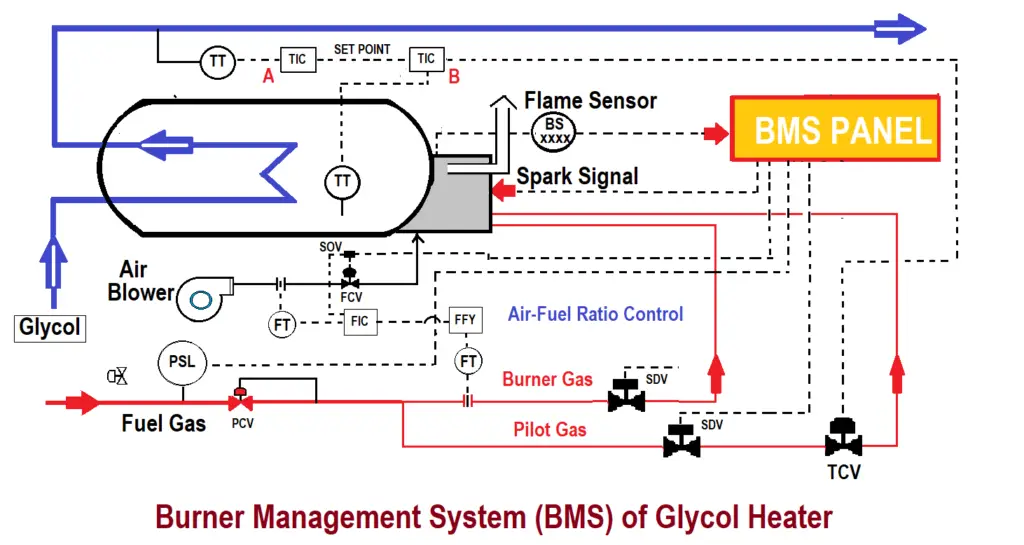
The BMS ensures that burners are ignited, operated, and shut down in a controlled and verified manner. It automatically executes a shutdown if unsafe conditions are detected, such as abnormal pressure, temperature, or flame failure, thereby reducing the risk of fire, explosion, or equipment damage.
A properly designed BMS also helps reduce unplanned outages and costly downtime by detecting faults early and enforcing safe operating logic.
Key Functions of a Burner Management System

Start-up Control — The BMS controls the safe start-up sequence, including purging the combustion chamber, igniting the burner, and regulating fuel and combustion air flow. It verifies permissives such as pressure, airflow, and valve positions before allowing ignition.
Operation Monitoring — During normal operation, the BMS continuously monitors fuel flow, air-to-fuel ratio, flame presence, and combustion chamber pressure to maintain stable and safe combustion.
Fault Detection — The BMS detects abnormal or unsafe conditions in burner operation and initiates protective actions, including alarms or burner shutdown.
Emergency Shutdown — In the event of critical conditions such as flame failure, loss of fuel pressure, or unsafe furnace conditions, the BMS initiates an immediate fuel trip to prevent hazardous situations.
Safety Assurance — The BMS ensures the burner operates within defined safety limits, preventing conditions such as fuel accumulation, explosions, or over-pressurization.
Typical Components of a BMS
Controller — The controller is the logic solver of the BMS. It receives inputs from field devices, executes safety logic, and sends commands to final control elements to manage burner operation.
Flame Detectors — Flame detectors monitor the presence and stability of the flame using ultraviolet (UV), infrared (IR), or flame rod technologies and provide continuous feedback to the controller.
Fuel Valves — Fuel valves control and isolate the fuel supply to the burner. They are actuated by the BMS to ensure fuel is admitted only when all safety conditions are satisfied.
Air Dampers — Air dampers regulate combustion air flow to maintain the proper air-to-fuel ratio. Their position is adjusted based on airflow and combustion feedback.
Ignition System — The ignition system initiates combustion during start-up using spark igniters or pilot burners, under direct control of the BMS.
Process Sensors — Pressure, temperature, and flow sensors monitor furnace and fuel conditions and provide critical safety feedback to the BMS.
Control Panel and HMI — The control panel houses the BMS hardware, while the Human-Machine Interface (HMI) provides operators with status indication, alarms, and limited supervisory control.
Start-up Sequence in a Burner Management System
The BMS manages a defined and interlocked sequence to safely start combustion equipment such as boilers, furnaces, or incinerators. While details vary by application, a typical sequence includes the following steps.

Pre Start-up Checks
Before start-up, the BMS verifies all permissive conditions, including fuel supply availability, combustion air flow, valve positions, and the health of safety devices.
Purging
A purge cycle removes residual or unburnt gases from the combustion chamber using forced airflow. Purge duration is determined by furnace volume and applicable safety standards.
Ignition
After successful purging, the ignition system is energized to ignite the fuel-air mixture. The BMS confirms flame establishment within a specified time.
Fuel Ramp-up
Once flame is proven, fuel input is gradually increased to reach the required firing rate while maintaining stable combustion conditions.
Combustion Monitoring
Throughout start-up, the BMS continuously monitors flame stability, pressure, temperature, and exhaust conditions to ensure safe operation.
BMS Control and Monitoring
Air and Fuel Control — The BMS coordinates air and fuel delivery to maintain safe combustion conditions, often interfacing with the basic process control system (BPCS).
Flame Monitoring and Control — Continuous flame supervision ensures immediate shutdown if flame failure or instability occurs.
Fault Detection and Diagnostics — The BMS performs diagnostics, detects abnormal conditions, and generates alarms to assist operators in corrective actions.
Types of Burner Management Systems (BMS)
There are two main types of Burner Management Systems used in industrial applications:
1. Separate Control System
In this approach, the Burner Management System and the basic process control system (BPCS) are implemented as independent systems, each with its own hardware, logic, and operator interface.
2. Integrated Control System
In an integrated approach, the BMS and control functions are implemented within a single system, providing a unified platform for operation and safety management.
An integrated BMS typically offers:
- A common operating interface
- Integrated fire and gas detection
- Integrated peer-to-peer control
- Common power supply
- Built-in diagnostics
- Integrated security tools
- Integrated backup and recovery
- Support for post-incident analysis
- Integrated simulation and optimization tools
- Faster data exchange through direct internal communication
Difference Between Safety Instrumented System (SIS) and Burner Management System (BMS)
While both SIS and BMS perform safety-related functions, they serve different roles.
A Safety Instrumented System (SIS) provides plant-wide safety functions, such as emergency shutdown, fire and gas detection, and over-pressure protection.
A Burner Management System (BMS) is a dedicated safety system for combustion equipment, responsible for burner sequencing, flame supervision, and fuel isolation to ensure safe burner operation and regulatory compliance.
Advantages of BMS
- Reduced operator intervention and shorter shutdown times
- Faster recovery from process upsets
- Easier integration of components and control systems
- No requirement for time synchronization
- Lower hardware and installation costs by using a single system
- Reduced spare parts inventory
- Easier and more cost-effective engineering and maintenance
- Reduced number of operating personnel
- Lower training time and effort
- Improved system accessibility
Disadvantages of BMS
- Reduced flexibility compared to separate systems
- Separate systems can be easier to manage and troubleshoot
- Separated systems may result in lower long-term administrative costs
- A hardware failure in an integrated system can affect both functions, while separate systems remain independent
Conclusion
A Burner Management System (BMS) plays a critical role in ensuring the safe and reliable operation of industrial combustion equipment. By controlling burner start-up, continuously monitoring flame conditions, and executing protective shutdowns during unsafe situations, the BMS helps prevent accidents, equipment damage, and unplanned downtime. Proper design, implementation, and maintenance of a Burner Management System are essential for meeting safety standards and achieving stable and efficient burner operation.
Read Next: