A bimetal is a composite material created by bonding two different metals into one structure. This design allows engineers to combine distinct characteristics such as strength, flexibility, and thermal response into a single unit.
What is Bimetal?-Definition and Meaning
A bimetal is a material created by permanently bonding two different metals so they function as a single unit while still retaining their individual characteristics. Unlike mixed metals, each layer in this structure keeps its own physical and chemical properties, making it highly functional in engineering applications.
The bimetal meaning lies in this combination—bringing together two metals to achieve performance that a single material cannot provide alone. It is commonly used in systems where temperature changes need to produce controlled mechanical movement.
In broader terms, bimetallic means using two metals strategically to improve efficiency, especially in thermal and structural applications.
A key example of this concept is explained through the bimetal strip definition. It refers to a strip made by bonding two metals with different rates of thermal expansion. When exposed to heat, one metal expands more than the other, causing the strip to bend.
This simple but effective mechanism is widely used in thermal control devices and automatic switching systems, where precise response to temperature changes is essential.
Composition of Bimetal Element
When considering the bimetal element is composed of, it generally involves pairing two metals with contrasting thermal expansion properties. One layer is a high-expansion metal such as copper or brass, while the other is a low-expansion metal like steel or nickel-based alloys.
This difference in behavior is what makes bimetals effective in temperature-responsive applications.
Common combinations used in bimetallic strips include:
- Iron combined with nickel, where iron expands more readily
- Brass bonded with steel for a clear expansion contrast
- Copper paired with iron for reliable thermal response
- Constantan matched with Invar for precise and stable performance
Together, these pairings form strong, layered metal composites that are widely used in industrial and engineering applications.
Key Properties of Bimetals
Bimetals are valued for their ability to respond reliably to temperature changes while maintaining structural integrity. Their performance comes from a combination of thermal and mechanical characteristics:
- Differential Expansion Behavior
The most important feature is the unequal expansion of the two metals. When heated, the metal with a higher expansion rate increases in length more than the other, causing the bonded strip to curve toward the side that expands less. - Temperature Sensitivity
The degree of bending changes consistently with temperature variation. This predictable response makes bimetals ideal for accurate sensing and control applications. - Mechanical Strength and Flexibility
Bimetals are engineered to balance stiffness and elasticity. They can flex repeatedly without cracking, making them suitable for long-term use in dynamic systems. - Wide Operating Range
These materials can function effectively across a broad temperature span, from extremely low to very high conditions, while maintaining stability and accuracy over time. - Controlled Motion Capability
Depending on the design, bimetals can produce small deflections, rotational movement (as seen in coils), or quick snap actions used in switching mechanisms. - Resistance to Environmental Effects
Many bimetals are designed with protective properties, allowing them to withstand moisture, chemicals, and other harsh environmental conditions.
These qualities make bimetallic material suitable for precision engineering applications and heat-sensitive components.
How Do Bimetals Work?
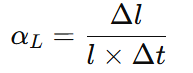
The operation of a bimetal is based on a simple physical principle: different metals expand and contract at different rates when exposed to temperature changes. This behavior is described by the coefficient of linear thermal expansion, which measures how much a material’s length changes with temperature.
Where:
- αL = coefficient of linear thermal expansion
- l = original length
- Δl = change in length
- Δt = change in temperature
A typical bimetal consists of two thin metal strips bonded together along their length. Each metal responds differently to heat, but since they are joined, they cannot expand independently.
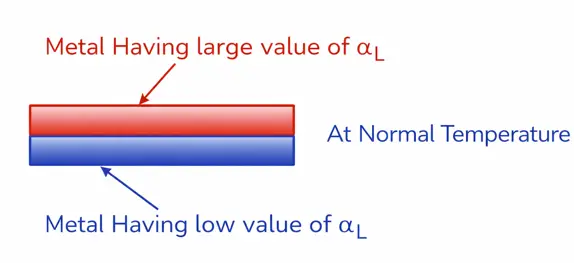
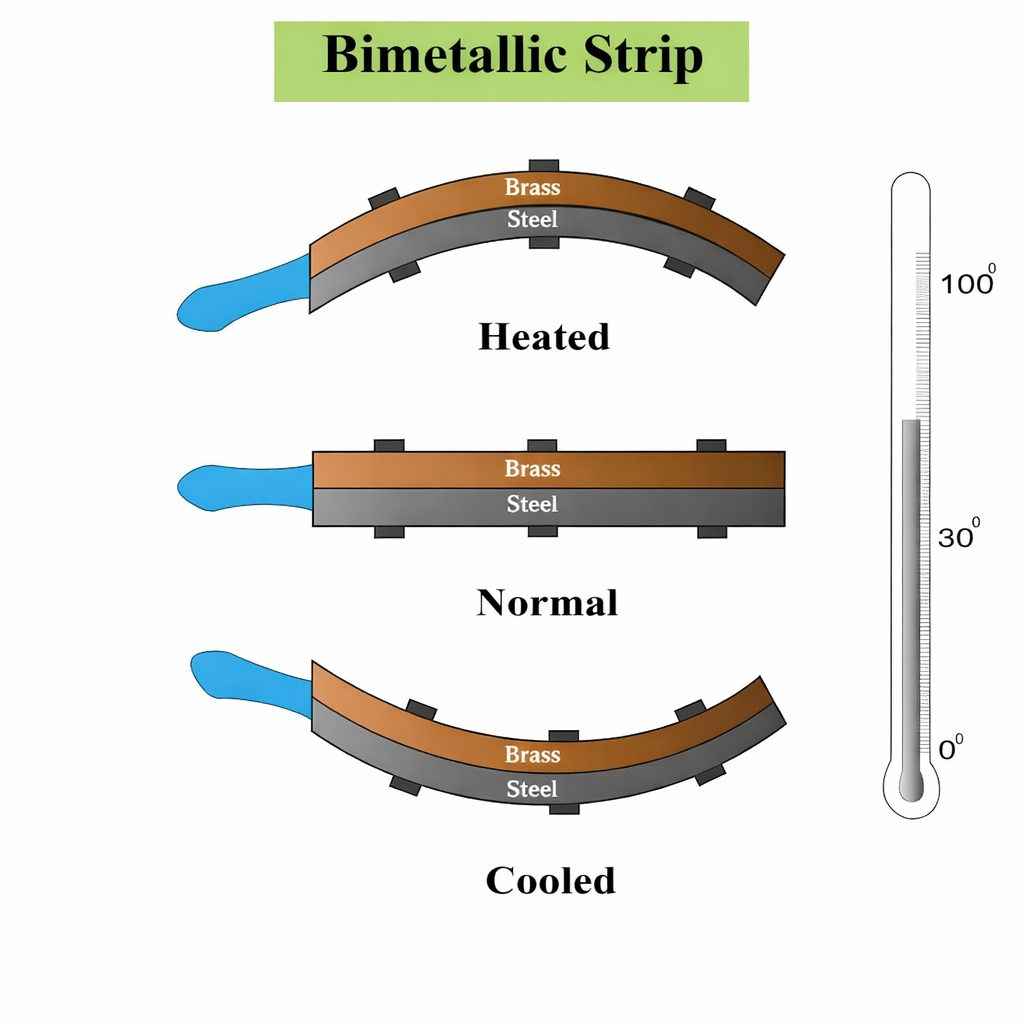
At normal temperatures, the strip remains straight. However, when heat is applied, the metal with the higher thermal coefficient of expansion rate lengthens more than the other. Because both layers are fixed together, this mismatch forces the strip to bend. The side with greater expansion moves outward, while the side with lower expansion forms the inner curve.
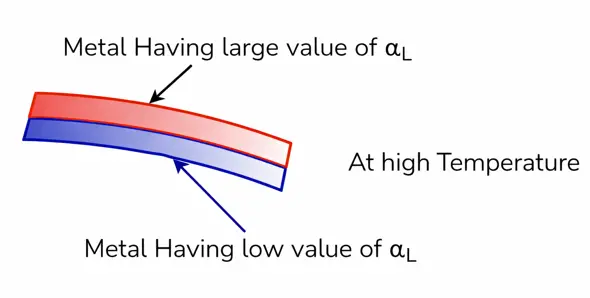
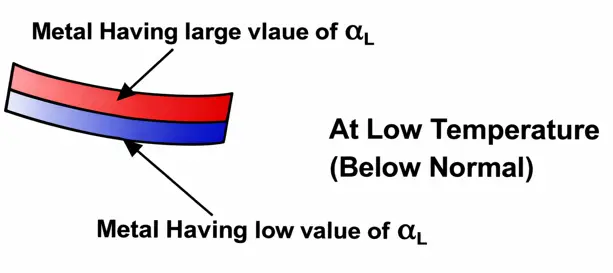
As the bimetallic strip cools, it curves into an arc. In this bent shape, the material with the smaller coefficient of linear expansion lies along the outer edge, while the material with the larger coefficient is positioned on the inner edge, as illustrated in the figure below.
This working principle is widely used to create devices that can detect, measure, or control temperature without the need for complex electronics.
Common Types of Bimetallic Strip Designs
Choosing the right materials is the first step in designing a bimetallic strip. It is also important to study existing designs, as understanding proven methods can save time and reduce effort when creating new designs.
The three most common types of bimetallic strip designs are disc, ribbon, and coil. The disc type is the most widely used and is made by bonding two metal discs together. The ribbon type consists of two flat metal strips joined along their length. The coil type is formed by winding the bonded strips into a spiral shape.
Each design has its own advantages and limitations. Therefore, the best choice depends on the specific needs of the application.
Major Applications of Bimetals
Bimetals are widely used in different applications across various fields. Some of the common uses are given below:
Bimetal Thermometers
Bimetallic strips are commonly used in direct-reading thermometers, where they are typically shaped into a spiral or coil. In this arrangement, one end of the coiled strip is fixed to the body of the instrument, while the other end is attached to a pointer. A common design of a thermometer that utilizes a coiled bimetallic strip is illustrated in the figure below:
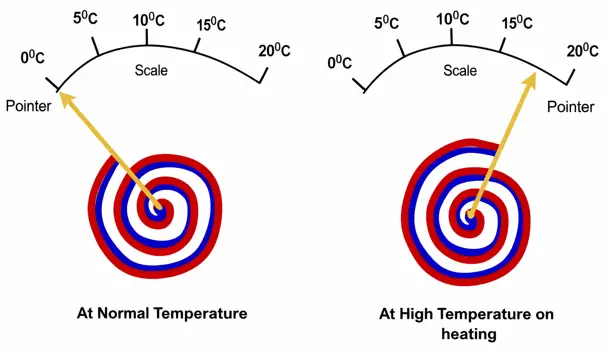
As the temperature rises, the coil undergoes bending due to unequal expansion of the two metals. This causes the free end of the coil to rotate, moving the pointer across a calibrated scale.
Since the scale is marked in temperature units, the position of the pointer directly shows the corresponding temperature reading.
Thermostat
Bimetallic strips are widely used in thermostats to automatically regulate temperature in various electrical devices such as electric heaters, irons, refrigerators, and ovens. In some designs, the electric current flowing through the thermostat itself generates the heat required for its functioning.
A common form of a bimetallic thermostat used for this purpose is illustrated in the figure below:
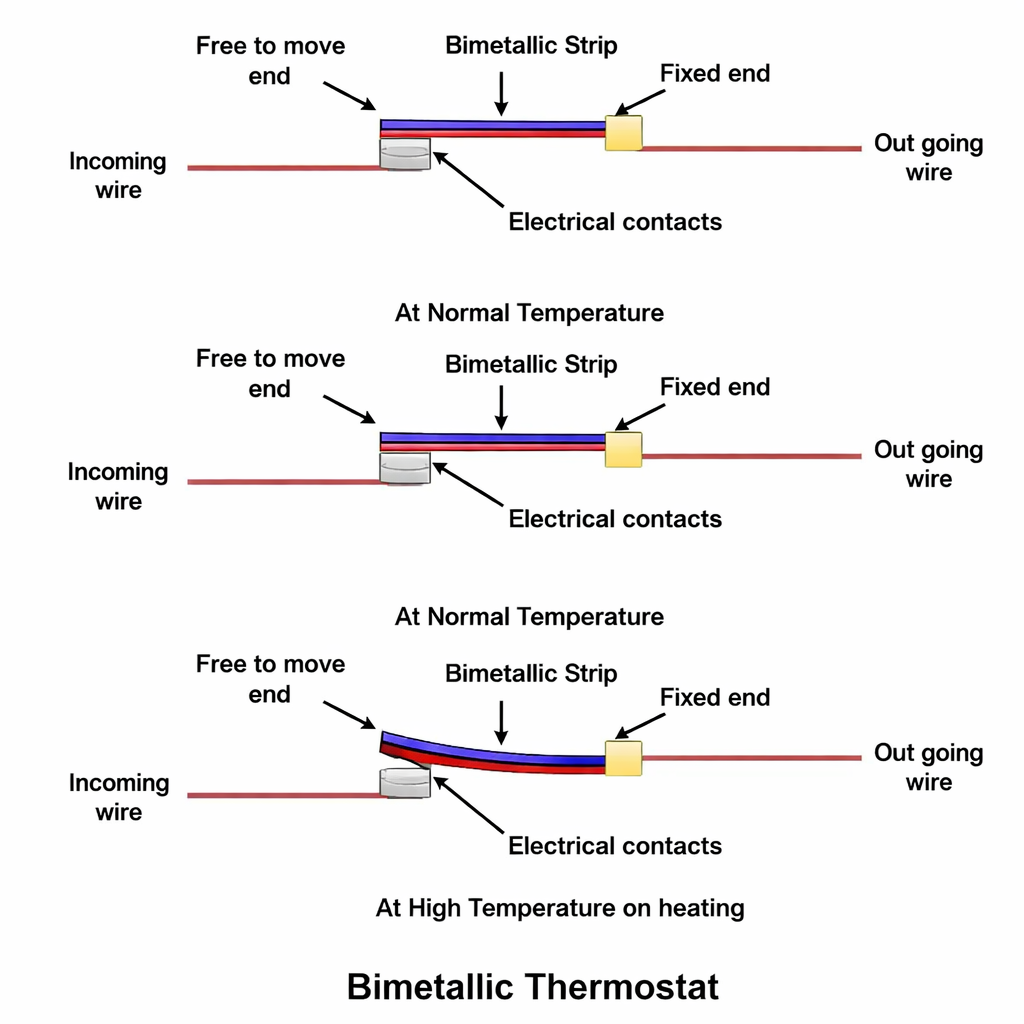
In a thermostat, one end of the bimetallic strip is firmly fixed and connected to the power supply, while the other end remains free to move. A movable contact is attached to this free end, so it shifts position as the strip bends due to temperature changes.
Under normal temperature conditions, the movable contact touches a fixed contact, allowing the circuit to remain complete. When the temperature rises, the strip bends, causing the movable contact to separate from the fixed one, thereby interrupting the circuit (or completing it, depending on the design).
As the temperature drops back to normal, the strip regains its original shape, and the contact returns to its initial position, once again opening or closing the circuit as intended.
Protective Devives- Overcurrent Devices
Bimetallic relays are commonly employed for overcurrent protection in electrical equipment. In these devices, the current flowing through the circuit passes through a heating element, which raises the temperature of a bimetallic strip.
As the strip heats up, it bends due to unequal expansion of the metals. This bending action triggers a tripping mechanism that disconnects the circuit or device from the power supply, preventing potential damage.
A typical example of such a protective device is a circuit breaker.
Clocks
Mechanical clocks are highly affected by temperature variations, which can lead to inaccuracies in timekeeping. This issue can be minimized by incorporating a bimetallic strip.
A common design uses a balance wheel with a rim made from two metals having different coefficients of expansion. When the temperature increases, the rim bends inward slightly, decreasing its diameter and causing the clock to run faster. Conversely, when the temperature drops, the rim bends outward, increasing its diameter and slowing the clock down. This behavior helps offset changes in the spring’s elasticity due to temperature fluctuations.
Coins
To reduce production costs and discourage melting for metal value, many coins are made using layered metals. For instance, modern coins may consist of a less expensive core material coated with a thin layer of a more valuable metal to maintain appearance.
Some coins are trimetallic, containing three layers of different metals, while others are bimetallic, featuring two distinct sections made from different materials—such as an outer ring and an inner core.
Cans
Many food cans are made from steel coated with tin, which protects the metal from rusting by forming a thin oxide layer. These are examples of trimetallic structures with layered materials.
Aluminum cans are another common type, typically consisting of an aluminum body and a lid made from an aluminum alloy. While this design allows easy opening, it can complicate recycling due to the combination of materials.
Blades
Cutting tools like bandsaw and reciprocating saw blades often use bimetal construction. The cutting edge is made from hard, wear-resistant high-speed steel, while the backing is composed of tougher, more flexible high-carbon steel.
This combination provides both durability and efficiency—the hard teeth ensure effective cutting, while the flexible base reduces the risk of cracking or breaking during use.
Conclusion
In summary, a bimetal is a versatile material designed to leverage the strengths of two metals in one structure. Its role in temperature-sensitive applications, mechanical systems, and industrial design makes it essential in modern engineering.
Read Next: