The basic insulation level(BIL) is a critical parameter in power system engineering that defines the ability of electrical equipment to withstand high-voltage surges caused by lightning and switching operations. Understanding basic insulation level (BIL) helps engineers design reliable systems, select appropriate insulation, and protect transformers, switchgear, and transmission equipment from insulation failure.
In this article, we explain what is basic insulation level, its meaning in electrical engineering, calculation method, IEC standards, tables for 11 kV and 33 kV systems, and its role in transformers and testing.
What Is Basic Insulation Level (BIL)?
When lightning- or switching-induced impulse overvoltages occur in a power system, surge protection devices such as lightning arresters discharge the excess energy to limit damage. However, these devices require a short operating time, during which the insulation of connected equipment must withstand the transient voltage stress without failure. This required withstand capability is defined as the Basic Insulation Level (BIL).
Basic Insulation Level (BIL) is the rated impulse withstand voltage of electrical equipment, representing the highest lightning or switching surge voltage the insulation can tolerate under standardized test conditions. It is a fundamental insulation parameter in power systems and is measured in kilovolts (kV). BIL establishes the minimum insulation strength necessary to ensure equipment remains intact until protective devices operate.
In electrical engineering practice, BIL is used to specify and coordinate the insulation performance of transformers, circuit breakers, bushings, insulators, and switchgear. A higher basic insulation level reflects stronger insulation, improved resistance to lightning surges, reduced risk of insulation breakdown, and enhanced system reliability. For this reason, the term BIL electrical is widely applied in insulation coordination studies, substation design, and equipment rating selection.
Power systems are subjected to various overvoltage stresses that differ in magnitude, duration, waveform, and frequency. Designing insulation to withstand all possible overvoltages indefinitely is neither economical nor necessary. Instead, systems are engineered for an appropriate BIL based on expected overvoltage conditions and the performance of installed protective devices, which rapidly suppress abnormal voltages.
Lightning impulse overvoltages typically persist for only a few microseconds and are quickly controlled by surge arresters. Electrical equipment insulation must therefore endure the impulse stress only until the arrester operates. This dielectric strength is defined by the Basic Insulation Level, specified as the peak value of a standard 1.2/50 microsecond lightning impulse withstand voltage.
Because insulation design—especially for transformers—significantly influences equipment cost, international standards aim to optimize BIL values to achieve safety and reliability without unnecessary overdesign. Although natural lightning surges are unpredictable, standardized impulse waveforms are used in high-voltage testing to provide a consistent basis for evaluating insulation performance and verifying BIL compliance.
Impulse Voltage
Impulse voltage refers to a short-duration, high-magnitude voltage surge that appears in power systems due to lightning strikes, switching operations, or fault clearing events. To evaluate how electrical equipment responds to such sudden stresses, standardized impulse waveforms are used in insulation testing.
According to American standards, the specified lightning impulse test waveform is 1.5/40 microseconds, while Indian and IEC standards adopt the 1.2/50 microsecond impulse waveform. This notation has precise technical significance.
A 1.2/50 µs impulse voltage represents a unidirectional surge that rises from zero to its peak value in 1.2 microseconds (rise time) and then decays to 50% of the peak value in 50 microseconds (decay time). This standardized waveform closely simulates real lightning conditions experienced by power system equipment.
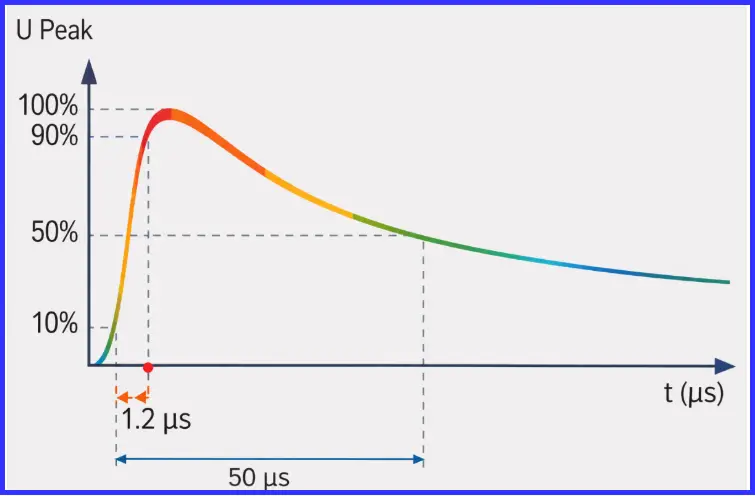
The insulation breakdown or flashover voltage of electrical equipment tested with this impulse waveform must be equal to or higher than the assigned Basic Insulation Level (BIL). In contrast, the sparkover and discharge voltages of surge protection devices—such as lightning arresters—are intentionally set below the equipment insulation strength.
This coordination ensures that, during impulse overvoltage events, the surge is diverted safely through the arrester rather than causing insulation failure in the equipment. A sufficient protective margin between the arrester operating level and the equipment insulation level is therefore essential for reliable system performance
Basic Insulation Level Unit
The basic insulation level unit is:
- Kilovolt (kV)
Example:
- 11 kV system → BIL = 75 kV
- 33 kV system → BIL = 170 kV
Sometimes the term kV BIL is used to specify impulse withstand capability.
Basic Insulation Level Formula and Calculation
There is no single universal basic insulation level formula, but BIL selection is based on:
- System nominal voltage
- Overvoltage margin
- IEC or IEEE standards
- Insulation coordination studies
Approximate Calculation Concept
BIL≈Nominal Voltage×Safety Factor
Where safety factor typically ranges from 5 to 8 depending on system class and standard.
Example:
- For an 11 kV system
11×7≈75 kV (standard value)
Basic Insulation Level (BIL) for Different System Voltages (Up to 220 kV)
The Basic Insulation Level of electrical equipment varies according to system voltage and applicable standards such as Indian Standards (IS), British Standards (BS), and IEC recommendations. The table below provides a consolidated comparison of commonly used BIL values up to 220 kV.
| Nominal System Voltage (kV) | Rated Voltage (kV) | Indian Standards BIL (kV) | British Standards BIL (kV) | IEC / Standard BIL (kV) |
| 11 | 12 | 75 | – | 75 |
| 22 | 24 | 125 | – | 125 |
| 33 | 36 | 170 | 200 | 170 |
| 66 | 72.5 | 325 | 450 | 325 |
| 132 | 145 | 550 / 650 | 650 / 750 | 650 |
| 220 | 245 | 900 / 1050 | 900 / 1050 | 1050 |
This basic insulation level table is widely used in substation and transformer design.
Basic Insulation Level for 11 kV and 33 kV Systems
The basic insulation level for 11 kV systems is typically 75 kV BIL. This insulation rating is widely applied to 11 kV transformers, switchgear, bushings, and insulators, ensuring reliable operation during lightning surges and switching transients commonly encountered in medium-voltage networks.
For higher voltage networks, the basic insulation level for 33 kV systems is generally 170 kV BIL. The increased BIL requirement is necessary due to the higher operating voltage, greater exposure to lightning and switching overvoltages, and longer insulation and clearance distances associated with 33 kV equipment.
Proper selection of basic insulation level for 11 kV and 33 kV systems is essential for effective insulation coordination, protection device performance, and long-term system reliability.
BIL for Transformer
BIL for transformer is one of the most important design parameters. Transformer insulation must withstand impulse voltages at:
- Primary winding
- Secondary winding
- Neutral terminals
Example transformer ratings:
- 11/0.433 kV transformer → 75 kV BIL
- 33/11 kV transformer → 170 kV BIL
Transformer manufacturers clearly specify BIL values on nameplates and datasheets.
BIL Testing
BIL testing is performed to verify insulation strength using lightning impulse generators.
Types of BIL Tests:
- Full-wave impulse test
- Chopped-wave impulse test
- Withstand test
If insulation fails during testing, the equipment is rejected or redesigned.
Basic Insulation Level IEC Standard
The basic insulation level IEC standard is primarily defined in:
- IEC 60071 – Insulation coordination
- IEC 60076 – Power transformers
- IEC 62271 – High-voltage switchgear
These standards ensure uniform insulation ratings worldwide.
Applications of Basic Insulation Level
Basic insulation level is used in:
- Insulation coordination studies
- Substation layout design
- Selection of surge arresters
- Transformer and switchgear specification
- Power system reliability assessment
It is also widely discussed in basic insulation level PPT presentations for electrical engineering education and training.
Key Takeaways
- Understanding Basic Insulation Level (BIL): BIL represents the maximum surge voltage that electrical insulation can withstand before protective devices are triggered.
- Role of Surge Protection Devices: Surge protectors act rapidly to divert excess voltage, safeguarding electrical equipment from transient overvoltages.
- System Design Strategy: Electrical systems are engineered around defined BIL values to manage expected surge conditions while avoiding unnecessary insulation expenses.
- Standardized Impulse Testing: Waveforms such as the 1.2/50 microsecond impulse are used to replicate lightning effects and verify the insulation’s dielectric capability.
- Built-In Safety Margins: For reliable protection, equipment insulation must tolerate voltages above the BIL, while surge protection devices are set to operate at lower voltage thresholds.
Conclusion
The basic insulation level is a fundamental concept in electrical power systems that defines the impulse withstand capability of equipment. Understanding what is basic insulation level, its definition, table values, formula concepts, and IEC standards is essential for safe and reliable system design. Proper selection of BIL for transformers, switchgear, and transmission equipment minimizes insulation failure, improves system reliability, and ensures compliance with international standards.
By applying correct BIL electrical meaning and values for 11 kV, 33 kV, and higher voltage systems, engineers can effectively protect power networks from lightning and switching surges.
Read Next: