Underground cables are widely used in urban power distribution systems, industrial installations, and high-density residential areas. They offer a safe and reliable method of transmitting electrical power while eliminating many of the drawbacks associated with overhead transmission lines. However, despite their benefits, underground cables also have certain limitations related to cost, maintenance, and fault detection. In this article, we will discuss the 14 advantages and disadvantages of underground cables in detail.
Advantages (Pros) of Underground Cables
- Improved Aesthetic Appearance
Since underground cables are laid below the earth’s surface, they do not obstruct landscapes or city views, making them ideal for urban and residential areas. - Higher Reliability
Underground cables are protected from weather conditions such as storms, lightning, snow, and strong winds, resulting in fewer power interruptions. - Low Maintenance Requirements
Once installed, underground cables require very little routine maintenance compared to overhead transmission lines. - Reduced Risk of Accidents
The chances of accidents caused by broken conductors, falling poles, or electric shocks are significantly reduced. - Better Public Safety
Because live conductors are buried underground, the risk to humans and animals is minimal. - Less Susceptible to Environmental Damage
Underground cables are not affected by pollution, ice formation, or tree branches. - Lower Transmission Losses
The absence of corona loss and reduced conductor spacing help minimize power losses. - Improved System Stability
Underground cable systems provide better voltage regulation and stable power delivery. - No Right-of-Way Problems
They eliminate the need for wide transmission corridors required by overhead lines. - Reduced Noise Pollution
Unlike overhead lines, underground cables do not produce audible noise during operation. - Longer Service Life
With proper insulation and installation, underground cables can operate reliably for many years. - Suitable for High-Density Areas
They are ideal for cities, commercial complexes, and industrial zones where space is limited. - Low Electromagnetic Interference
Underground cables cause minimal interference with nearby communication systems. - Unaffected by Severe Weather
Power supply remains reliable even during cyclones, heavy rainfall, and storms.
Disadvantages (Cons) of Underground Cables
- High Initial Installation Cost
The cost of cables, trenching, insulation, and installation is much higher than overhead systems. - Difficult Fault Detection
Identifying the exact location of a fault in underground cables is complex and time-consuming. - Complicated Repair Process
Repairing underground cables requires excavation, which increases downtime and expense. - Longer Installation Time
Civil work involved in trenching and laying cables makes installation slow. - Limited Heat Dissipation
Heat generated in underground cables is not easily dissipated, limiting current-carrying capacity. - High Repair Cost
Maintenance and fault repair are expensive due to labor and excavation requirements. - Difficult System Expansion
Adding new cables or increasing capacity after installation is challenging. - Moisture Ingress Risk
If insulation is damaged, moisture can penetrate and cause insulation failure. - Complex Jointing Requirements
Cable joints and terminations must be done carefully to prevent failures. - High Charging Current
Underground cables have higher capacitance, leading to charging current issues. - Not Economical for Long Distances
For long-distance transmission, underground cables are less cost-effective. - Thermal Stress on Insulation
Poor soil conditions can lead to overheating and insulation deterioration. - Difficult Route Modification
Changing or relocating underground cables is expensive and disruptive. - Skilled Labor Requirement
Installation and maintenance require trained and experienced personnel.
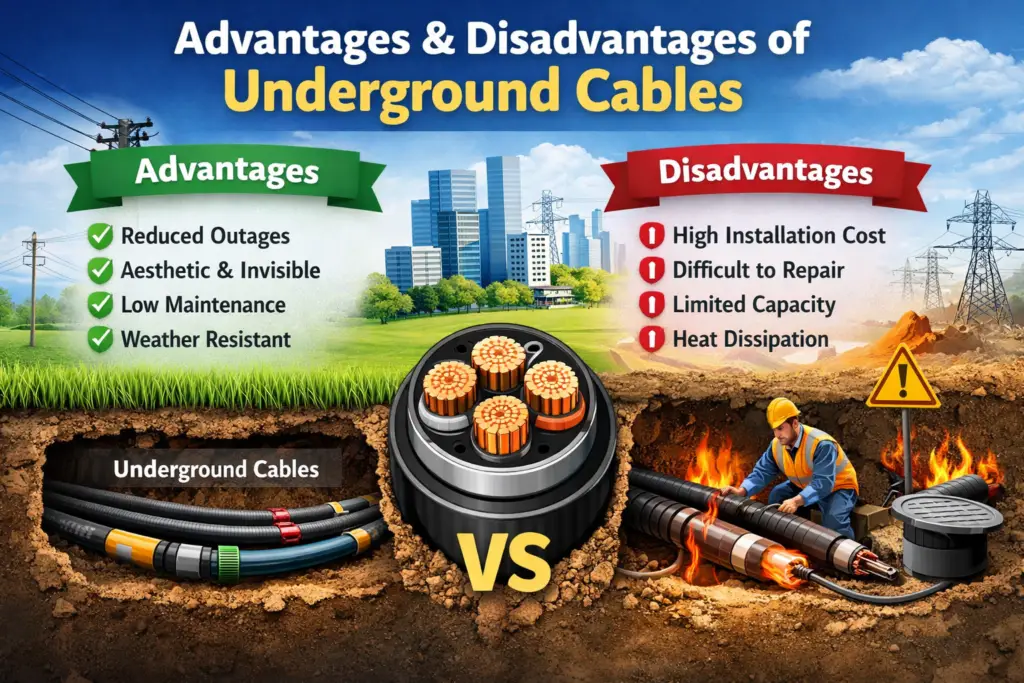
Summary Table: Advantages & Disadvantages of Underground Cables
| Sr. No. | Advantages of Underground Cables | Disadvantages of Underground Cables |
| 1 | Improved appearance | High installation cost |
| 2 | High reliability | Difficult fault detection |
| 3 | Low maintenance | Complicated repairs |
| 4 | Reduced accidents | Longer installation time |
| 5 | Better safety | Limited heat dissipation |
| 6 | Environmental protection | High repair cost |
| 7 | Lower power losses | Difficult expansion |
| 8 | System stability | Moisture ingress risk |
| 9 | No right-of-way issues | Complex jointing |
| 10 | Noise-free operation | High charging current |
| 11 | Long service life | Not economical for long distances |
| 12 | Ideal for dense areas | Thermal stress |
| 13 | Low interference | Difficult route changes |
| 14 | Weather resistant | Skilled labor needed |
Applications of Underground Cables
Underground cables are commonly used in:
- Urban power distribution systems
- Residential and commercial buildings
- Industrial plants and refineries
- Airports and railway stations
- Metro rail and underground transport systems
- Critical infrastructure and data centers
Conclusion
Underground cables provide a safe, reliable, and aesthetically pleasing solution for modern power distribution systems. Their resistance to environmental disturbances and low maintenance needs make them ideal for urban and industrial applications.
However, their high installation cost, difficulty in fault detection, and limited heat dissipation restrict their use in long-distance transmission.
By understanding the advantages and disadvantages of underground cables, engineers can select the most suitable power transmission method for efficient and reliable electrical systems.
Read Next: