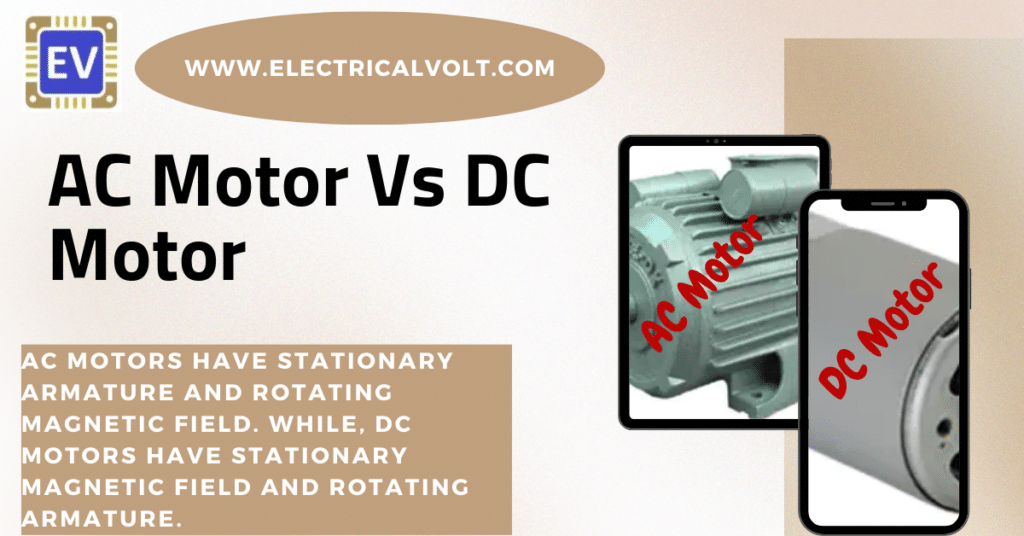
The main difference between AC and DC motors is that AC motors run on alternating current and have a stationary armature with a rotating magnetic field, while DC motors run on direct current and have a rotating armature with a stationary magnetic field.
AC motor has a stationary armature and rotating magnetic field. While DC motor has a stationary magnetic field and rotating armature.
Electric motors play a vital role in minimizing human effort in running various tasks in residential and industrial areas, as they are extremely efficient and automated. An electric motor is a machine that transforms electric energy into mechanical energy.
In this article, we will discuss the differences between two different types of electric motors based on the input power supplied to them as follows –
- AC Motor
- DC Motor
What is an AC motor?
An AC Motor is defined as a device that transforms AC input power supplied to it into mechanical output energy. The principle of operation of AC motors is based on electromagnetic induction, where a magnetic field induces a current in a conductor, generating motion.
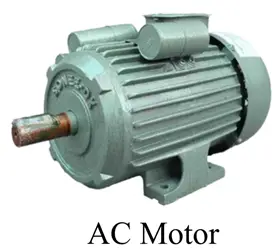
An AC motor is comprised mainly of two components: the stator and the rotor.
- Stator: This is the static or immovable part of the AC motor. It has a conducting coil called the armature winding, which produces the electromagnetic field. This field interacts with the rotor, causing it to rotate.
- Rotor: The rotating part of the AC motor that is driven by the electromagnetic field from the stator. The rotor is responsible for converting electrical energy into mechanical energy, which powers machines and devices.
Types of AC Motors
AC motors can be classified in two ways:
1. Based on the Phase of Supplied Current:
- Single-phase AC motor:
- Mainly used in household appliances like fans, washing machines, and air conditioners.
- Requires a starting mechanism since single-phase motors are not self-starting.
- Three-phase AC motor:
- Widely used in industrial applications, including pumps, compressors, conveyor systems, and HVAC systems.
- Self-starting, highly efficient, and capable of handling heavy loads.
2. Based on Operation:
- Synchronous Motor:
- Rotor rotates at the same speed as the stator’s rotating magnetic field.
- Used in applications requiring constant speed, such as timing devices, generators, and precision machinery.
- Asynchronous (Induction) Motor:
- Stator has multiple windings, and the rotor is either a squirrel cage or wound type.
- AC supplied to the stator generates an alternating flux called a rotational magnetic field.
- Rotor rotates slightly slower than the stator field.
- Commonly used in pumps, fans, and industrial machinery.
Additional Notes:
- AC motors are generally low maintenance because they do not have brushes or commutators (except in special types).
- Their speed can be controlled by varying the input frequency or the number of poles in the stator.
- They are ideal for applications requiring continuous operation and high efficiency.
What is a DC motor?
A DC Motor is defined as a device that transforms DC input power supplied to it into mechanical output energy. The principle of operation of DC motors is based on Lorentz Law, which states that a conducting coil placed in an existing magnetic field experiences a force, causing motion. This force enables the rotor to rotate and produce mechanical energy.
Similar to an AC motor, a DC motor is comprised mainly of two parts: the stator and the rotor.
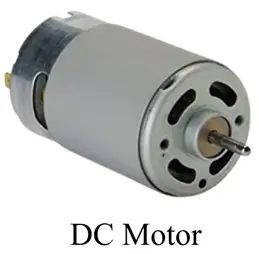
Similar to an AC motor, a DC motor is comprised mainly of two parts: the stator and the rotor.
- Stator: The stationary part of the motor that produces a constant electromagnetic field. It remains fixed and provides the magnetic flux needed for motor operation.
- Rotor (Armature): The rotating part of the DC motor. When the rotor interacts with the stator’s magnetic field, it starts rotating, converting electrical energy into mechanical energy. In DC motors, the rotor is commonly called the armature.
Types of DC Motors
DC motors can be broadly classified into five main types, each suited for different applications:
1. Permanent Magnet DC Motor (PMDC):
- Uses permanent magnets to produce the stator magnetic field.
- Compact, efficient, and widely used in small appliances and toys.
2. Series DC Motor:
- Field winding is connected in series with the armature.
- Provides high starting torque, suitable for cranes, hoists, and traction systems.
3. Shunt DC Motor:
- Field winding is connected in parallel (shunt) with the armature.
- Offers better speed regulation, ideal for lathes, conveyors, and fans.
4. Compound DC Motor:
- Combines series and shunt windings.
- Provides a balance of high starting torque and good speed regulation, often used in elevators and presses.
5. Brushless DC Motor (BLDC):
- No brushes or commutators; uses electronic controllers to supply current to the windings.
- Highly efficient, low maintenance, and widely used in electric vehicles, drones, computer fans, and robotics.
- Offers high speed, precise control, and long operational life.
Additional Notes:
- DC motors are self-starting and allow easy speed control by varying the armature voltage or field current.
- They require regular maintenance because of brushes and commutators.
- DC motors are ideal for applications where precise speed control and high starting torque are important.
Difference Between AC and DC Motor Construction
| Parameter | AC Motor Construction | DC Motor Construction |
| Main Components | Stator (stationary part) and Rotor (rotating part) | Stator (stationary part) and Armature/Rotor (rotating part) |
| Stator | Contains armature winding that produces a rotating magnetic field | Produces a constant magnetic field using field winding or permanent magnets |
| Rotor | Rotating part, usually a squirrel cage or wound rotor, interacts with stator magnetic field | Rotating part (armature) receives current via commutator and brushes to produce motion |
| Brushes | Usually no brushes (except in some special AC motors) | Brushes present to transfer current to the armature |
| Commutator | Not required | Required to reverse current direction in the armature |
| Windings | Stator: multi-phase windings; Rotor: short-circuited or wound | Stator: field winding or permanent magnet; Armature: windings connected to commutator |
| Construction Complexity | Simpler rotor design; less maintenance | More complex due to commutator and brushes; requires regular maintenance |
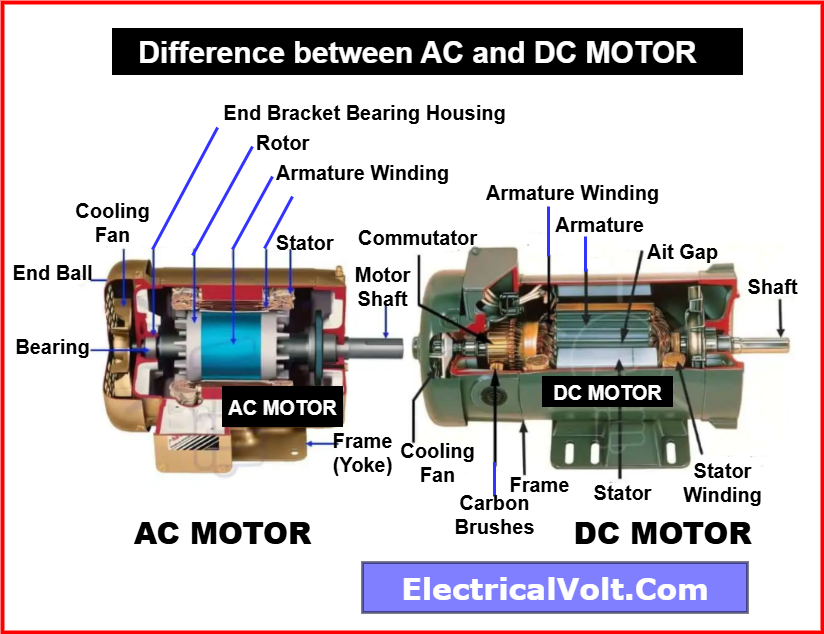
Difference Between AC and DC Motor Diagrams
- DC Motor Diagrams:
- Show brushes and a commutator that reverse the current in the rotating armature.
- Include a two-terminal connection for a DC power source.
- Highlight the rotating armature interacting with the stationary magnetic field to generate torque.
- AC Motor Diagrams (especially induction motors):
- Do not have brushes or a commutator.
- Feature a stationary stator with multi-phase windings that create a rotating magnetic field.
- Show a rotor that rotates due to electromagnetic induction.
- Typically have three terminals for a three-phase AC supply.
DC motor diagrams emphasize current reversal and armature rotation, while AC motor diagrams focus on electromagnetic induction with a stationary stator and a rotating rotor, reflecting the differences in power input, internal construction, and torque generation mechanisms.
AC Motor vs DC Motor – Key Differences
The most notable differences between an AC motor and a DC motor are listed in the table given below –
| Parameter | AC Motor | DC Motor |
| Description | AC motor is a machine that runs on an alternating electric current source as input to produce mechanical energy from electrical energy. | DC motor is a machine that runs on direct electric current to produce mechanical energy from electrical energy. |
| Types of Motor | There are two types of AC motors – synchronous AC motors and induction motors. Induction motors can be of two main types namely – Single-phase AC motors and Three-phase AC motors. | DC motors can be broadly classified into 2 main types, viz. brushed and brushless DC motors. |
| Working Principle | AC motor works on the principle of Electromagnetic induction. | DC motor operates on the principle of Lorentz Law. |
| Supply source | AC motors are provided with a three-phase AC supply current from the main power grid. | DC motors are provided with DC current via DC generators, batteries, cells, converters, etc. |
| Type of current supplied at input | AC motor is supplied with alternating current at the input. | DC motor is supplied with direct current at the input. |
| Input supply phase | AC motors are supplied with a three-phase AC supply as the input source. | DC motors are supplied with only DC supply as the input source. |
| Starting of Motor | Three-phase AC motors are Self-starting. However, single-phase AC motors need a starting mechanism. | DC motors are self-starting. |
| Upkeep | Due to the absence of brushes, the AC motors do not require frequent maintenance or upgrade. | Due to the presence of brushes, DC motors require frequent maintenance or upgrades to function properly. |
| Input Terminals | There is three input terminals (RYB) present in the AC motor. | Two input terminals of DC supply (positive and negative) are present in DC motors. |
| Commutators and Brushes | No commutator and brushes | DC motors have commutators and brushes. |
| Performance | AC motors’ efficacy is comparatively lower than DC motors due to the occurrence of slip and eddy current losses. | The efficacy of DC motors is relatively higher than AC motors as issues arising due to eddy current losses and slip are absent. |
| Speed control | To control the speed of the AC motors, the input frequency of the current or the field poles has to be varied. | To control the speed of the DC motor, the armature voltage is varied. |
| Motor speed Reversal | By changing any one of the RYB phases at the stator terminal. | By reversing the armature or field supply in the case of a separately excited DC motor. In the case of the DC series and shunt motor, the polarity of the armature or field needs to be reversed. |
| Affordability | AC motors are comparatively cheaper than DC motors. | DC motors are comparatively more expensive than AC motors |
| Applications | AC motors find their applications in electronic devices or machines requiring fluctuating torque and high speed to operate. | DC motors find their applications in the operation of several electronic devices such as several home appliances such as mixers, microwaves, toys, etc. |
DC vs AC Motor Efficiency
| Factor | AC Motor Efficiency | DC Motor Efficiency |
| Energy Conversion | Lower due to slip, eddy current, and hysteresis losses in the rotor. | Higher, most input energy is effectively converted to mechanical output. |
| Typical Efficiency Range | 75% – 95% depending on load and type. | 85% – 98%, especially for permanent magnet and brushless types. |
| Load Conditions | Efficiency drops under partial or fluctuating loads. | Maintains high efficiency under varying loads due to better torque control. |
| Maintenance Impact | Lower maintenance; absence of brushes reduces friction losses. | Brushes and commutators can reduce efficiency over time if not maintained properly. |
| Industrial Suitability | Ideal for continuous operation like pumps, compressors, HVAC systems; slight slip reduces efficiency. | Perfect for precision applications like electric vehicles, robotics, and battery-powered tools. |
- DC motors are usually more efficient than AC motors for applications requiring precise speed and torque control.
- AC motors are suitable for heavy industrial operations where robustness and lower maintenance outweigh slight efficiency losses.
Speed Control of AC vs DC Motors
1. AC Motor Speed Control:
- The speed of an AC motor is mainly determined by the supply frequency and the number of poles in the stator.
- Methods of speed control:
- Variable Frequency Drive (VFD): Adjusts the input frequency to control motor speed.
- Changing the number of poles: Alters the synchronous speed of the motor (mainly for multi-speed motors).
- Voltage control: Less common, used in small single-phase motors for minor speed adjustments.
2. DC Motor Speed Control:
- The speed of a DC motor is controlled by adjusting the armature voltage or field current.
- Methods of speed control:
- Armature voltage control: Increasing or decreasing the voltage supplied to the armature changes the motor speed.
- Field flux control: Weakening or strengthening the magnetic field adjusts speed, mainly in shunt or compound motors.
Key Difference:
- AC motors require frequency or pole changes for speed control.
- DC motors allow direct voltage or field adjustments, offering precise speed regulation.
AC Motor vs. DC Motor Advantages
Both AC and DC motors have unique advantages that make them suitable for different industrial and commercial applications.
Advantages of AC Motors:
- Low startup power demands – reduces stress on connected components.
- Controllable starting current and acceleration – allows smooth operation.
- Speed and torque control using VFD (Variable Frequency Drive) or VSD (Variable Speed Drive).
- High durability and long lifespan – less frequent maintenance required.
- Supports multi-phase configurations – ideal for industrial machinery.
Advantages of DC Motors:
- Simple installation and maintenance – easy to set up and service.
- High startup torque and power – suitable for heavy load applications.
- Fast response to starting, stopping, and acceleration – precise speed control.
- Available in multiple standard voltages – flexible for various applications.
Comparison Table for AC vs DC Motor Advantages
| Parameter | AC Motor Advantages | DC Motor Advantages |
| Startup Power | Low startup power demands protect connected components | High startup power and torque for heavy loads |
| Control | Controllable starting current and acceleration; speed/torque adjustable with VFD/VSD | Fast response to starting, stopping, and acceleration; precise speed control |
| Maintenance | High durability; longer lifespan; less frequent maintenance | Simple installation and maintenance; easy to service |
| Efficiency | Suitable for continuous operation; good for industrial applications | Efficient energy use; converts more input energy into mechanical output |
| Configuration | Supports multi-phase setups; ideal for industrial machinery | Available in several standard voltages; flexible for varied applications |
| Applications | Pumps, compressors, fans, conveyors, HVAC systems | Electric vehicles, robotics, battery-powered tools, appliances |
Applications of AC and DC Motors
Applications of AC Motors:
AC motors are widely used where high efficiency, continuous operation, and low maintenance are required:
- Industrial machinery: Pumps, compressors, conveyor belts
- Household appliances: Fans, washing machines, air conditioners
- HVAC systems: Blowers, chillers, ventilation
- Electric vehicles & trains: Traction motors in some systems
- Power tools: Drills, grinders, and saws
Applications of DC Motors:
DC motors are preferred where precise speed control and high starting torque are needed:
- Home appliances: Mixers, blenders, vacuum cleaners, toys
- Automobiles: Electric vehicles, electric windows, wipers
- Industrial applications: Cranes, hoists, elevators, conveyor systems
- Robotics & automation: Servo motors, actuators
- Portable devices: Battery-operated gadgets and tools
Which Motor Is More Powerful: AC or DC?
When comparing power output, AC motors are generally capable of producing higher torque due to their ability to handle larger currents and multi-phase configurations. This makes them ideal for heavy-duty industrial applications such as compressors, pumps, and conveyor systems.
On the other hand, DC motors are highly efficient, converting a larger portion of input energy into mechanical energy. They provide precise speed control, rapid acceleration, and consistent performance, making them ideal for applications like electric vehicles, robotics, and battery-powered tools.
Key Points:
- AC Motors: High torque, suitable for continuous heavy loads, can operate in multi-phase setups.
- DC Motors: Efficient energy use, precise speed and torque control, excellent for variable load conditions.
- Flexibility: Both AC and DC motors are available in a wide range of sizes and power ratings, allowing industries to select the most suitable motor for specific applications.
While AC motors excel in high-power, heavy-load operations, DC motors shine in applications requiring efficiency, speed control, and responsivenes. The choice depends on the type of load, control requirements, and energy efficiency priorities.
Conclusion
In conclusion, this article highlights the key differences between AC and DC motors and these differences help in choosing the right kind of motor for a particular application. Both AC and DC motors find a wide variety of applications in residential and commercial fields. The most significant difference is that AC motors operate on single-phase or three-phase alternating supply, while DC motors run on a direct current supply.
Related Articles:
- DC Motor or Direct Current Motor
- Why DC Series Motor has High Starting Torque?
- Difference between Stator and Rotor
- Difference between Motor and Generator
- Condition for Maximum Power of DC Motor
- Universal Motor- Construction, Diagram, Working,Types & Characteristics
- Types of Motors Used in an Elevator (Elevator Motor)
- Different Types of Electric Motors and Their Applications
- Types of Single-Phase Induction Motors (Split Phase, Capacitor Start, Capacitor Run)
- Types of DC Motors – Series, Shunt and Compound Wound