Fault detection is one of the key challenges associated with underground cable systems. Unlike overhead transmission lines, underground cables are buried directly in the soil or installed inside ducts, making visual inspection practically impossible. As a result, identifying faults in such cables requires specialized testing techniques rather than simple observation.
To understand fault detection methods clearly, it is first necessary to study the common types of faults that occur in underground cables along with their underlying causes.
Types of Faults in Underground Cables
The most frequently encountered faults in underground cables are:
- Open-circuit faults
- Short-circuit faults
- Earth faults
Causes of Faults in Underground Cables
The primary cause of cable faults is the ingress of moisture into the insulation. Cable insulation, especially paper insulation, is hygroscopic in nature and readily absorbs moisture, which degrades its dielectric strength over time. Other contributing factors include mechanical damage during transportation or installation, excessive thermal stresses and electrical stresses during operation, and aging.
Damage to the lead sheath is another major cause of failure. This may result from chemical reactions with soil and water, corrosion, mechanical impact, or crystallization of lead caused by continuous vibration.
The major fault types and their detection techniques are discussed below.
Open-Circuit Fault
An open-circuit fault occurs when one or more conductors within the cable are broken, resulting in discontinuity of the current path. This may happen due to mechanical stress, excessive bending, or failure at cable joints where the conductor becomes detached.
Fault Detection
An open circuit is identified by its very high (infinite) resistance. To detect this fault, all conductors at the far end of the cable are shorted together and connected to earth. A megger is then used to measure the resistance between each conductor and earth.
Observation
If a conductor is open-circuited, the megger will indicate infinite resistance between that conductor and ground.
Short-Circuit Fault
A short-circuit fault occurs only in multi-core cables. This fault arises when the insulation between two or more conductors fails, allowing them to come into direct contact with each other. Such faults cannot be detected visually unless the cable is dismantled.
Fault Detection
A short circuit is characterized by zero or very low resistance. Using a megger, the resistance between pairs of conductors is measured two at a time.
Observation
A near-zero megger reading between any two conductors confirms the presence of a short-circuit fault.
Earth Fault
An earth fault takes place when a conductor comes into contact with the ground. This generally occurs due to damage to the outer sheath caused by soil chemicals, corrosion, vibration, or mechanical stress. In this condition, current flows through the earth, which offers a low-resistance path.
Fault Detection
The megger is connected between each conductor and earth, and the insulation resistance is measured individually for all cores.
Observation
If an earth fault exists, the megger will show a very low resistance value for the affected conductor.
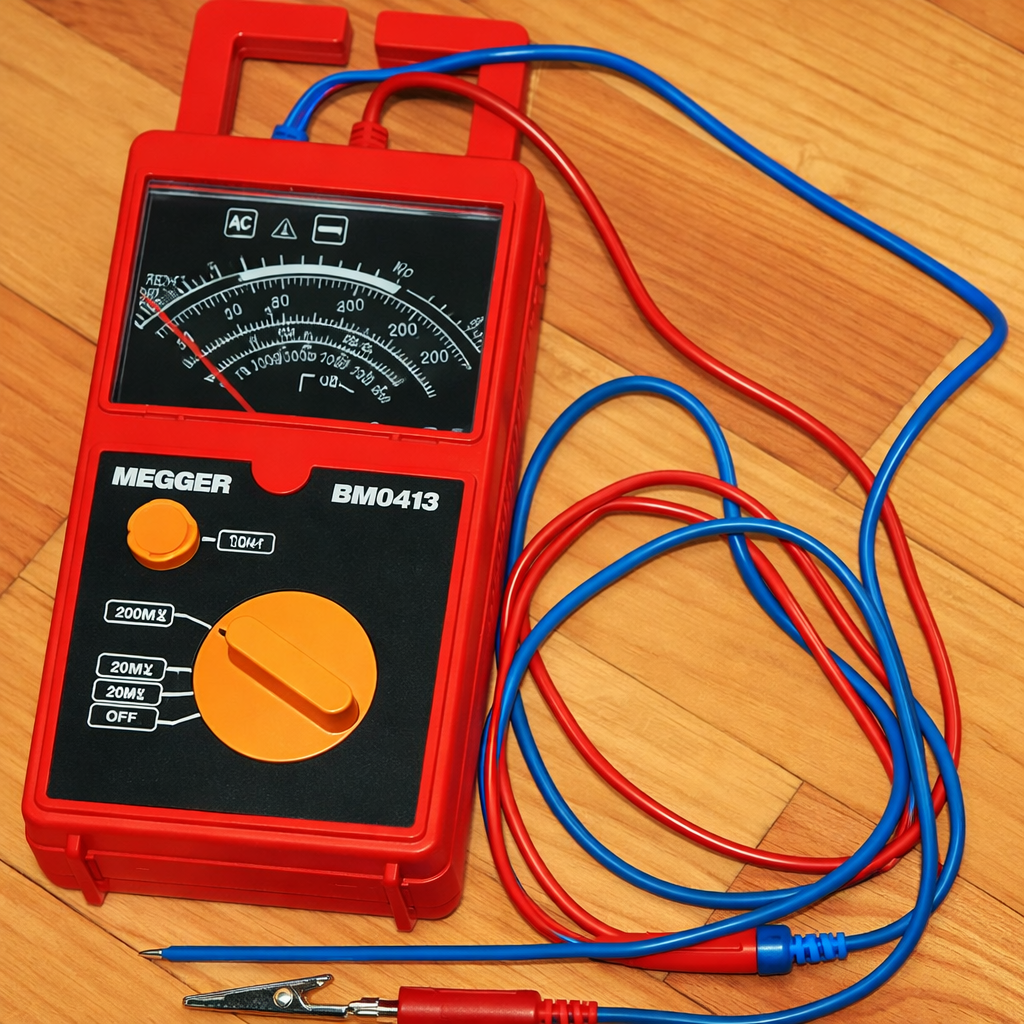
Fault Summary – Underground Cables
| Fault Type | Cause | Detection Method | Megger Indication |
| Open-Circuit Fault | Broken conductor, joint failure, mechanical stress | Resistance measurement between conductor and earth | Infinite resistance |
| Short-Circuit Fault | Insulation failure between conductors | Resistance measurement between conductor pairs | Zero or very low resistance |
| Earth Fault | Outer sheath damage, moisture ingress, corrosion | Resistance measurement between conductor and earth | Very low resistance |
Conclusion
Faults in underground cables cannot be detected using visual inspection methods due to their concealed installation. However, by understanding the nature of open-circuit faults, short-circuit faults, and earth faults, and by using insulation resistance testing instruments such as a megger, these faults can be effectively identified. Proper fault detection ensures faster maintenance, reduced downtime, and improved reliability of underground power systems.
Read Next: