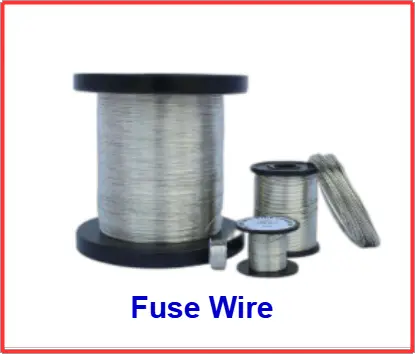
- Fuse Wire Definition: A fuse wire is a thin, low-melting-point conductor placed in series with an electrical circuit to protect it by melting and breaking the circuit during overcurrent conditions.
- Importance of Fuse Wire: Fuse wires prevent damage to appliances, reduce fire hazards caused by overheating or short circuits, and improve overall electrical safety.
- Working Principle: Fuse wires operate on the Joule heating effect, where heat generated by excessive current causes the wire to melt and interrupt the circuit.
- Materials and Alloys: Fuse wires are made from metals such as tin, lead, zinc, copper, and silver, with alloys preferred for controlled melting point, durability, and oxidation resistance.
- Key Properties: An ideal fuse wire has a low melting point, high conductivity, predictable melting behavior, quick response time, corrosion resistance, and low cost.
- Types of Fuse Wires: Fast-blow, slow-blow, high-voltage, low-voltage, and resettable (PTC) fuse wires are used based on circuit sensitivity and application requirements.
- Selection Criteria: Proper fuse wire selection depends on current rating, voltage rating, breaking capacity, material choice, and time-response characteristics.
- Advantages and Limitations: Fuse wires are simple, compact, and reliable but are single-use devices that require replacement after operation and offer limited selectivity compared to circuit breakers.
- Applications and Impact: Fuse wires are widely used in household wiring, automobiles, industrial equipment, power distribution systems, and electronic devices to ensure safe circuit operation.
A fuse wire is a crucial safety component in electrical circuits. It is a thin conductor made of a low-melting-point metal that melts and breaks the circuit when excessive current flows. This prevents electrical damage, overheating, and fire hazards. They are widely used in household wiring, industrial machines, automotive systems, and electronic circuits.
What is a Fuse Wire?
A fuse wire is an essential part of a fuse, which is a protective device used in electrical and electronic systems. It is placed in series with the circuit it protects. Under normal conditions, it carries the current safely. However, when the current exceeds its rated value, the wire heats up and melts, effectively breaking the circuit and stopping the flow of electricity.
A fuse wire is inserted in a fuse holder or fuse cartridge.
Why is a Fuse Wire Important?
- Prevents Damage – Protects electrical appliances and circuits from overcurrent.
- Avoids Fire Hazards – Stops overheating caused by short circuits.
- Ensures Safety – Minimizes the risk of electric shock or explosion.
Working Principle of a Fuse Wire
The fuse wire works based on the Joule heating effect, which states that when an electric current passes through a conductor, heat is produced due to electrical resistance. The amount of heat generated depends on the following equation: H= =I2Rt
Where:
- H = Heat generated (Joules)
- I = Current flowing through the wire (Amperes)
- R = Electrical resistance of the fuse wire (Ohms)
- t = Time for which current flows (Seconds)
If the heat produced is higher than the melting point of the fuse wire, it melts and opens the circuit, preventing further damage.
How does a Fuse Wire React to Overcurrent?
- Normal current → It remains intact, allowing current to pass.
- Slight overcurrent → It heats up but does not melt immediately.
- Severe overcurrent or short circuit → The wire melts quickly, breaking the circuit and stopping current flow.
Materials Used in Fuse Wires
Fuse wires are made of metals with low melting points and high conductivity so they can melt quickly during an overload. Some commonly used materials include:
| Material | Melting Point (°C) | Usage |
|---|---|---|
| Lead (Pb) | 327°C | Used in low-current applications |
| Tin (Sn) | 232°C | Common in household fuses |
| Lead-Tin Alloy | 183–250°C | Improves fuse wire performance |
| Zinc (Zn) | 420°C | Used in medium-current circuits |
| Copper (Cu) | 1085°C | Used in high-current fuses |
| Silver (Ag) | 961°C | Used in fast-acting fuses for sensitive equipment |
The most commonly used fuse wire is tin-lead alloy, as it balances melting point, conductivity, and durability, making it ideal for household and industrial applications.
Why are Alloys used Instead of Pure Metals in Fuse Wire?
Fuse element is made up of alloy for the following reasons:
- Controlled Melting Point – Alloys have a specific melting point, ensuring the fuse element melts at the desired current level.
- Prevents Oxidation – Alloys resist oxidation better than pure metals, increasing the fuse’s lifespan.
- Improved Durability – They provide better mechanical strength and stability in electrical circuits.
- Enhanced Performance – Alloys offer consistent performance under varying electrical loads.
- Better Conductivity – The right combination of metals ensures efficient current flow while maintaining safety.
Fuse Wire Properties
- Low Melting Point – It should melt quickly when excessive current flows.
- High Conductivity – It should allow normal current flow with minimal resistance.
- Corrosion Resistance – The material should resist oxidation for long-lasting performance.
- Stable Performance – It should provide consistent operation under varying loads.
- High Sensitivity to Heat – The wire should respond accurately to overheating.
- Low Cost – The material should be economical for wide usage.
- Non-Flammable – It should not catch fire when melting.
- Good Mechanical Strength – The wire should be strong enough to handle installation stresses.
- Predictable Melting Characteristics – It should melt at a precise temperature for safety.
- Quick Response Time – It should break the circuit instantly during faults.
Types of Fuse Wires
- Fast-Blow Fuse Wire
- Melts instantly when overcurrent flows
- Suitable for electronic circuits and semiconductor devices
- Protects delicate components from sudden voltage spikes
- Slow-Blow Fuse Wire
- Designed to withstand temporary current surges
- Used in motors, transformers, and refrigerators where inrush current is common
- Prevents unnecessary fuse blowing due to short-duration overloads
- High-Voltage Fuse Wire
- Used in power systems above 1 kV
- Made with ceramic casing and silver elements
- Common in transformers and switchgear protection
- Low-Voltage Fuse Wire
- Used in household circuits and appliances
- Typically rated below 1 kV
- Made from tin, lead, or zinc alloys
- Resettable Fuse Wire (PTC Fuse)
- Uses polymer or ceramic materials that reset automatically
- Found in mobile chargers, laptops, and battery circuits
- Does not require replacement after tripping
Read detailed article: Time Delay Fuses | Dual Element Fuses | Slow Blow Fuses
How to Select the Right Fuse Wire?
When choosing a fuse element, consider the following factors:
- Current Rating – Choose a wire that matches the expected load current.
- Voltage Rating – Ensure it is suitable for the operating voltage of the circuit.
- Breaking Capacity – Select a fuse that can handle short-circuit currents safely.
- Material – Pick the right metal based on the application and melting characteristics.
- Time Response – Use fast-blow fuses for delicate electronics and slow-blow fuses for motors.
Read detailed article: Step-by-Step Guide to Choose Right Fuse for a Panel
Example of Fuse Wire Selection
| Application | Current Rating | Recommended Fuse Wire |
| Household Wiring | 10A – 20A | Tin-Lead Alloy |
| Automobile | 5A – 30A | Copper or Silver |
| Motor Protection | 15A – 50A | Zinc or Copper |
| High-Voltage Circuits | 1 kV and above | Silver or Alloyed Copper |
Advantages
- Simple and Low-Cost – Easy to install and replace.
- Reliable Protection – Provides instant response to overcurrent.
- No Maintenance Required – Works automatically when needed.
- Energy-Efficient – Consumes very little power.
- Compact and Lightweight – Does not require much space in circuits.
Disadvantages
overloads and serious faults.
- Single-Use – Must be replaced after blowing.
- Slower than Circuit Breakers – Not suitable for highly sensitive loads.
- Not Resettable – Unlike MCBs (Miniature Circuit Breakers), fuses need manual replacement.
- Limited Selectivity – Cannot differentiate between minor overloads and serious faults.
Applications of Fuse Wires
- Household Electrical Circuits
- Protects wiring and prevents fire hazards
- Common in distribution boards and electric panels
- Automobiles and Vehicles
- Safeguards headlights, audio systems, and ignition circuits
- Prevents battery overloads in cars and motorcycles
- Industrial Equipment
- Used in machines, motors, and control panels
- Prevents costly damage to expensive industrial devices
- Power Distribution Systems
- Installed in transformers and substations for overload protection
- Used in renewable energy systems (solar, wind, etc.)
- Electronics and Telecommunications
- Protects microprocessors, sensors, and power adapters
- Used in television sets, computers, and mobile chargers
Conclusion
A fuse wire is an essential safety component in electrical and electronic circuits. It operates by melting when excess current flows, preventing electrical damage, short circuits, and fire hazards. It come in different types, including fast-blow, slow-blow, and high-voltage fuses, depending on the application. While they are cost-effective and reliable, they need manual replacement after operation. Proper selection of fuse wires based on current rating, material, and response time ensures efficient circuit protection.
Read Next: